A building’s aesthetic defines its immediate identity, but its concealed engineering dictates its structural safety. True engineering rigor means treating every bolt, screw, and anchor with the same precision as the glass and stone they hold.
Ashish Garg, Managing Partner, Building N Solutions
A building is expected to be beautiful, but it must also protect the people within. When we look at its façade, it is the glass that we see. But it is the aluminium frame, fasteners, pressure plates, EPDM, anchors and silicone that make the entire system strong, secure and weatherproof.A facade’s hidden details
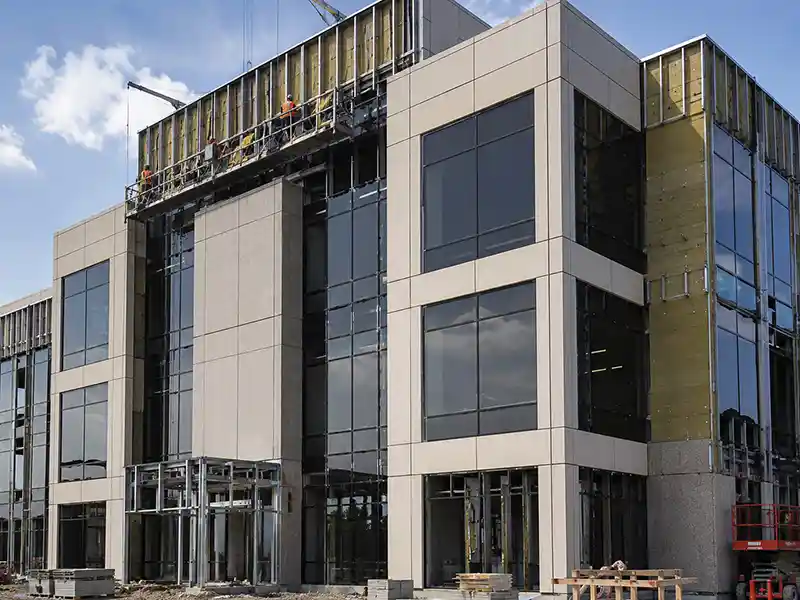
Behind every façade are hundreds of screws, anchors, bolts, brackets and small connecting components, which together carry the weight of the system and transfer wind, movement and other forces back to the building structure.These hidden details deserve far more attention than they usually receive. A façade may be designed around beautiful materials, but its long-term safety and performance often depend on connections that are barely visible once the building is complete.
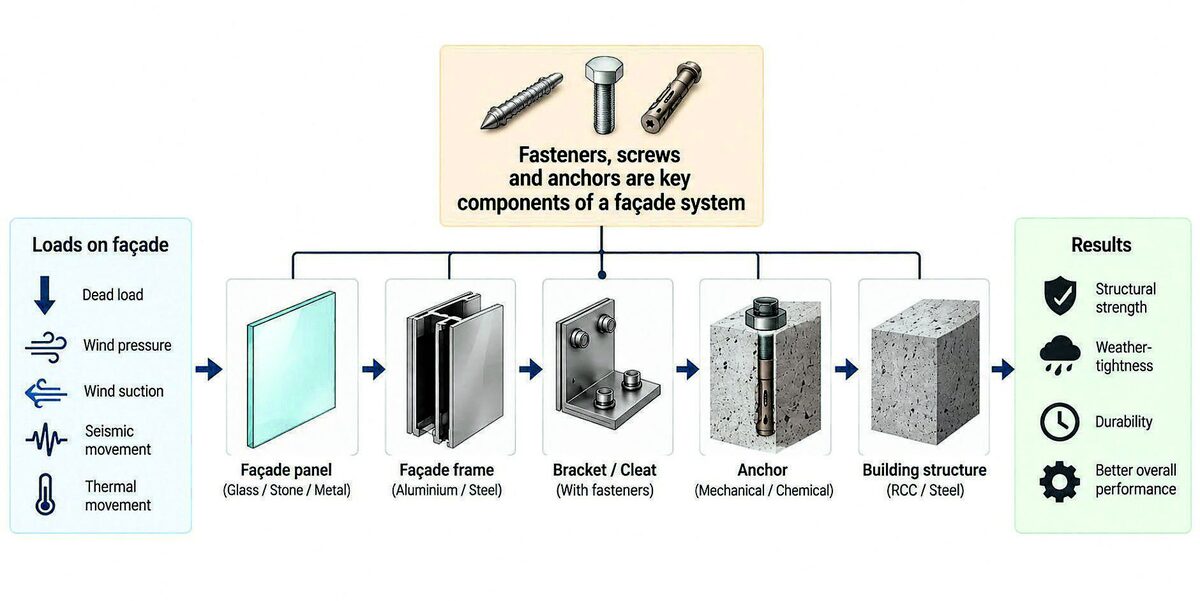
Consider a curtain wall drawing. The highlighted elements might be the sleek frames and glass panels, but an engineer’s eyes go straight to the anchor brackets at the slab. Every load on the façade—self-weight, wind pressure, suction, and seismic movement—transfers through those tiny connection points into the primary structure. Structural engineering models show that columns, beams, brackets, and anchors collectively transfer both dead and live loads. Wind tunnel tests often reveal corner suction forces nearly double those on interior walls, subjecting each fixing to complex, dynamic push-pull forces.
Engineers and project teams need to treat fasteners as first-class design elements. The question should not just be: does the building look good? but will these connectors hold up under rain, heat, vibration and time?Ashish Garg

We don’t think about lug nuts until a wheel flies off on the highway. A façade works the same way. As a mentor once reminded me: We admire the panel and frame, but a single failed fastener can compromise the entire facade.
Why fixing selection matters
Material compatibility dictates longevity. In coastal environments like Mumbai or Chennai, salt spray and high humidity accelerate galvanic corrosion when dissimilar metals touch without isolation. Aluminum mullions paired directly with carbon steel screws form an active galvanic cell. Field specifications must mandate A4/316 stainless steel fasteners, hot-dip galvanized components, and high-density EPDM or nylon isolation washers engineered for a long design life.Drawings vs onsite
When a building uses tens of thousands of identical fixings, site quality control is non-negotiable. If one anchor is under-torqued or placed too close to an edge, local failure transfers overload to adjacent fixings. On-site proof-load and pull-out testing on representative substrates catches defective anchors before panels go up. Quality assurance protocols must enforce calibrated torque wrenches, depth-stop drill bits, batch traceability logs, and photo verification prior to closing out bracket inspections.Marginal anchor stiffness allows brackets to flex under gust loads. That subtle movement tears the perimeter weather-seal, inviting water ingress, frame corrosion, thermal bridging, and internal wall damage. A tiny fixing error triggers a cascade: movement leads to joint failure, water penetration, accelerated corrosion, and costly tenant disruption.
Remediating a failed anchor on the 20th floor requires suspended scaffolding, panel removal, core drilling, and re-sealing—costing thousands times more than the original hardware. Investing in correct stainless fixings with certified embedment adds negligible upfront cost while protecting the asset for decades.