Fasteners are a small line in the BOQ. They hold up every other line. Specify them like structure –– not like hardware.Manoj Kumar, Sr. VP - Operations & Technical, ModDwell

Anchors: Where Façade Meets Building
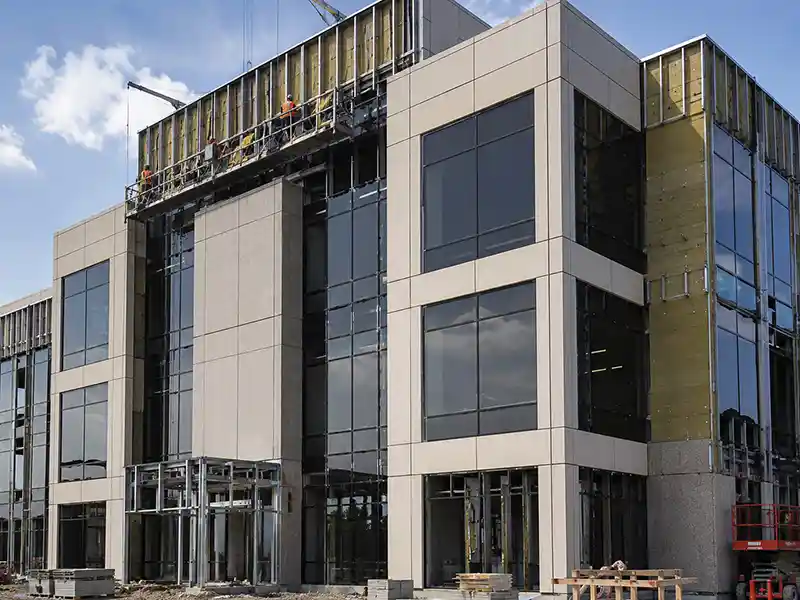
All the dead load and all the wind load end up at the anchor. Its capacity is not the number printed on the box. It depends on concrete grade, embedment depth, edge distance, anchor spacing, and whether the concrete is cracked. Façade brackets sit at the slab edge, exactly where edge distance is smallest.India’s updated code IS 1946 (Part 2): 2025 covers the design of post-installed anchors in concrete and treats cracked concrete as the default assumption. An anchor in a crack holds less than the same anchor in sound concrete. Mechanical and chemical anchors behave differently, so the choice belongs to the engineer, not the purchase team. Cast-in channels avoid site drilling altogether, but they must be planned before the slab is poured.
Screws and Bolts: Joints Nobody Sees
Inside the frame, screws and bolts join mullion to transom, bracket to mullion, and panel to panel. In aluminium, a screw’s pull-out strength depends on the wall thickness it bites into and the threads engaged. A thin wall with too few threads will not deliver the value the calculation assumes.Grade and torque matter as much. A2 stainless steel suits most inland sites. A4 belongs on the coast. An under-tightened bolt slips. An over-tightened one strips the thread or crushes the profile.
Movement and Corrosion
Aluminium expands by about 23 millionths of its length for every degree Celsius. A 3.6 m mullion going through a 50°C swing in surface temperature moves about 4 mm. If the connection has no slotted hole to absorb that, the fastener takes it as load, cycle after cycle.The same joint must also let the building sway. In an earthquake or a strong wind, floors move relative to each other, and the bracket has to allow that movement without shearing its bolts.
Corrosion is the slower failure. Aluminium against carbon steel, with moisture, behaves like a battery, and the aluminium loses. Separate dissimilar metals with a non-conductive isolator. Suggestion: use hot-dip galvanised or stainless steel brackets.
Five Checks Before Bulk Installation
- An anchor calculation using real edge distances from the slab drawings, not catalogue values.
- A tested, assessed anchor. No site substitution without a fresh calculation.
- Pull-out tests on the actual site concrete, with results recorded.
- Torque values on the shop drawing and a calibrated torque wrench on site.
- Fastener grade, isolators and slot details drawn, not left to the fitter.