The Red Brick House designed by Aura Architecture Studio negotiates the pressures of climate, privacy, and material permanence through a considered architecture of brick, void, and filtered light.
In a landscape shaped by dust, heat and seasonal extremes, brick is the only honest answer. It is durable, almost entirely self-sufficient, and native to the ground. Building in fired clay grounds, the regional tradition of thermal-mass construction, where the wall functions not as a barrier but as a climatic instrument, absorbing heat during the day and releasing it gradually through the night.
The Red Brick House is not a resistance to climate but a reconciliation with it. The house expresses its response to climate through material intelligence and spatial clarity. Rooted in regional material, it offers shade, light and calm with quiet clarity, forming an architecture of permanence.
Principal Architect Tawish Tayal

Fact File
Area: 5,200 sq. ft.
Typology: Residential
Project Lead: Ar. Nitya Prakash, Ar. Sejal Awasty
Editorial & Content: Ar. Parthiv Verma
Photographs: Purnesh Dev Nikhanj
Material Palette
Finishes: Asian Paints, ICA
Wall Cover/Cladding: Asian Paints, Jindals
Lighting/Switches: Schneider
Sanitaryware: Kohler
Facade System: Jindal
Windows: Fenesta
Flooring: Simpolo
Hardware: Hettich, Dorset
The house is oriented along a west-east axis, with the primary facade addressing the street to the west and the rear elevation opening to the east. On the north and south flanks, the building mass is selectively removed to introduce punctures that draw natural light deep into the plan.
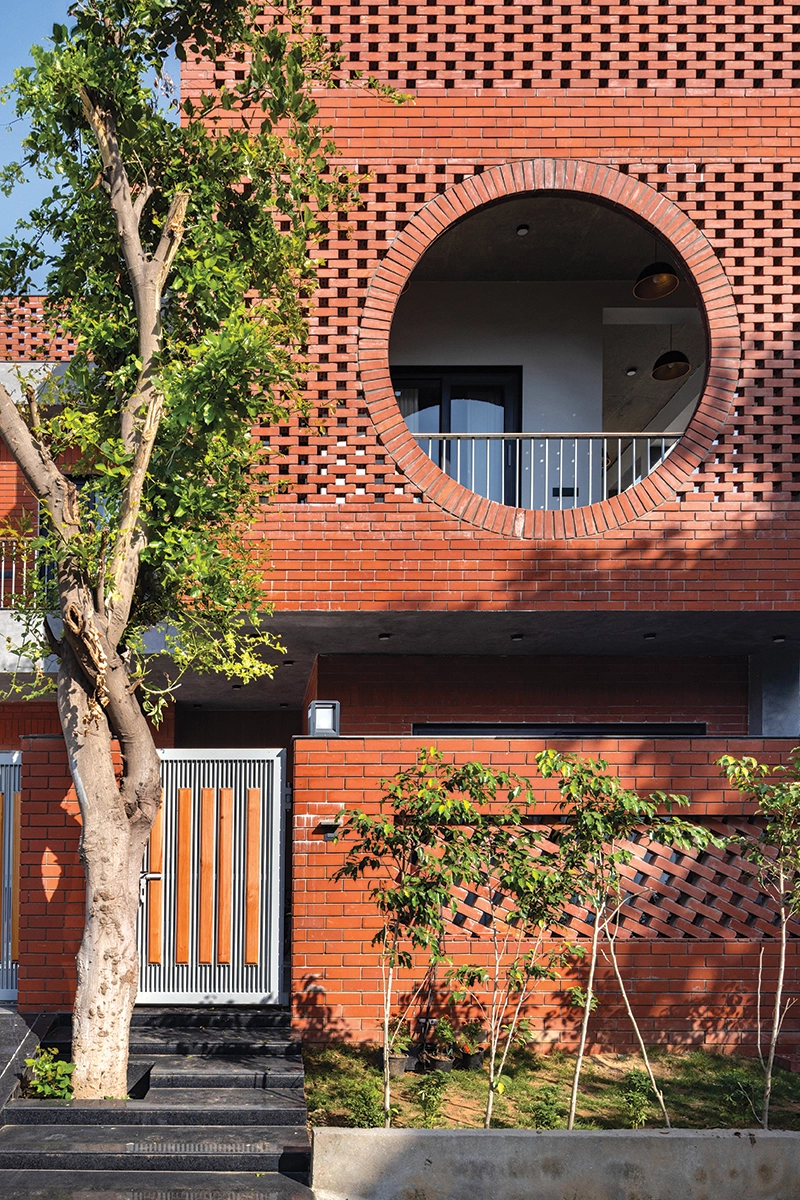
On the western façade, the upper volume is presented as a bold projecting brick mass whose entire surface is woven with a diagonal jaali screen, a grid of small square perforations that dissolves solidity into a breathing skin of light and shadow. Set within this porous field, a large circular void frames the projecting balcony, its concentric rings of brick radiating outward to produce an aperture that performs as both a shade structure and a framing device.
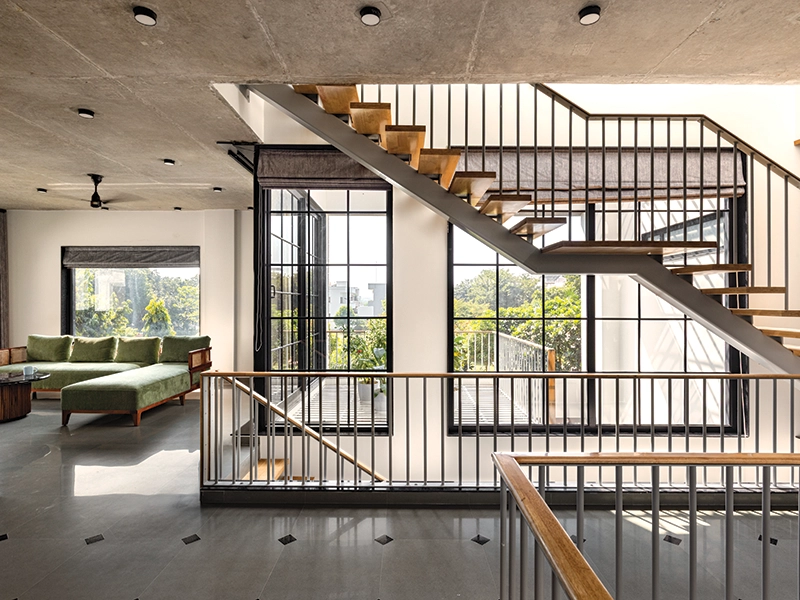
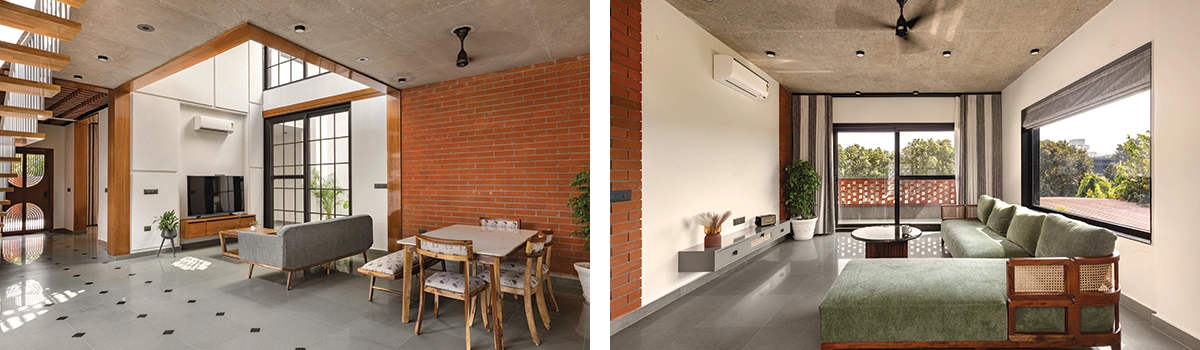
Exposed concrete slabs, raw surfaces, an internal brick pergola that diffuses incoming light into shifting patterns across the floor, Kota stone flooring, geometric inlays that define circulation and demarcate zones, and a design philosophy in which the construction process itself becomes the aesthetic language.