
Linked Hybrid - An Open City Within A City
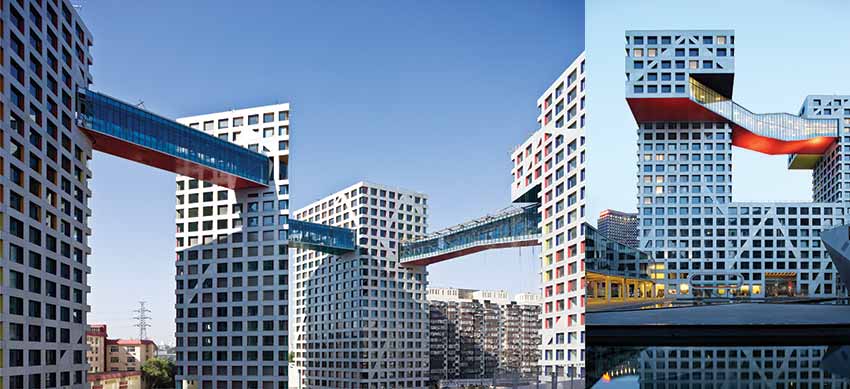
"The council of Tall Buildings and Urban Habitat (CTBUH) has recently awarded the Steven Holl Architects' Linked Hybrid Complex in Beijing as the 'CTBUH 2009 Best Tall Building Overall' selecting it from among various candidates from regions worldwide.
The CTBUH recognizes one outstanding tall building from each of four geographical regions: Americas, Asia and Australia, Europe, and Middle East and Africa annually. Recipients must possess seamless integration of architectural form, structure, and building systems, as well as exhibit sustainable design qualities working to preserve the quality of urban life and this year the honor goes to Steven Holl Architects' for their superb design of "Linked Hybrid Complex" in Beijing.
Commenting on the project during an award ceremony, CTBUH Awards Committee Chairman Mr. Gordon Gill stated, "This project is very rich in thought, both programmatically and architecturally. It presents an advances typology for dense urban living," whereas CTBUH Executive Director Antony Wood said, "This project 'Linked Hybrid' points the way forward for the intensified multi-use, multi-level connected cities of the future."
Project Description
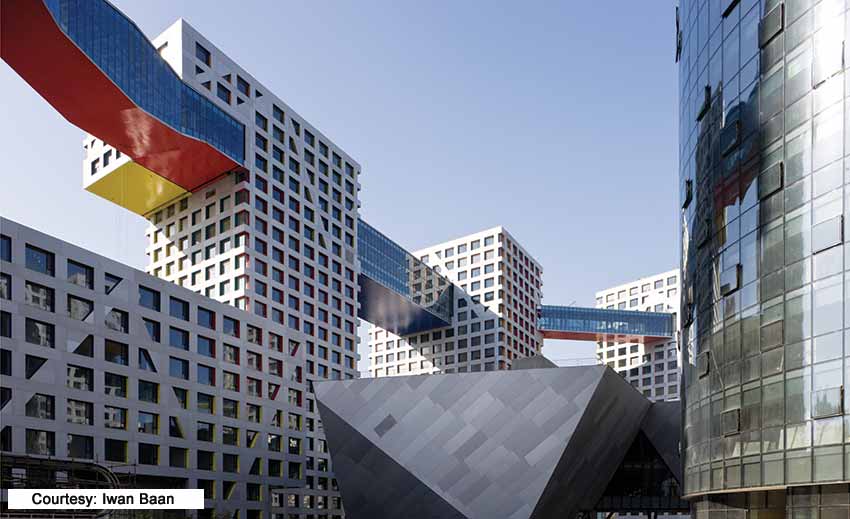
The 220,000 square-meter Linked Hybrid complex in Beijing, aims to counter the current urban developments in China by creating a twenty-first century porous urban space, inviting and open to the public from every side. A filmic urban experience of space; around, over and through multifaceted spatial layers, as well as the many passages through the project, makes the Linked Hybrid an "open city within a city." The project promotes interactive relations and encourages encounters in the public spaces that vary from commercial, residential, and educational to recreational; a three-dimensional public urban space.

| Location | : Beijing, China |
| Architect | : Steven Holl Architects |
| Client | : Modern Group |
| Floor area (square) | : 2383797sf/221462sm |
| Floor area (square) above | : 1753775sf/162931sm |
| Floor area (square) below | : 629635sf/58495sm |
| Building area (square) | : 2368060sf/220000sm |
| Status | : Completed |
| Structural Engineer | : Guy Nordenson and Associates: Derek Chan, Erik Nelson, Guy Nordenson, Claire Argow |
| Associate Structural Engineer | : Capital Engineering and China Academy of Building Research: Xiao Congzhen |
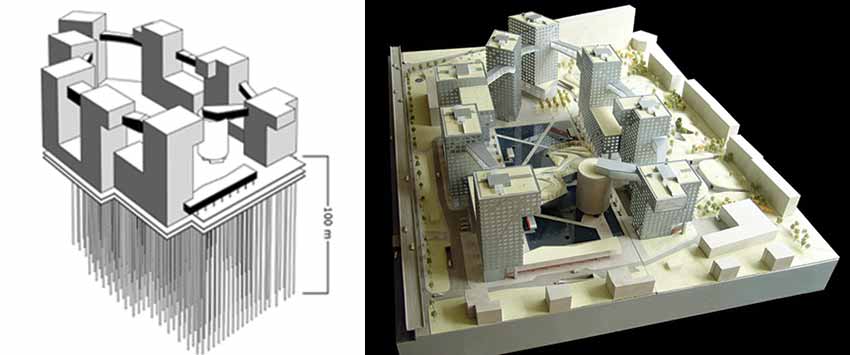
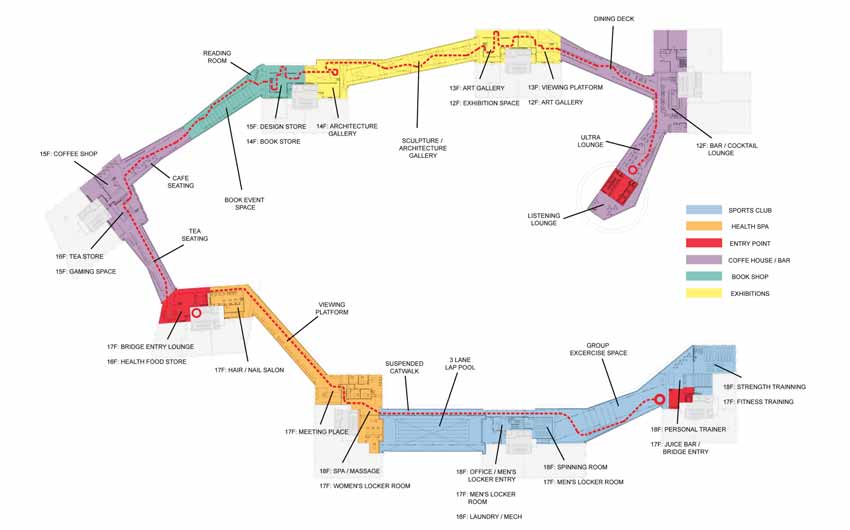
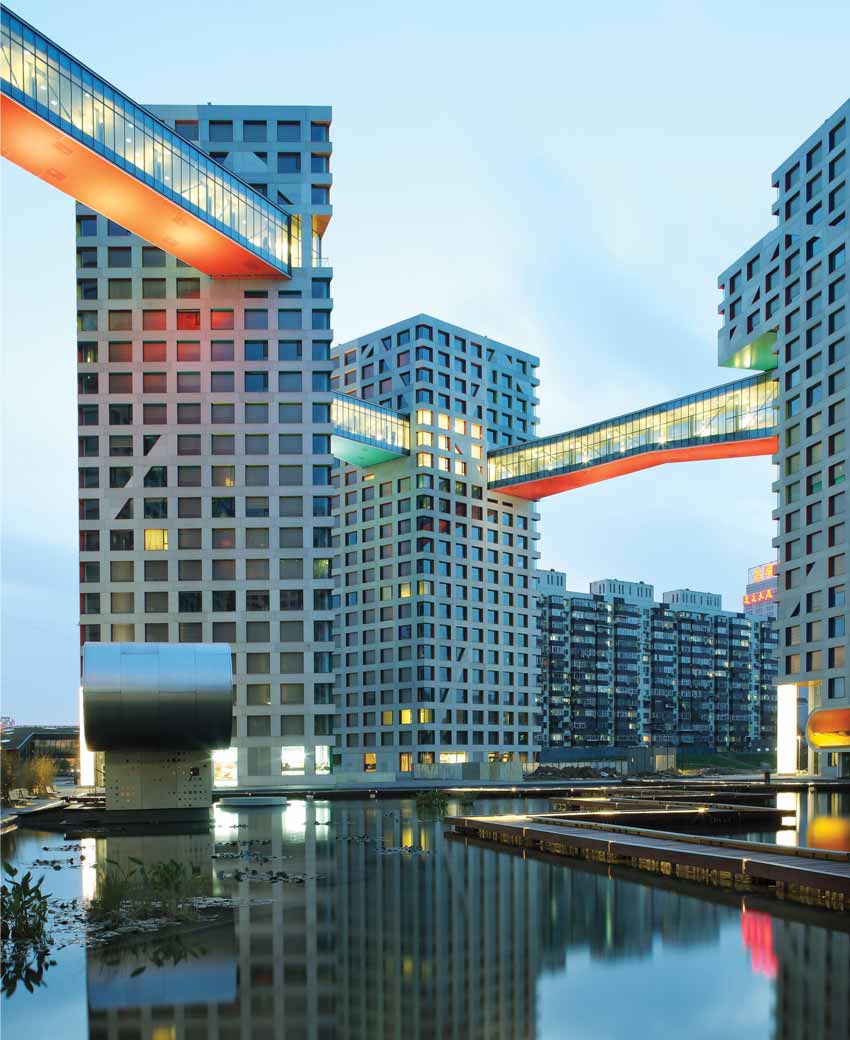
All public functions on the ground level - including a restaurant, hotel, Montessori school, kindergarten, and cinema - have connections with the green spaces surrounding and penetrating the project. Elevators displace like a "jump cut" to another series of passages on higher levels. From the 18th floor a multi-functional series of skybridges with a swimming pool, a fitness room, a café, a gallery, etc., connects the eight residential towers and the hotel tower, and offers views over the unfolding city. Programmatically, this loop aspires to be semi-lattice-like rather than simplistically linear. Hope the public sky-loop and the base-loop will constantly generate random relationships; functioning as social condensers in a special experience of city life to both residents and visitors.
Focused on the experience of passage of the body through space, the towers are organized to take movement, timing and sequence into consideration. The point of view changes with a slight ramp up, a slow right turn. The encircled towers express a collective aspiration; rather than towers as isolated objects or private islands in an increasingly privatized city, the hope is for new "Z" dimension urban sectors that aspire to individuation in urban living while shaping public space.
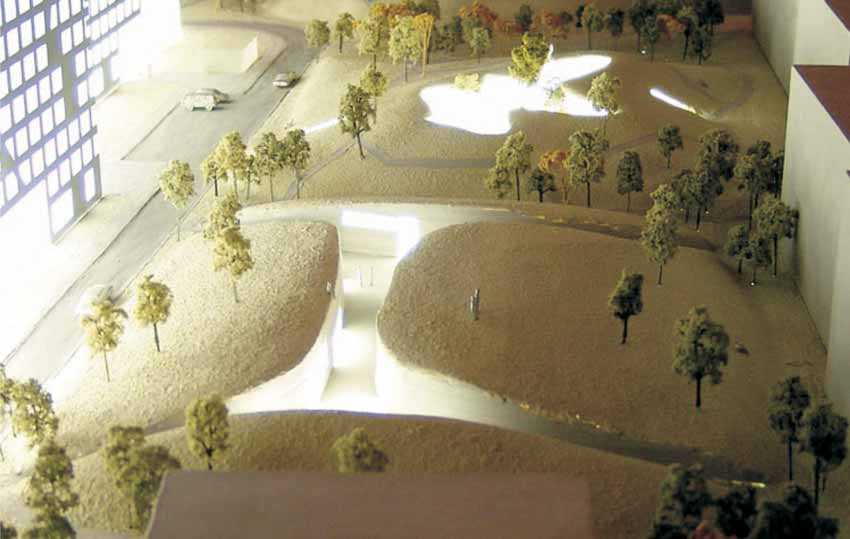
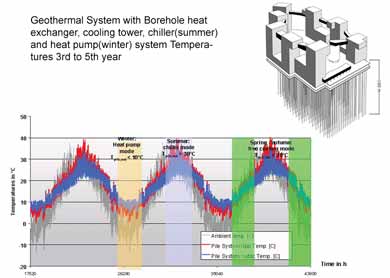
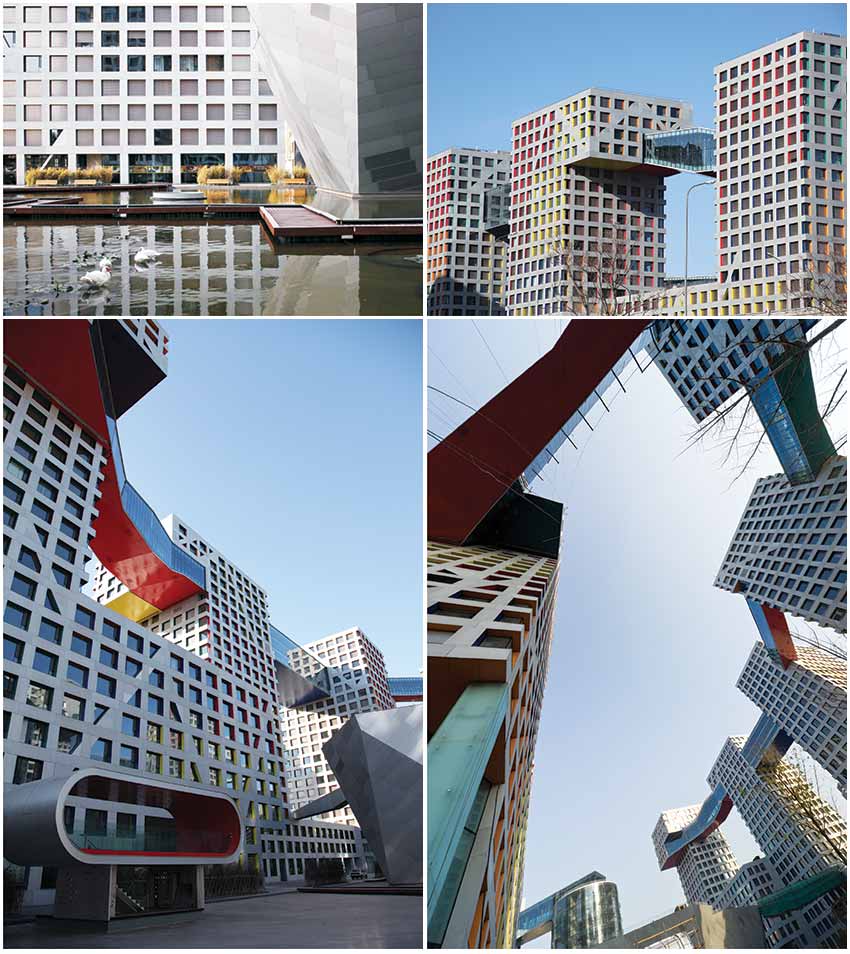
Geo-thermal wells [660 at 100 meters deep] provide Linked Hybrid with cooling in summer and heating in winter, and make Linked Hybrid one of the largest green residential projects. The large urban space in the center of the project is activated by a greywater recycling pond with water lilies and grasses in which the cinematheque and the hotel appear to float. During winters the pool freezes to become an ice-skating rink. The cinematheque is not only a gathering venue but also a visual focus to the area. The cinematheque architecture floats on its reflection in the shallow pond, and projections on its facades indicate films playing within. The first floor of the building, with views over the landscape, is left open to the community. The polychrome of Chinese Buddhist architecture inspires a chromatic dimension. The undersides of the bridges and cantilevered portions are colored membranes that glow with projected nightlight and the window jambs have been colored by chance operations based on the 'Book of Changes' with colors found in ancient temples.
Towers
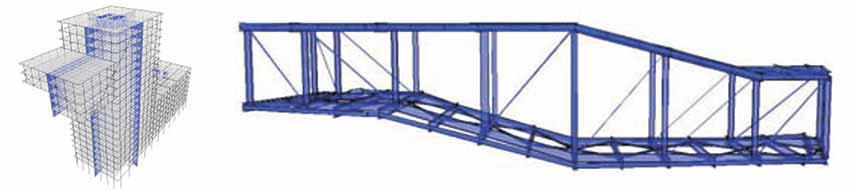
The project is a housing development for 622 apartments and a small hotel in eight interconnected towers. The towers are about 30m by 30m in plan with concrete flat slabs spanning between core and cross concrete shear walls and a perimeter concrete moment frame. The frame is a grid of uniform dimension interspersed with diagonal members. These diagonals occur on an adhoc basis where required for building cantilevers, overhangs and overall stiffness. Taking into consideration the substantial seismic demands of Beijing and the stringent code requirement of torsion, GNA undertook a number of design challenges: the core and cross concrete shear walls were used around the elevator shafts to provide a gravity load path for the long span flat plates and also substantial stiffness and resistance to seismic activity. Each of the seven bridges is isolated from the towers to minimize transfer from the bridge to the building tower.
The weight of the large cantilevers at the upper levels was decreased by using steel and concrete composite framing to cut down the self-weight. Lastly, systematic bracing members were added around the perimeter of the towers to increase torsional rigidity.
Bridges
The goal of the bridge structural design was to maximize transparency and create floating hallways of light, traversing 30 to 40 meters between the heavy concrete towers. In order to span the great distance required and also to achieve the utmost transparency, the bridges utilize a pair of parallel steel trusses (the truss being the most efficient form to resist flexure). A Pratt truss configuration was chosen to use thin tension only diagonal members and, in order to make the truss more elegant, the angle of the diagonals is variel, achieving a truss form with members oriented in such a fashion that the sizes of the diagonals have equal stresses, hence equal sizes. The connections between vertical and horizontal truss members were made rigid to form a complete three-dimensional rigid Vierendeel frame. This provides additional stiffness and redundancy to the bridge structure and allows for the removal of the center panel diagonal members.Bridge Isolators
The bridges are light and glass enclosed. In order to protect them from the effects of significant tower movement under an extreme seismic event, it was decided to isolate both sides of the bridges. The system selected was a "friction pendulum isolator" which is provided by Earthquake Protection Systems of California. The isolators are shaped with a radius to achieve a described period of vibration that will minimize the shear transfer by reducing the resonance. In an earthquake, the bridges will move up to 40cm relative to the buildings, sparing them, and the buildings, of the effects of lateral forces.
Everingham Rotating House Australia
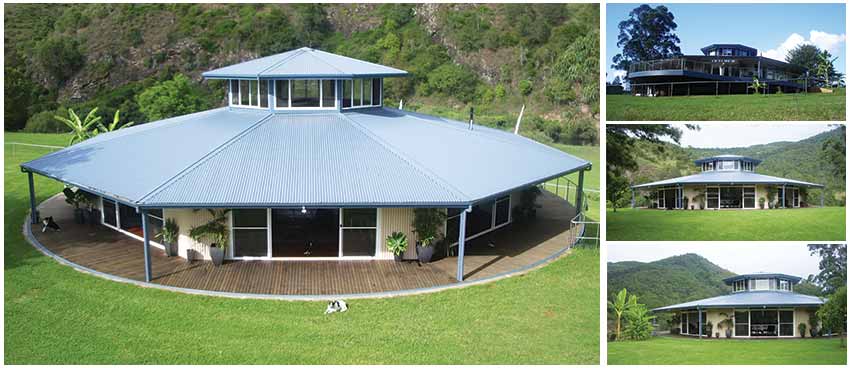
An Australian couple Everinghams dreamt to make a house a decade ago that can allow the user to match the orientation of the home to the daily weather patterns. And today their imagination has taken a shape of reality in the form of Everingham Rotating house that can rotate up to 360 degree if and when desired within a 180 degree retainer wall and a 180 degrees fixed deck and railing. The couple feel that they are on the eleventh clouds as their dream comes true.
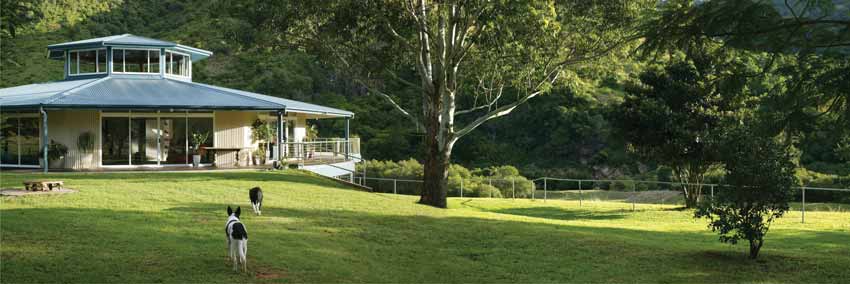
The Everinghams have been in a spin since they moved into their dream home in the countryside north of Sydney three years ago. They can turn the house to follow the sun without having to leave the comfort of their armchairs. "When you wake up you do wonder where you'll be facing," said Luke Everingham, a sound-engineer who came up with an idea of a rotating house with his wife, Deb.
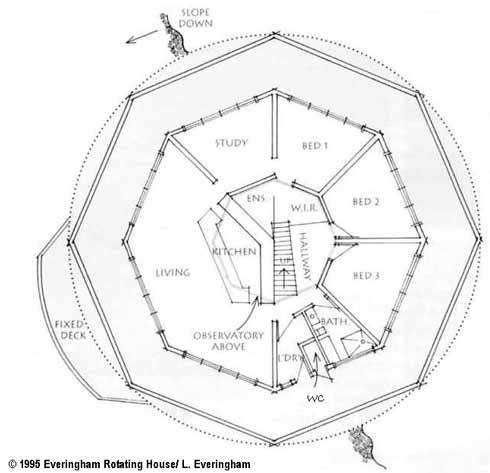
Concept of the project
The rotating house guarantees a different view every time you wake up. The concept for this project is the result of nearly a decade of intermittent research, planning and design, and ten months of construction over a two year period consuming all disposable time. The project was completed in March 2006.As per the owner and designer of the house Mr. Everingham, "The idea was born when our neighbors were expounding the virtues of their new home and commented that if they could start again they would orientate the house 15 degrees more to the north. To this, Deb his wife said "Wouldn't it be handy to have a house that could move?"
Immediately Mr. Everingham started thinking the features which could lead the house to move. Certainly several points come in his mind as Weight? The average house would weigh approximately 20-30 tons or about 1 ton per square. Weight is not difficult - ancient mechanical and structural engineering, he commented. What about Shape? The conventional rectangular prism would not be suitable, he pointed. After experimenting with scale drawings to investigate octagonal and circular shapes, he was pleasantly surprised as a number of preliminary designs and layouts were created.
Elaborating on his points he said "At this stage we sat on it for many years on the assumption that the cost would be prohibitive. In mid 2002, we decided that our 87-year-old white ant-ravaged farm house was beyond renovation and hence we started looking for new house options. We were somewhat shocked at the cost and how mundane the end result would be compared to our "Everingham Rotating House" design.
In January 2003, research into the cost of the project commenced, and 6 weeks later we came up with an estimation that it would not cost any more to construct than a conventional house of a similar size and level of appointment.
The construction of the house would not have been possible without the assistance of the Coastline Credit Union in Taree. The standard banks did not have the appropriate computer pigeon holes to cater for our particular circumstances. The Credit Union was prepared to consider our application on its own merits. By December 2003 we had organized finance and construction certificates and building commenced!
Design concept
The entire design concept has been firmly based on the following principles:- The cost must not exceed that of a conventional house of the same size and level of appointment;
- The layout and finish must be highly functional;
- The end result must require very little maintenance;
- The house must be white ant proof;
- The rotating aspect must allow the occupants to maximize exploitation of weather conditions, seasonal conditions and outstanding 360-degree views.
Features of the house
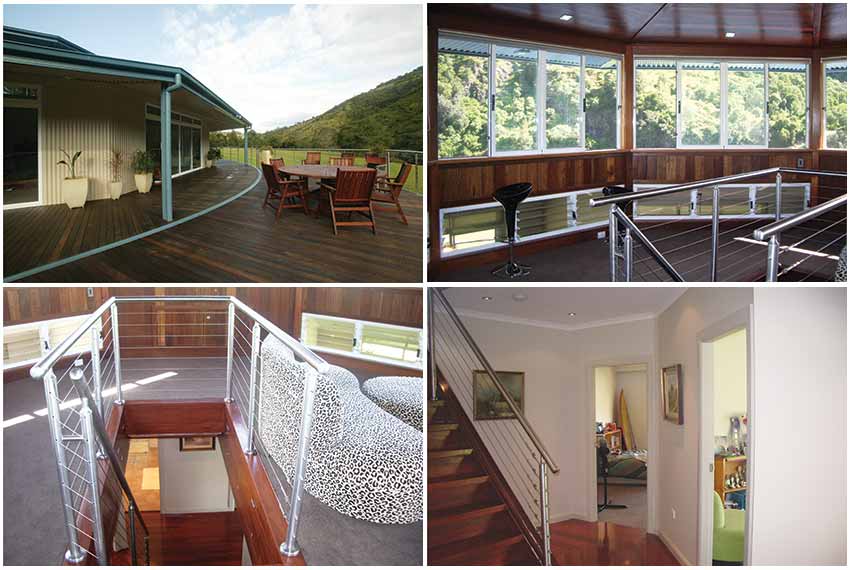
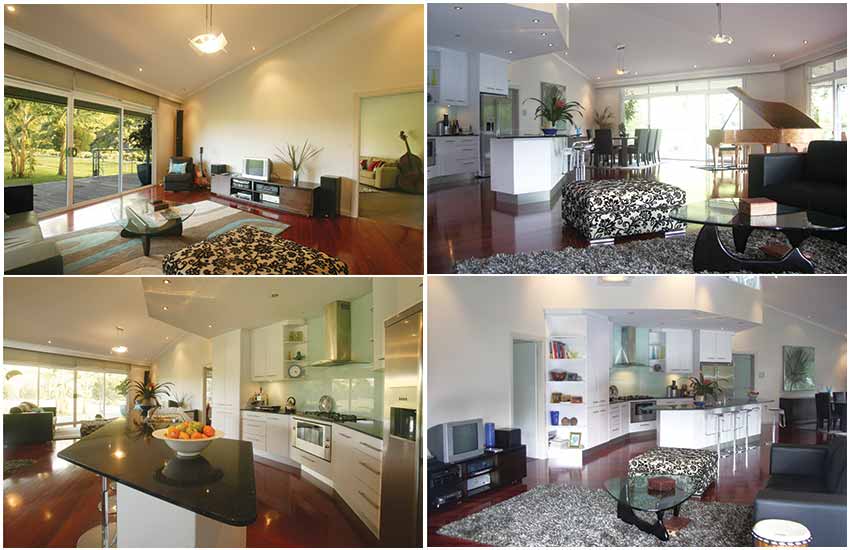
The Everingham rotating house is a 24-metre diameter octagon and this octagonal nature of the house allows for irregular-shaped rooms with a lot more space than most conventional houses. Windows and glass doors constitute a large part of the exterior walls, in order to take advantage of both the views and the warmth of the sun. The wraparound verandah is a 3 meters wide hardwood timber deck.The entire structure, weighing approximately 50 tons, rotates up to 360-degrees if and when desired, within a 180 degree retainer wall and a 180 degree fixed deck and railing. The house can be set up to follow the sun or to avoid the sun. It can be moved to get out of the wind or to catch the breeze. The house is relatively cheap to build due to the simple design of the electrics and plumbing and the simple nature of the rotation device which controls the rotation by using a touch panel on the wall of the living room which can be pre-programmed or operated manually." Some other features of this house are listed below:
- The exterior walls: vertical corrugated COLORBOND®
- The interior walls: predominantly Gyprock
- The mechanics: 200-ton central bearing, 32 outrigger wheels and two 500-watt electric motors attached to reduction gearboxes and drive-wheels.
- Insulation: CSR Bradford 2.5 Anticon roof insulation, all internal and external walls use the R32 sound screen wall batts and 100ml thick ceiling batts throughout the ceiling.
- Geothermal piping 120 meters long and 2.5 meters deep supplies a constant 22oc to the house through the central core.
- Roofing: COLORBOND®
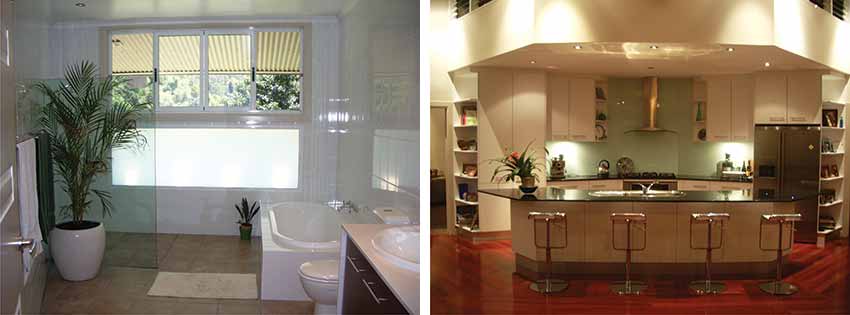
The house cost about $1900 a square meter to build and can complete a full rotation in about 30 minutes, according to Everinghams. The family is now in the business of exporting the Everingham Rotating House (ERH) around the world. Each ERH can be customized to meet the requirements of each unique application (i.e. Larger or smaller diameter, more or less bedrooms, utilization under house area for storage or garage etc, an internal garage, second story, second story verandah 360 degrees etc). These designs are directed at the domestic and commercial markets. In addition, there are many environmental options available. They have further researched to make this already environmentally friendly house... friendlier.
Georg Spreng’s House Is More Than a House
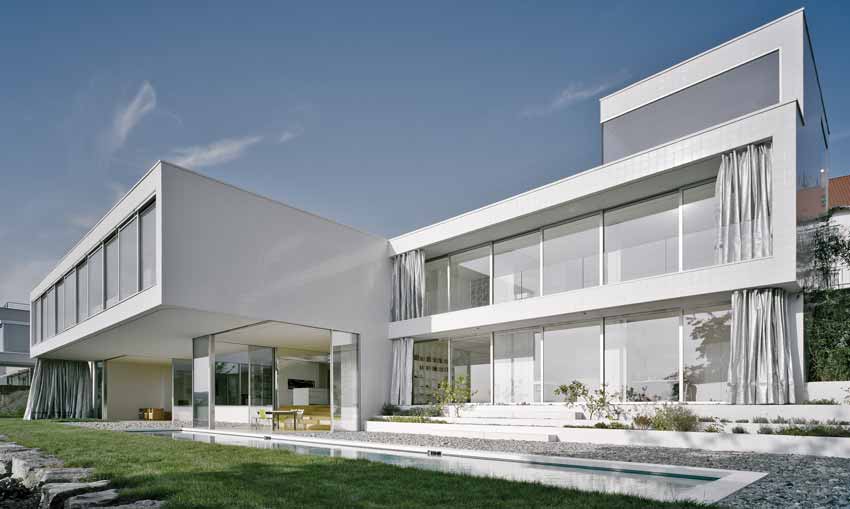
Everyone desires to make their house a home and do best to make their dream project a reality. An industrial designer Georg Spreng, also the founder of group Frogdesign has spent many years of his life living in Canada, and the experiences he made there were very important to him. In Canada Georg Spreng had lived on an estate which was so large one could loose ones way on it. Living in a house, he experienced that different weather – proved how vulnerable humans are and how strong nature can be. From these experiences, he developed an intense connection to nature. This is why – with his own house - it was important for him to build up a connection to the landscape and to let the house step in to the background. He wishes to bring a sense of the expansive open spaces back to his homeland in Wissgoldingen, Germany also. Spreng's idea was to combine work and living in one building; but he also wanted that each have their own separate areas. If at one side he needs the house to be connected with the landscape then at the other side being a design professional, he is interested in materials combination and how people react to them and handle them.
| Project | : Residential House with Jewellery Studio |
| Location | : Wissgoldingen, Southern Germany, near Stuttgart |
| Architects | : C18 Architects, Stuttgart |
| Date of completion | : May 2008 |
| Gross floor area | : 615 m² |
| Gross volume | : 2.049 m³ |
| Photographer | : Miss Brigida Gonzalez (www.brigidagonzalez.de) |
| Client | : Georg Spreng |
With all these in mind, Spreng approach to the German based architectural firm C18 architects and has a detail dialogue with the architects. The dialogue between the two lead to unusual material combination, to combination which doesn't follow established conventions. Materials should be allowed to speak, be allowed to appeal to sense and feelings. The location Spreng selected is the Swabian Alb, a low mountain range in Baden-Württemberg, Germany, fascinated by breathtaking landscapes, vast views, jagged cliffs and large caves belonging to widely branches out underground system.

After visiting the site of construction, C18 Architects developed a layout which accomplishes well all desired features. Designed by Marcus Kaestle, Andreas Ocker and Michel Roeder of C18 Architects the two level structures contain a house and a Jewellery studio.
Structural Design
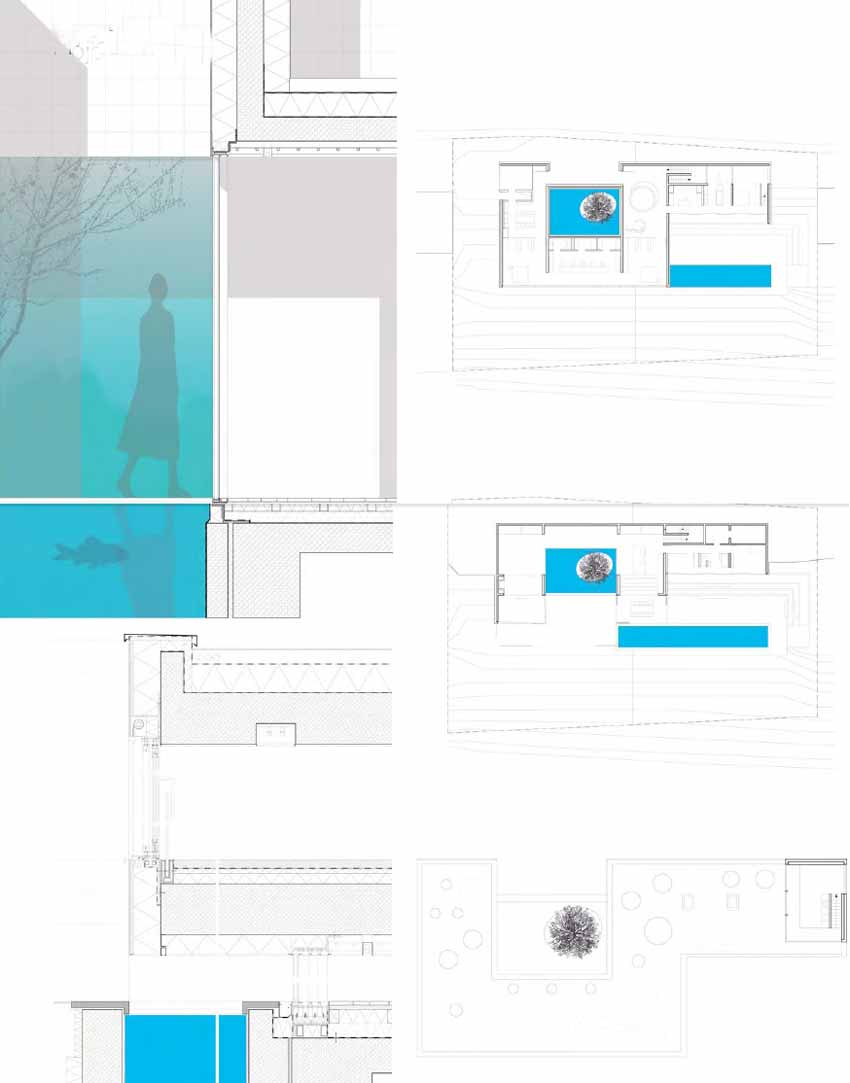
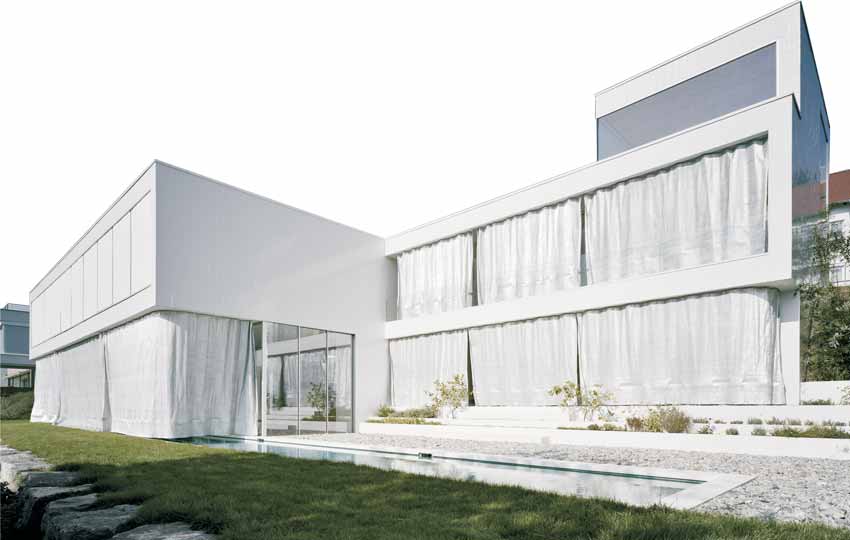
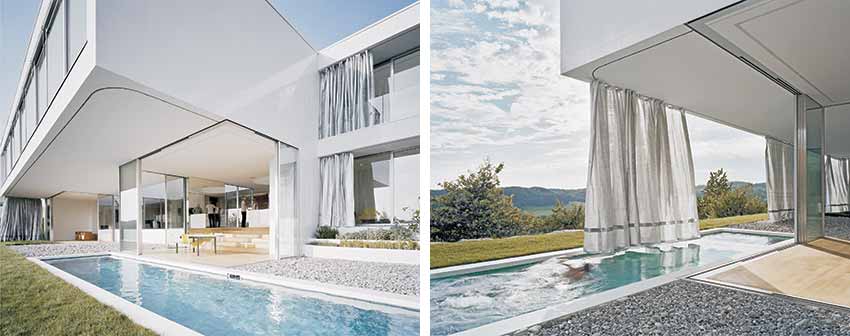
Towards the street the building is closed; it attracts attention with its cladding of white square tiles. The buildings cubic shape also distinguishes it from its neighbors. Even if the house is closed towards the street, it doesn't close itself to the neighbors. A tower room with a window facing the street positions the building in the neighborhood. No fence hinders visitors from entering the premises and looking over a wall onto a pond in an open atrium and into the living area. At this point two entrances lay symmetrically to each side. They both have red emergency shutdown buttons as bell buttons. From this standing point one can already notice a considerable lot about this house; the way it entangles inside and outside and that it is a special house.Two levels lay over one another like two U-shaped brackets. The upper bracket is open towards the street; the lower bracket is open towards the countryside. Through the resulting eyelet one can look down from the entrance area onto a pond in which lays a small island upon which a tree was planted. The tip of this tree can be seen from the upper level from the street. The lower bracket has shorter sides than the upper one so that the upper level projects over the lower level and roofs parts of the outdoor area. The necessary construction for the up to six meters long projections was statically an enormous challenge. To the left of these two brackets a row of rooms and bathrooms joins on. At the end of this the staircase is located over which the crow's nest - already seen from outside - is reached.
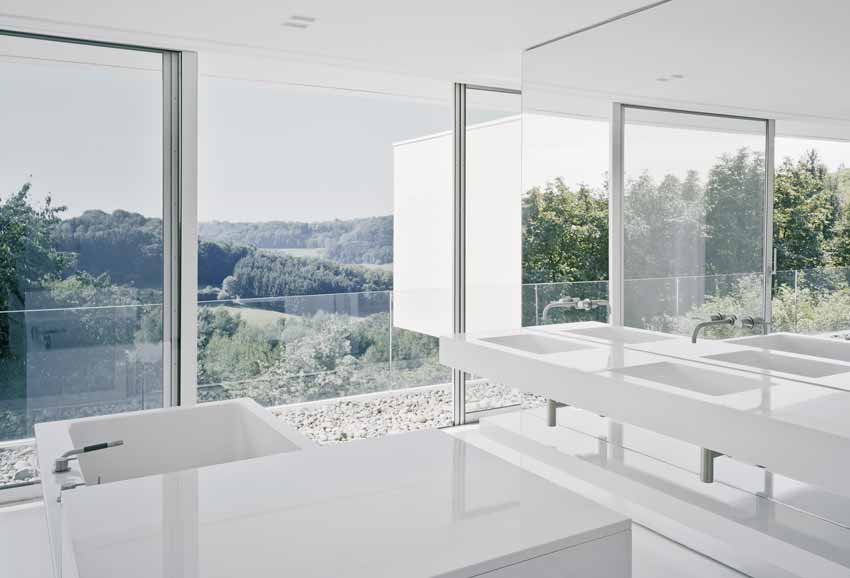
All rooms on both levels are open to the southwest, to countryside with hardly any housing. One doesn't only see fields and meadows but also the weather coming along. Open rooms, a room-high glazing with thin profiles, spaces formed by changing floor levels over the whole width of the living area, spaces which lead into the landscape and also continue the landscape in the interior.
Upon entering the house ones first impression is surprising. Large round skylights lighten the area from above and through an even larger round opening in the floor light reaches a lower level. The light flooding through the openings connects both levels with each other. A yellow bench nestles up to the balustrade. One thing is clear: the cliché of the architects or designer house isn't going to be reproduced here. In the entrance area the floor, walls and built-in wardrobes are all white. One opens the wardrobe doors – they have no handles and open upon pressure – to find the inside is painted in a variety of colors. To the left the lower level is reached over a staircase which is blue-painted and the bedrooms lay alongside. Straight on one reaches the studio which can also be reached directly from the outside by the second entrance.
Experiment with Materials
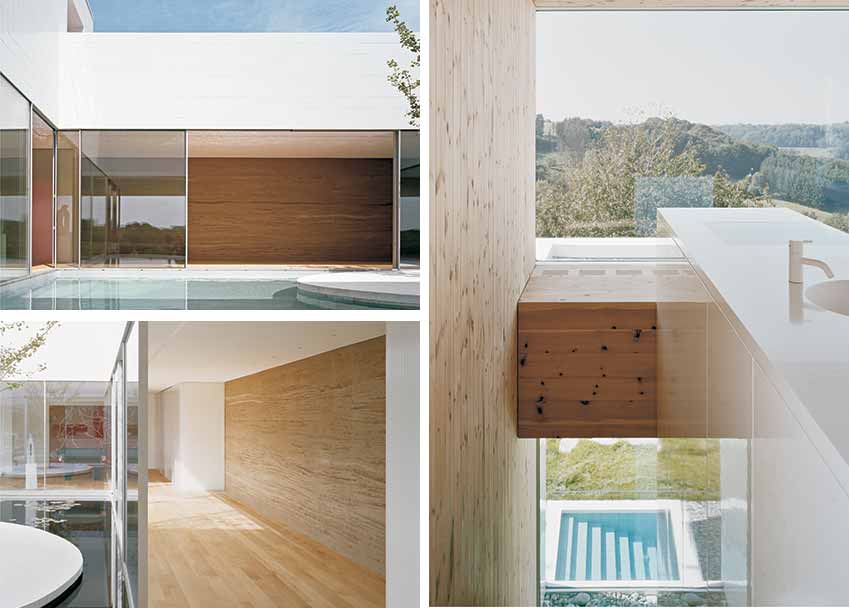
The clients' desire for the best material composition led nowhere not even towards the street - plastered paths or flat terraces; instead there is crude gravel like normally found on the bed of a mountain river. The curtains are made of a silvery shiny material which was developed to cover scaffolding on construction sites. In the living area, the back wall against the ground was constructed by stamping layer over layer of clay. Some of the layers are pigmented lightly so that a picture emerges which resembles a view over the Alb with foggy valleys. Architects have taken full advantages of their client's openness and also use it playfully and tactfully.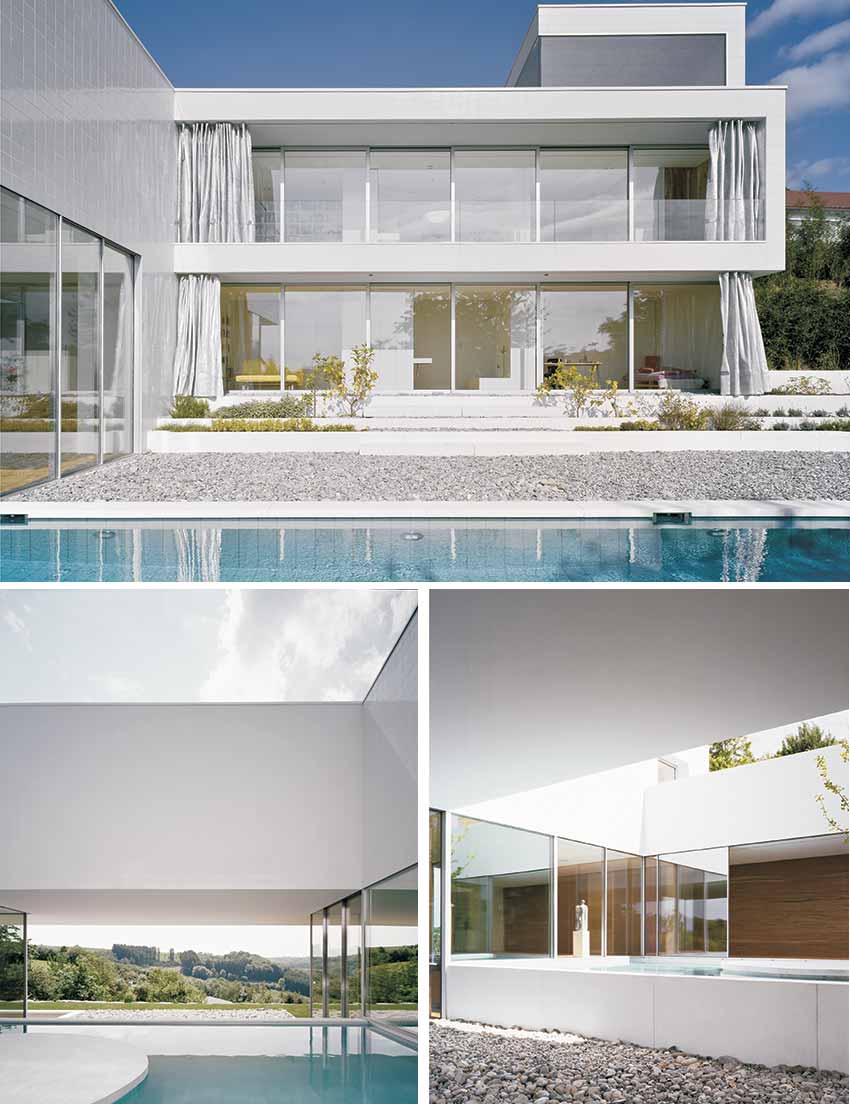
The house is an experimenting field. Conventions of living as well as architectural conventions "how things have always been done" were abandoned. But a game wouldn't be a game if it weren't taken seriously. None of the tiles on the facades were cut. The large mirrors which cover the walls on the garden level between living area and atrium are each out of one piece. The wooden floor made out of Canadian birch is high-quality processed. The wall plaster has a high percentage of clay which works - like the stamped clay wall - humidity regulating. The room-high glazing with its extremely thin profiles is the first of its kind with these dimensions. The balustrade around the skylight in the entrance area is rounded in such a way that it feels good to touch but nothing is laid on top. Everything has a reason; is considered and intended, even if one wouldn't have thought of the solution by oneself.
C18 Architects have designed an exceptional house. A house which gives you lust, makes you lust for living and lust for the countryside. And as unconventional as it may be in the neighborhood - it fits in. It is a known fact that it's not easy to pull the wool over the eyes of people from the Alb. Life was too hard to risk relying on somebody else without question.
Aqua Villa [Delhi]
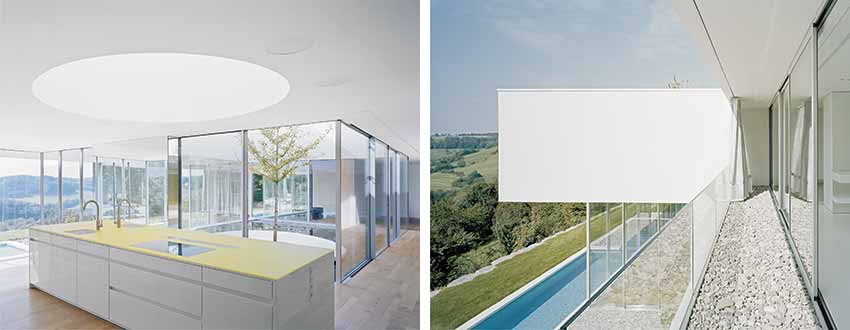
With a design philosophy to create integrated design solutions imbibing amalgamated, efficient, robust, and sustainable designs leading to performative architecture, Studio Symbiosis, an architectural & interior design studio based in Delhi, London and Stuttgart has come up with a magnificent design of a Villa, located in the heart of Lutyens Delhi. The practice believes that, with computational tools, it is possible to create elegant design solutions driven by performance.
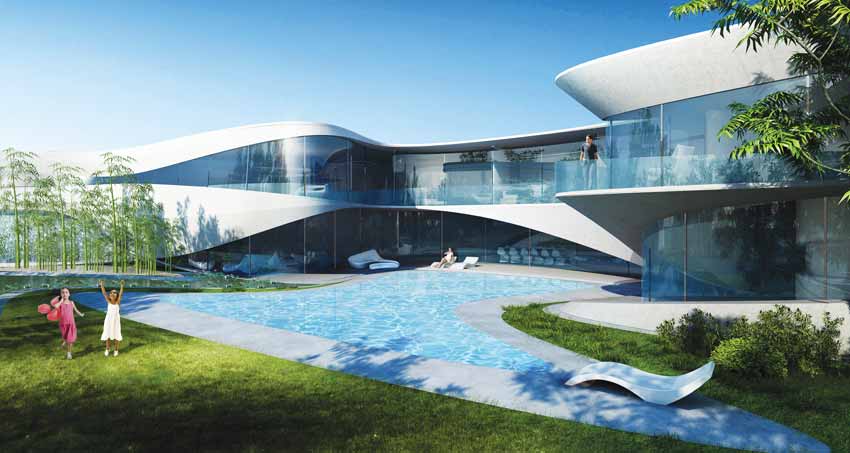
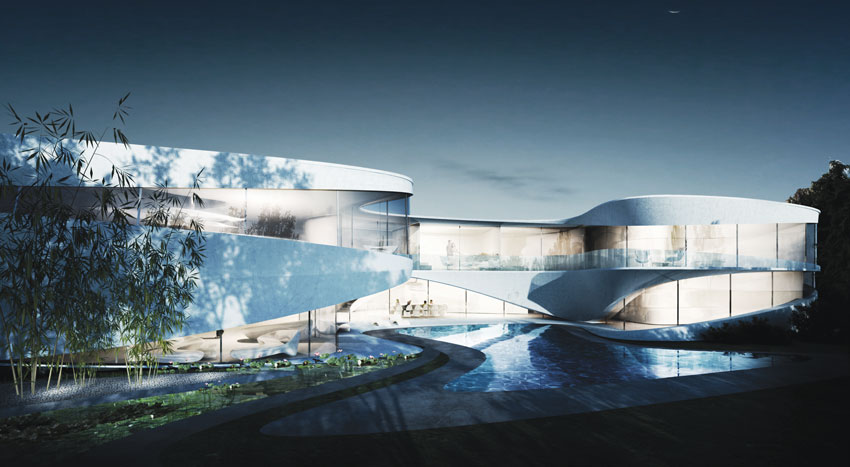
Aqua Villa has been designed as a sensitive building, sitting in harmony with its surroundings. The design is an outcome of overlap and interaction of the design parameters of movement patterns, solar studies, soft-subtle transition zones, interaction of built and landscape and of the old and the new.
The design form emerges and flows out of the existing building. The lines of the first floor bridge connection to the existing house emanate and disperse on the site.
| Location: | New Delhi |
| Built up Area: | 680sqm |
| Site Area: | 1290 sqm (excluding existing villa) |
| Architecture/Landscape: | Studio Symbiosis |
Interlocking Spaces
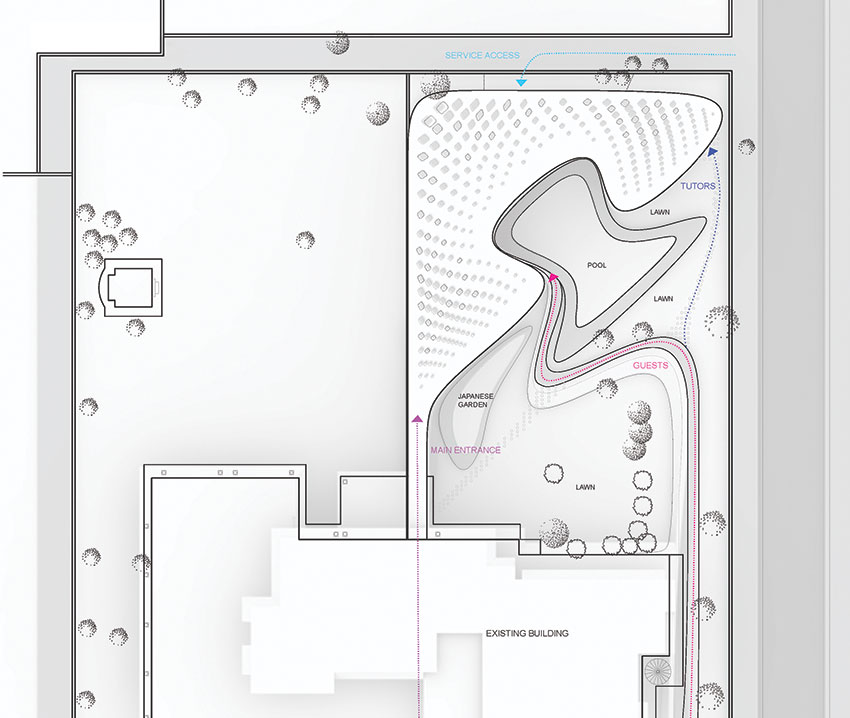
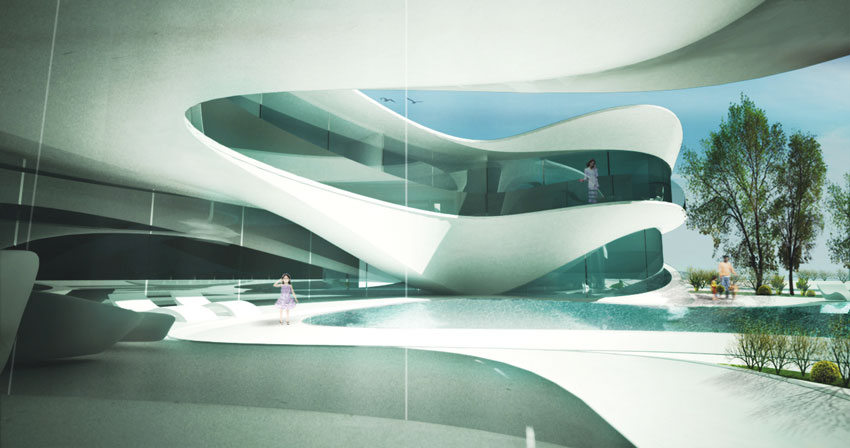
Aqua villa has a swimming pool sitting amidst the design. It creates a soft transition zone between the proposed villa, the landscape and the existing house, modulating and amalgamating these varied elements into one interlocking system.
Movement Patterns
The movement patterns lead to a three point access to the proposal. The first one is through a covered walkway connecting the existing house to the new one with a water wall along the transition space. The second connection is for guests coming in evening from the side walkway which travels along the landscape and creates a more semi private entrance to the building. The third is a service entry for the staff and nanny from the north east boundary of the proposal, which ensures there is no cross movement of the staff through the villa.
Elegance
The façade is designed in a way that it continues from the existing building and then starts to respond to the program of the new building. A sense of elegance has been imbibed in the façade of the building with the lines moving effortlessly over the proposal. Grand glass doors have been integrated into the proposal.
Built-Landscape
The relationship of the built to landscape was very important in the design. The interior spaces flow out onto the landscape on the ground floor and on the upper floors deep luxurious sit out areas overlook the pool / green.
Functional Gradient
The space allocation has been done in a way that there is gradation from public to private. The ground floor has been designed as semi private while the first floor is completely private.
Transformational Spaces
In an event of a gathering, the spaces on the ground floor open up and work in coherence with each other to create one grand experiential space.
Sustainability Integrated
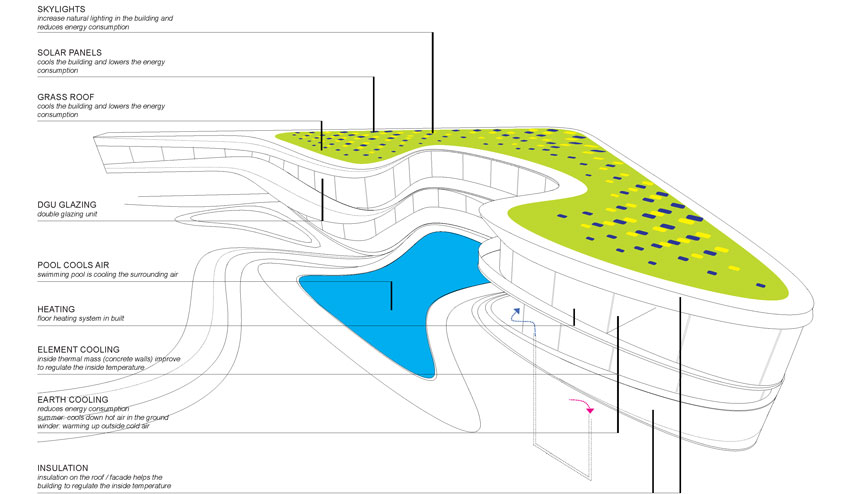
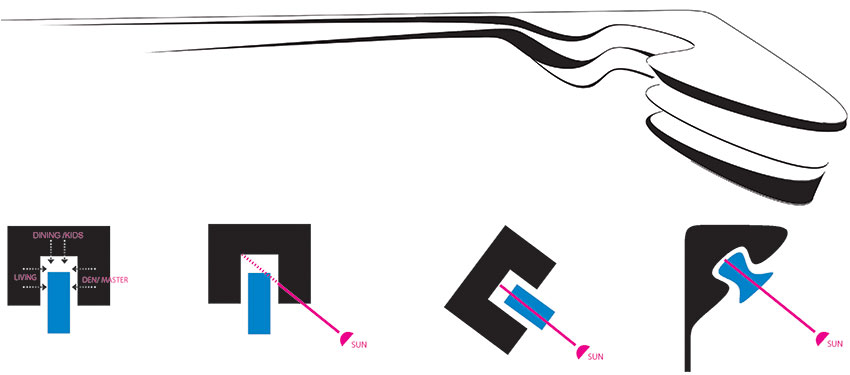
Solar studies have been an integral part of the design process to achieve ambient light and shadow condition on the sundeck and inside the villa.The pool centered in the courtyard is creating evaporative cooling in summer. Balcony cantilever depth depending on summer sun angle to shade direct sun light and to let the winter sun in during the cold winter season.
Kanpur Riverfront Development [Uttar Pradesh]
| Architects | : Studio Symbiosis |
| Location | : Kanpur, India |
| Partners | : Amit Gupta and Britta Knobel Gupta |
| Area | : 1156 Acres |
| Year | : 2013 |
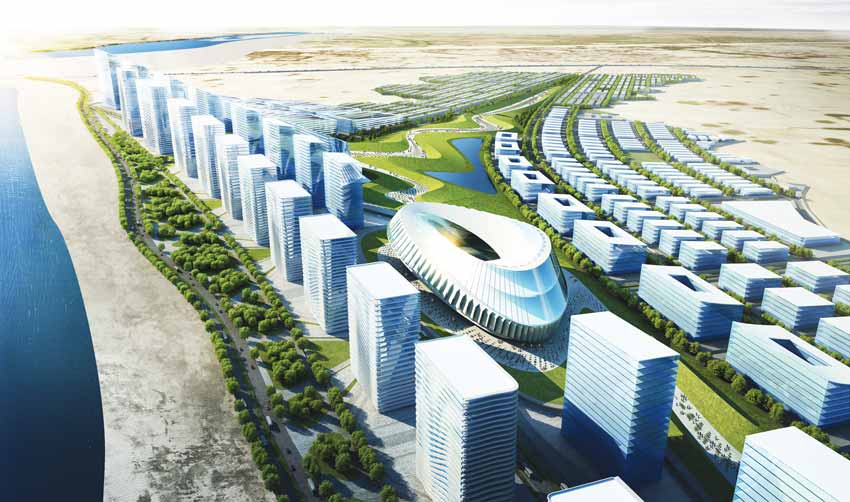
Ganga provides the most influential and dominant context for the master plan. The existing patterns of Ganga were studied and through digital simulation density patterns emulating the Ganga patterns were translated into the central green of the master plan. This central green area gives the master plan a distinct character and acts as breathing lungs for the city.
Auto expo is located at the heart of the master plan, sitting amidst the central green. It is located at a very important interface of the central green and the promenade. It's an amalgamation zone of various activities of the master plan cascading into each other thereby creating a functionally rich urban plaza.
Ahmedabad Hotel [Gujarat]
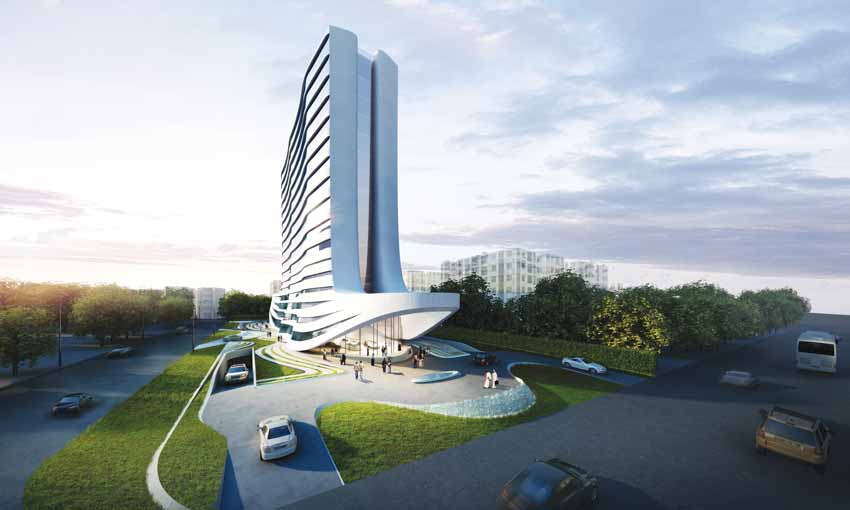
| Architects | : Studio Symbiosis |
| Location | : Ahmedabad, Gujarat, India |
| Partners | : Amit Gupta, Britta Knobel Gupta, Vandana Sehgal (Hon.) |
| Site Area | : 6860 sqm |
| Built-up Area | : 24,000 sqm |
| Completion | : June 2015 |
The idea of creating a design with soft subtle touches and imbibing a sense of elegance has been instilled in the proposal from the creation of the form itself. The different functions in the building with different programmatic requirements are blending together thus resulting in this iconic building. The building comprises three waves which are very carefully translated into dramatic key spaces on the lower floors, and on the upper floors they translate into room grids with focus on standardized room sizes.
These waves emerge effortlessly from the landscape creating a sense of harmonic relationship with the ground. The profile of the building has been designed with keen emphasis given both to the smooth transition from the horizontal landscape to the vertical building and to the standardization and repetition of the façade components.
Master Plan for ‘New Allahabad’
| At a Glance | |
| Project | : Allahabad Masterplan, Allahabad, State U.P., India |
| Architect | : Studio Symbiosis |
| Partners | : Dr. Vandana Sehgal (Hon.), Britta Knobel Gupta, Amit Gupta |
| Client | : UPSIDC |
| Site Area | : 1500 Acres |
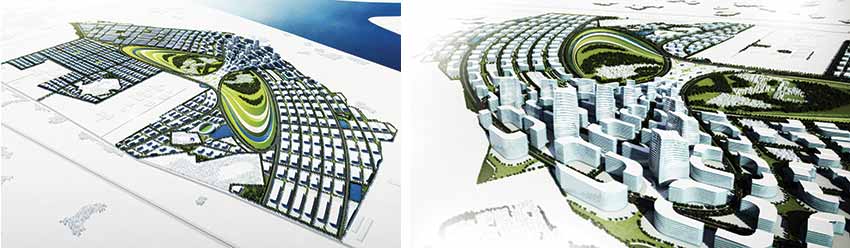
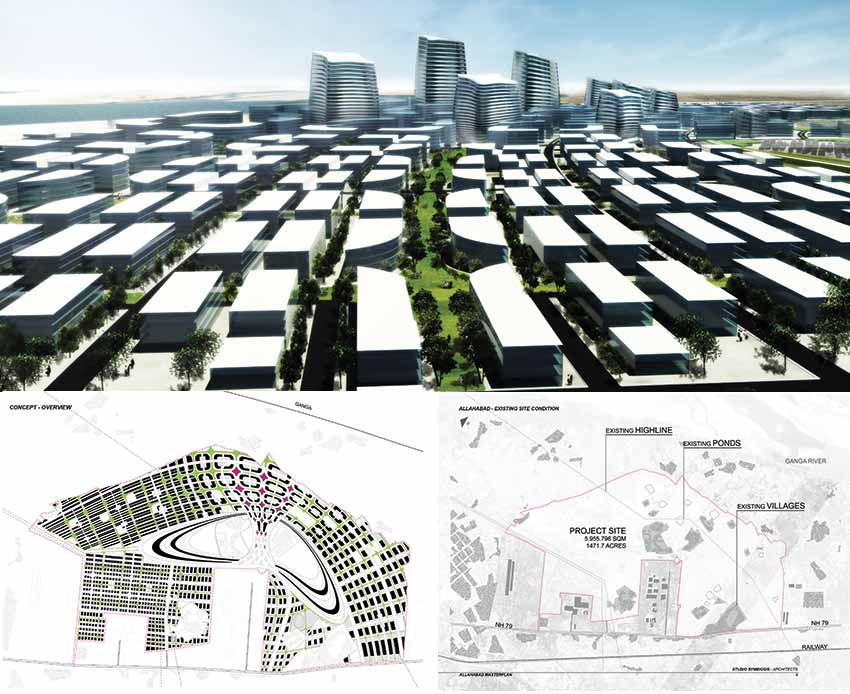
The proposal was to design a new township on the pattern of Sangam -- convergence and unity -- with ample area demarcated for industries and institutions. The Architectural firm proposed a plan for an area of 1,500 acres that includes 32% industrial area, 24% residential, 16% green and over 9% has been earmarked for institutions while the rest for mixed use, transport and public amenities. The township is planned to be developed with world-class infrastructure catering to all needs of industries and residents. There would be zero discharge mechanism for water conservation and waste management. The proposed township would be self-reliant in energy with separate transport networks, easily accessible bus stands and cycle tracks.
Design: Reconceiving Sangam
The master plan by Studio Symbiosis takes into account the single most important feature of the city "Sangam". It is the meeting point of the three holy rivers of India; Ganga, Yamuna and Sarasvati. It's not just a spiritual marker but also a significant geological phenomenon and defines unity and amalgamation.The concept of "Sangam" has been integrated in the master plan as a diagram of connectivity and unity. The universal symbol of unity creates a continuous loop defining three zones. These zones depicting the trinity have been inscribed as a formal as well as a programmatic element of the master plan. It is grafted in the heart of the master plan and acts as a melting point for the city as a commercial and recreational hub.
The site is interrupted due to the existing settlements and ponds that cannot be moved. The design creates a sweeping gesture combining the site into one entity and still accommodating the villages on the site. This results in creating a comprehensive connected scheme.
Amalgamation
The brief requires a mixed use master plan consisting of Industries, Residential, Housing, Institutional, Commercial and Mixed use. The various typologies have been morphed from one to another and correspond to the zoning. This results in an amalgamated master plan design whereby the perception during movement is a gradual change in the form resulting in a sense of unity of the diverse typologies.The built and the green have been designed as one system. Green network and the built environment are integrated into one, which seamlessly flows on the site. This unified system of built and green was important to create a city level and neighborhood green, which creates a sense of living within the nature in the master plan along with a layer of pedestrian network.

The star form of the green transforms from un-built to the built feature of the buildings in the central Sangam area, along with the neighborhood green morphing into urban green plazas. The functional diversity has been unified by a seamless skyline. This undulating skyline merges the various functional requirements of the master plan into a visually coherent system.
The master plan is designed as a Sustainable master plan and a zero discharge city. At the planning stage, the green percentage, porosity of the materials, transportation network and walking distances have been accounted for. In the second stage of the design, implementation elements of Energy, Water and Waste management systems have been embedded in the planning bylaws.
Athletic Ripples: Mixed Use Sports Architecture
| Architects | Studio Symbiosis |
| Partners | Amit Gupta and Britta Knobel Gupta |
| Client | Navodaya Vidyalaya Samiti |
| Site Area | 1,00,000 sqm |
| Built up Area | 31,000 sqm |
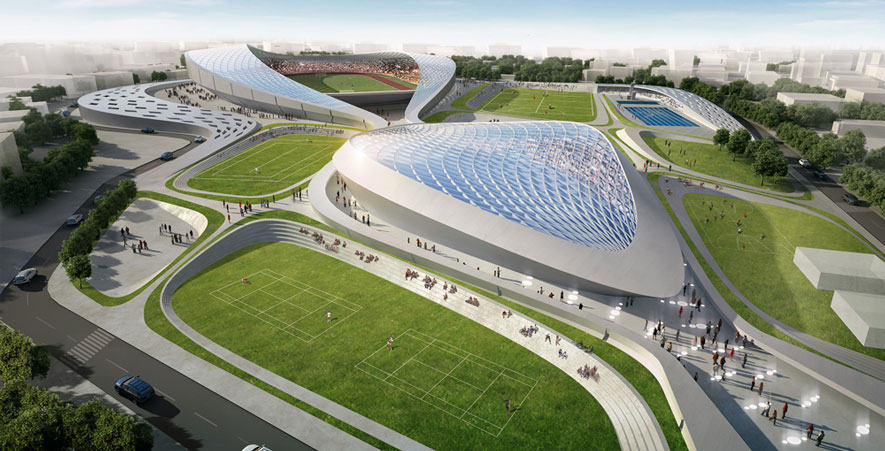
According to Architects Amit Gupta and Britta Knobel Gupta, "Athletic Ripples" is a project based on interfacing the user and his built environment into a coherent whole. The program has been translated into trajectories of movement. These flow lines generated the formal idea which is underlined by interweaving of the various activities. This results in creating a design with an inherent quality of interaction.
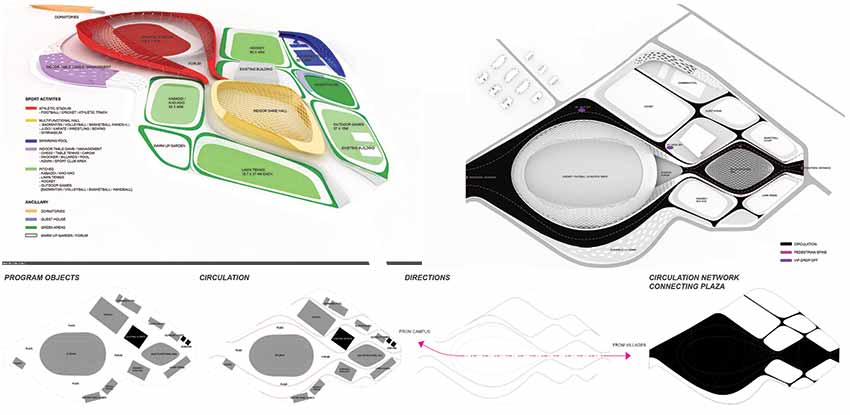
Each section of the project contains a different sporting activity space, individually designed in a range of varying forms and styles, each is loosely moulded on the concept of ripples in water. The firm defines, "Conceptually these programmatic zones were treated as pebbles dropped in water. It is the inference of the water field, thus creating ripples giving a guideline for the formal design language of the project." The 'droplets' vary in size, design and purpose, but Studio Symbiosis unified each section by designing them to symbolize individual pebbles in a pond.
The program asks for a stadium which accommodates cricket pitch, football ground and an athletics running track. Along with this function, a number of indoor outdoor sports activities are located on site as required by the brief.
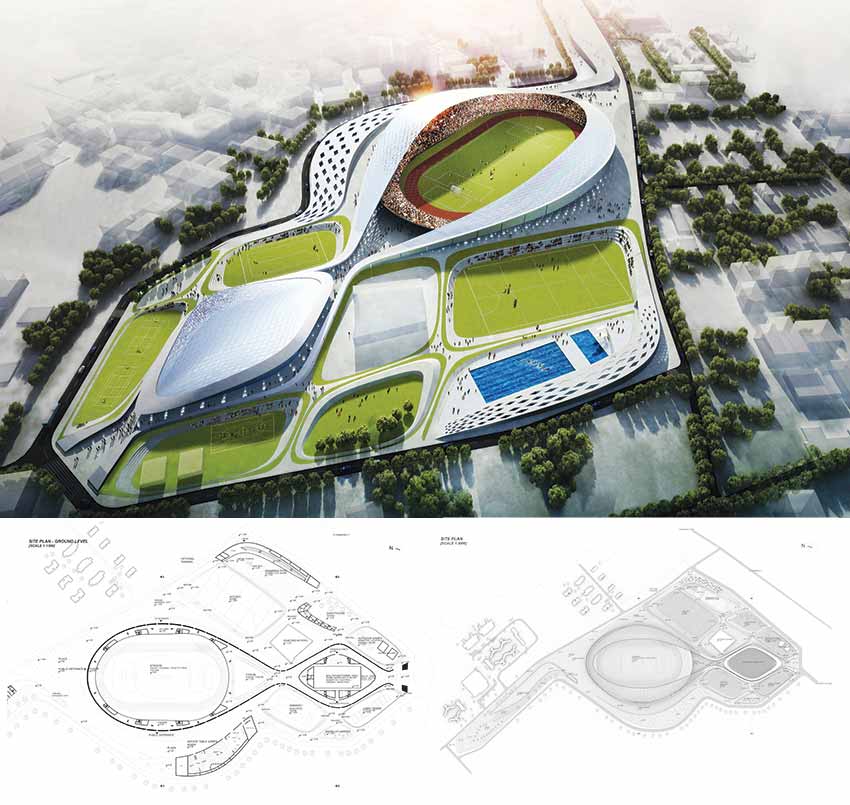
Special emphasis has been laid during design process to minimize the congestion. The central pedestrian zone caters for the primary movement on site. This linear zone has been kept exclusively for the pedestrians, thereby instilling the feeling of being in a green sports complex. It has been attempted to eliminate the dogma of vehicular congestion related to projects like this. This corridor being axial in nature branches into different activities.
A continuous silhouette has been designed for the project. As a design outlook, it has been taken into account that being a sports complex, an atmosphere of being nested in nature is created. The built form does not sit in disjunction with the surroundings, but on the contrary, flows out of the landscape itself.
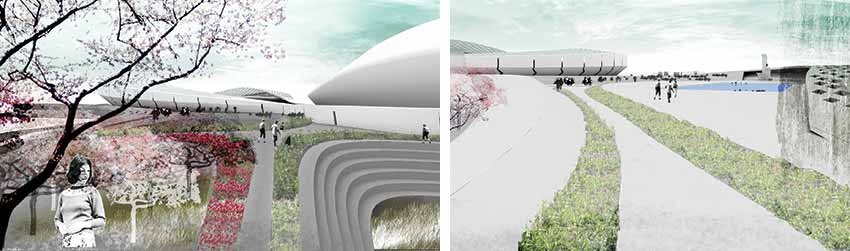
Piezoelectricity is being looked to be applied on the landscape pavers. The system will harvest the kinetic energy generated by crowds in areas of heavy foot traffic.
The sports center also boasts an impressive roster of sustainable and energy-efficient building strategies. Solar cells are proposed for the roof of the stadiums to harness the abundantly available solar energy. These solar cells would be integrated on the roof of the stadium as a design element and only a certain percent of the roof panels will be designed as solar panels. There is a proposed mix of solar panels and pneumatic panels on the roof to maintain the required light intensity inside the stadium.
Water Droplet Resort
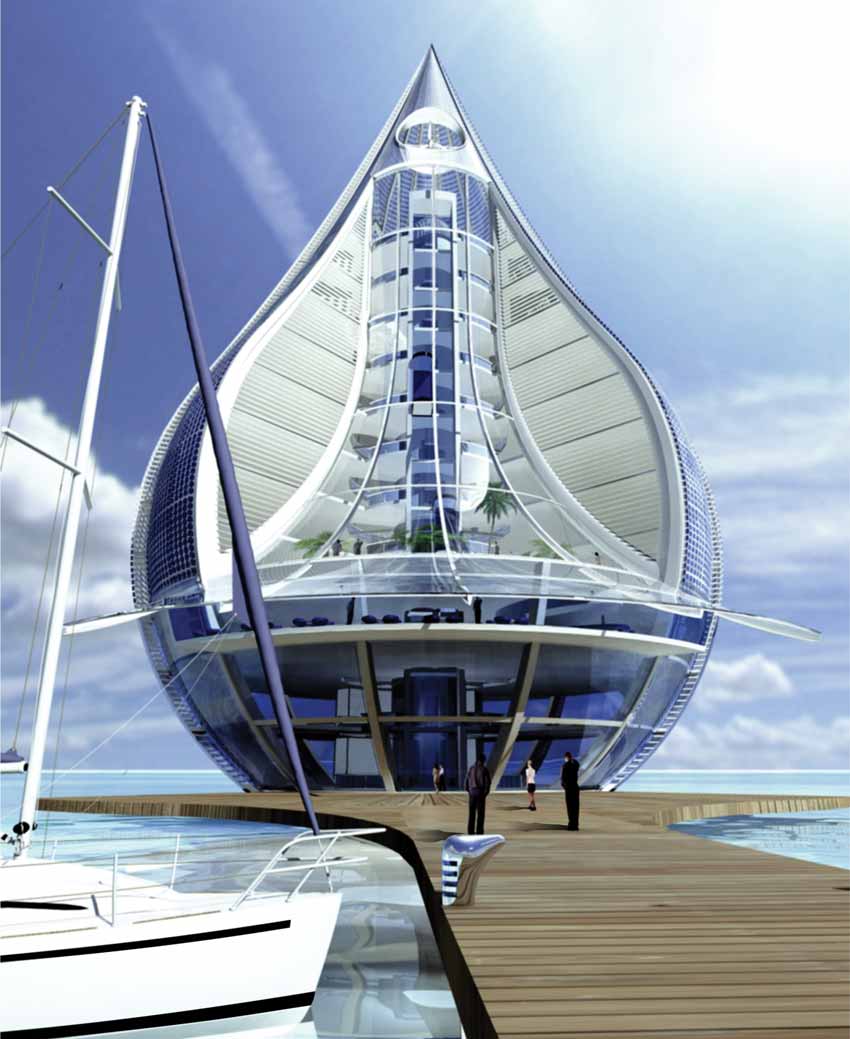
Hi-tech and architecturally designed Water Droplet Resort not only contribute to the knowledge and culture of the coming generations, but also adds to the financial returns of its promoters and investors.
Based on an innovative concept 'Water Droplet resort' is an architectural marvel that has been designed in the shape of water drop by Orlando De Urrutia. It is the first building of its type which converts air into water with the help of solar power. It sounds unbelievable or magic but is true! The concept to design the building is nothing but a combination of technology and nature.
Inspired by the form of a drop of water falling from the heights, the building is projected and thought to create conscience of the water. Designed for construction in warm and humid coasts, the Water Building Resort, will house an aquarium, Restaurant, Gyms, Hotel, Spa services, Convention Halls and Conference rooms. Moreover, the bottom floor of this resort complex will have a water treatment zone for purifying rain water and salty sea water and a technological investigation center to control and verify water quality. The building also incorporates a technology research center (Cidemco) which controlled certification of quality industrial products.
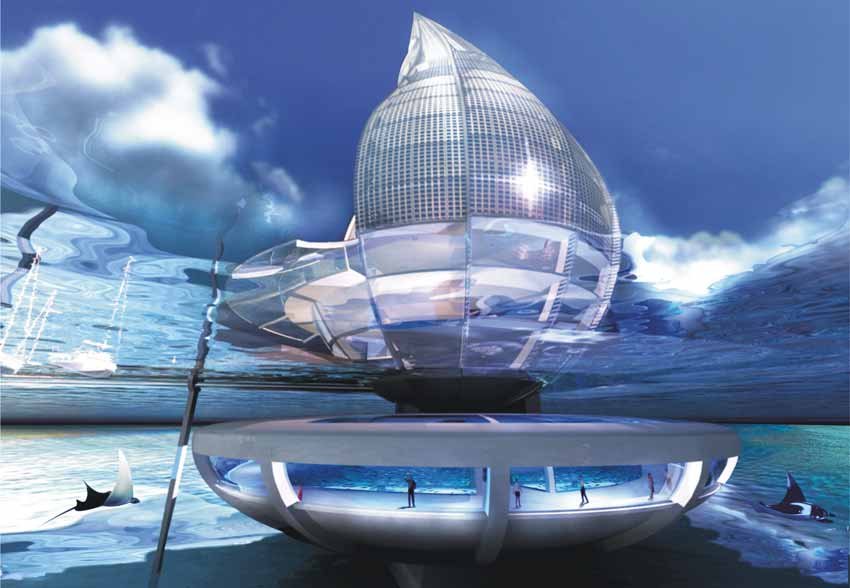
The building design allows the integration of renewable energy uptake and energy optimization. The sun-facing facade is covered with photovoltaic crystals latest technology that allows transparency and energy to capture the electricity of the building.
The facade opposite the sun are shutters that allow air to enter which is conducted through the water producing equipment. The air passing through the central courtyard is speeding up and out the upper wind turbine, generating electricity for all teams abasteceder.
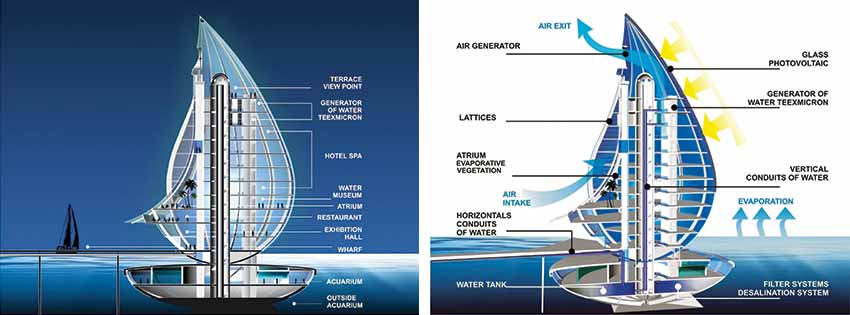
Water Building Resort, will be the first build in the world that transform the air into water, starting to obtain water from the air it seems to science fiction, however it is a reality thanks to new technology and modern TeexMicron incorporated in this building.
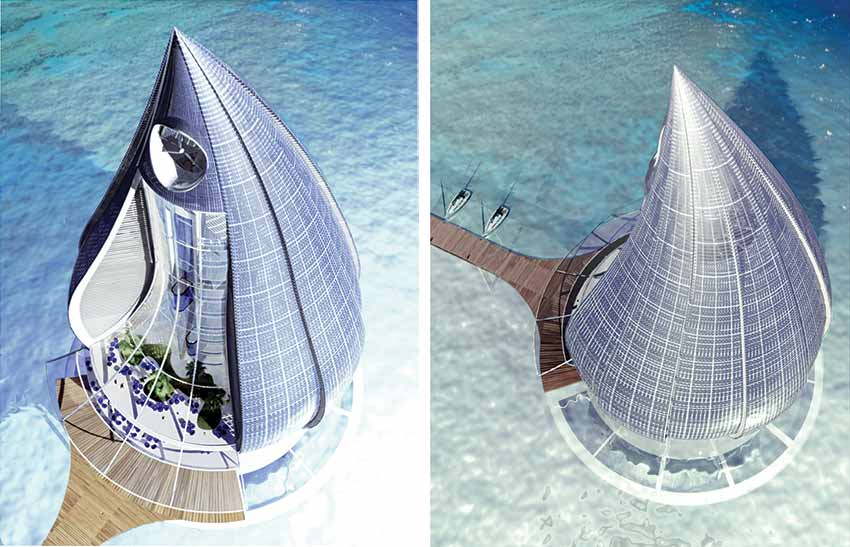
Their production based on the condensation of the humidity that is in the air, its location in the water of the sea, add a big value regarding a bigger condensation. Allowing to take advantage of the night daily evaporation and condensation.
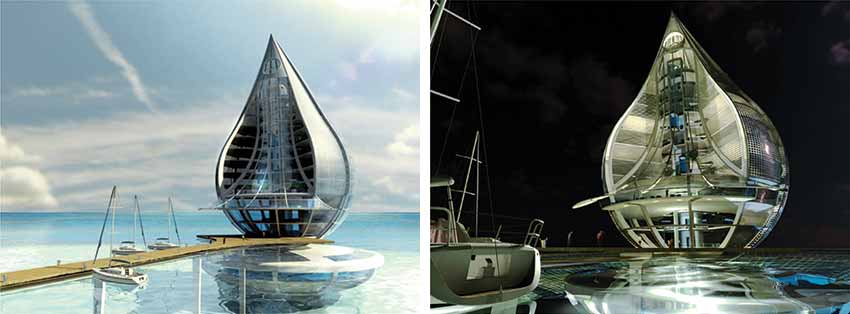
Moreover, Building Water Resort recycles water from rain and purging with marine desalination equipment incorporated in the base of the building. Water generators "TeexMicron" capable of producing 5,000 liters of water per volume of 21.17 m3 team, 48 people, for the calculations we use an average of 105 liters per person.
Dragonfly Future Metabolic Farm for Urban Agriculture
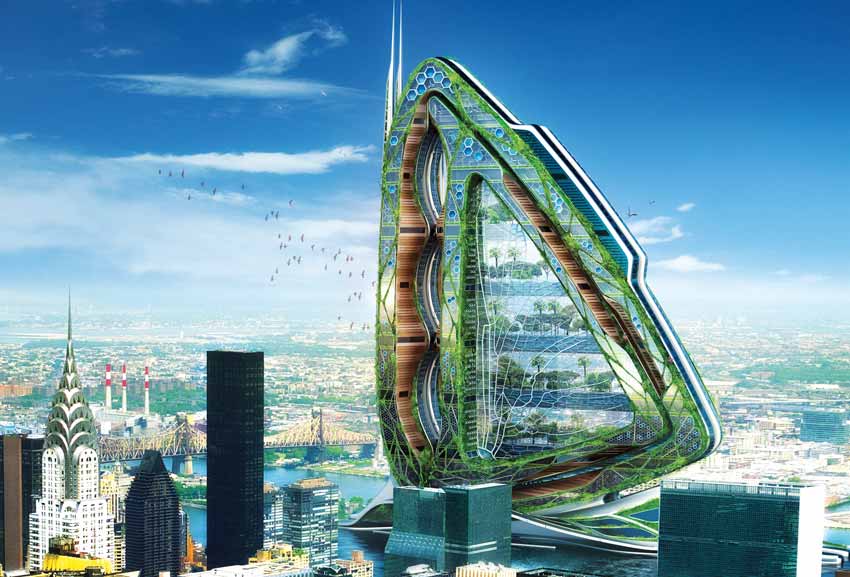
Dragonfly, the 21st century Metabolic Farm for New York City has been designed with the intention of easing the ever-increasing need for ecological and environmental self-sufficiency in the urban cityscape.
Belgian firm Vincent Callebaut Architectures have designed a vertical farm based on the wings of a dragonfly. Proposed for the East River at the south edge of Rooselvelt Island in New York City, the tower is a true living organism being self-sufficient in water, energy and bio–fertilizing. Spanning 132 floors and 600 vertical meters, the dragonfly can accommodate 28 different agricultural fields for the production of fruit, vegetables, grains, meat and dairy.
This Dragonfly wing shaped superstructure features wind and solar power producing capability and includes housing, offices, research labs and communal areas separated from farms, orchards and production rooms. Throughout the glass and steel set of wings, animal and plant farming is arranged as well as soil nutrient levels are maintained properly.
Food Challenge of the 21st Century
According to the PNUD (Programme of the United Nations for the Development), the worldwide urban population will go from 3.1 billion of inhabitants in 2009 up to 5.5 billion of inhabitants within 2025. Looking for a positive energetic assessment, the contemporary city aims within fifteen years at producing cleanly and intensively more energy than it consumes so as to pack this urban exodus! It develops therefore the urban agriculture to become food self-sufficient by recycling at the same time its liquid waste by phyto-purification, its solid waste in fertilizers by composting and by producing energy by biomass, photovoltaic cells and other renewable energies (thermo solar, photovoltaic solar, wind, tide-turbine energies…).
In order to avoid the asphyxiation of the planet and the feeding of its 9 billion of inhabitants within 2050, it deals thus with reinventing the traditional energetic pattern between the city and the countryside between western countries, emerging countries and developing countries. This sum up as following: on the one hand import of natural and food resources, and on the other hand export of waste and pollution. The ecologic city aims at reintegrating the farming function on the urban scale by emphasizing the role of the urban agriculture in the use and the reuse of natural resources and biodegradable waste so as to close the loop of ecologic flows.
The urban agriculture can feed the city without any pesticide or chemical fungicide (whose toxicity is proved on the human being: cancer, sterility…), and make it less food dependant of its backcountry or other regions of the world. Organizing the distribution of fresh products in short circuits, that means linked directly with the consumer, the urban agriculture complete thus the traditional agriculture. In addition to the nutritive quality of the produced and consumed food, the urban agriculture is also a growth lever of the urban unemployment market and the local economy. It is used directly as a social link in the conciliation of the primary needs of the newcomers with the challenge of their integration in the life of the city, fighting thus against poverty and exclusion. On the sanitary level, this farm approach presents also an interesting potential for the decontamination of polluted grounds and undergrounds as well as for the purification of the polluted atmosphere.
Dragonfly, a Nourishing Vertically Cultivated Central Park
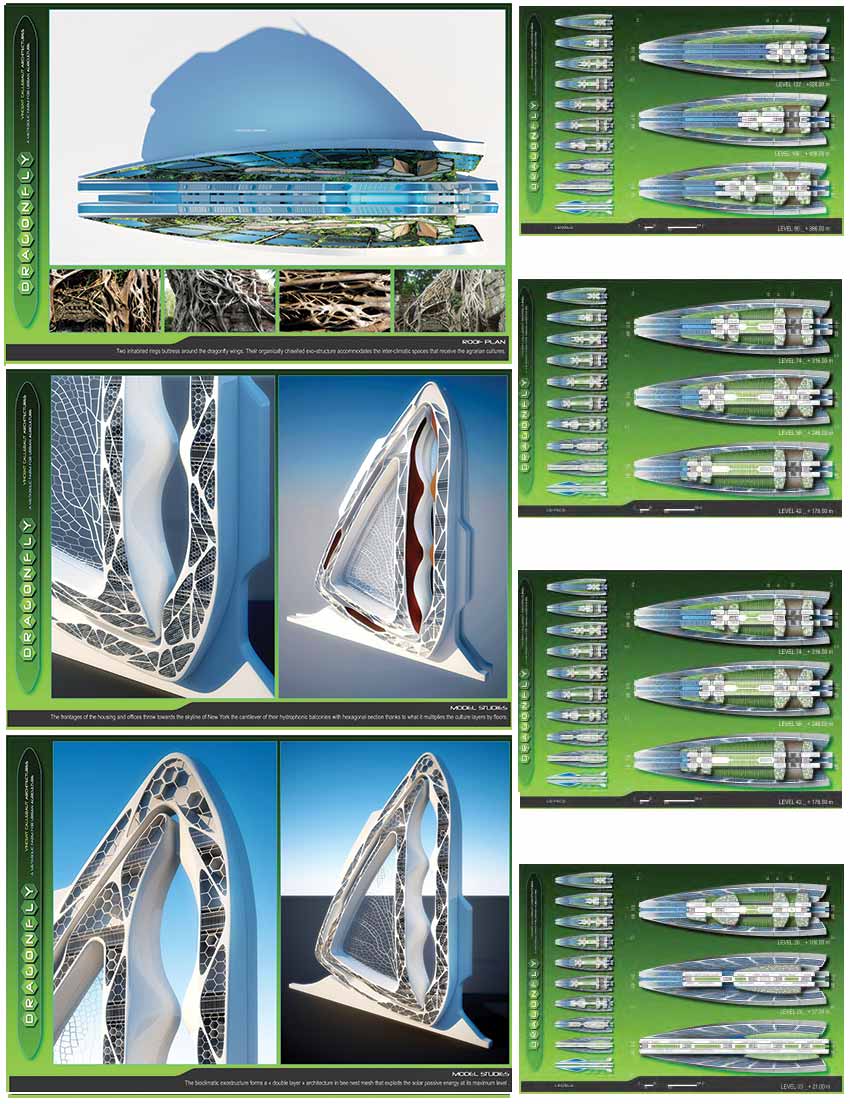
The architecture has to be in the service of this new agriculture and to design this new social desire in this context of ecologic mutation and food autonomy! The Dragonfly project suggests therefore building a prototype of urban farm offering around a mixed programme of housing, offices and laboratories in ecological engineering, farming spaces which are vertically laid out in several floors and partly cultivated by its own inhabitants. This vertical farm sets up all the sustainable applications in organic agriculture based on the intensive production varied according to the rhythm of the seasons. This nourishing agriculture is furthermore in favor of the reuse of biodegradable waste and the keeping of energy and renewable resources for a planning of ecosystemic densification.
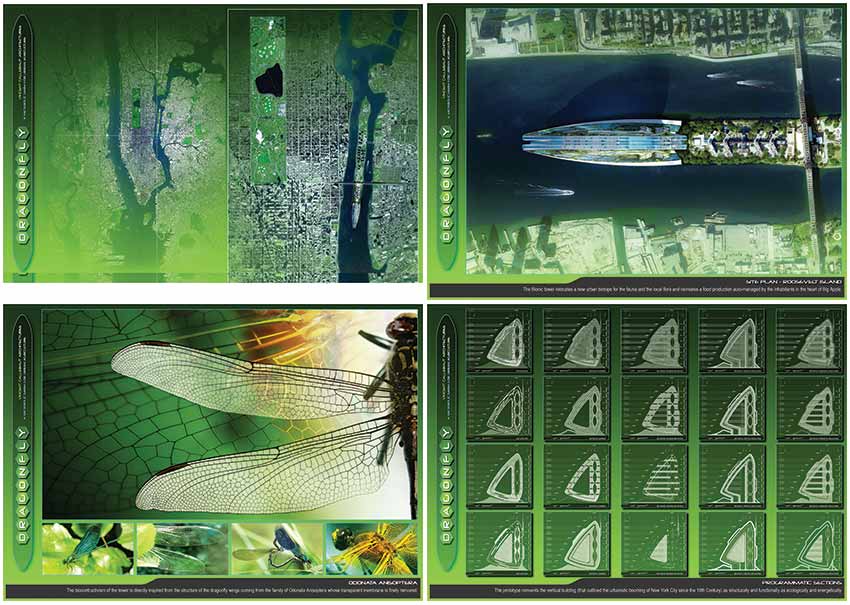
In order to conceptualize this project and give our point of view in the ecological and social crisis debates, Dragonfly sets up along the East River at the South edge of the Rooselvelt Island in New York between Manhattan’s Island and the Queens’ district. So as to face the land pressure, Dragonfly stretches itself vertically under the shape of a bionic tower relocating a new urban biotope for the fauna and the local flora and recreating a food production auto-managed by the inhabitants in the heart of the Big Apple.
Floor by floor, the tower proposes not only stock farming, ensuring the production of meat, milk, poultry and eggs but also farming grounds, true biological reactors continuously regenerated with organic humus. It diversifies the cultivated varieties to avoid the washing of stratums of soft substratum. Thus, the cultures succeed one another vertically according to their agronomical ability to provide some elements of the ground between the essences that are sowed and harvested.
The tower, true living organism, becomes thus metabolic and self-sufficient in water, energy, and bio-fertilizing. Nothing is lost; everything is recyclable to a continuous auto-feeding!
A Bionic and Energetically Self-sufficient Architecture
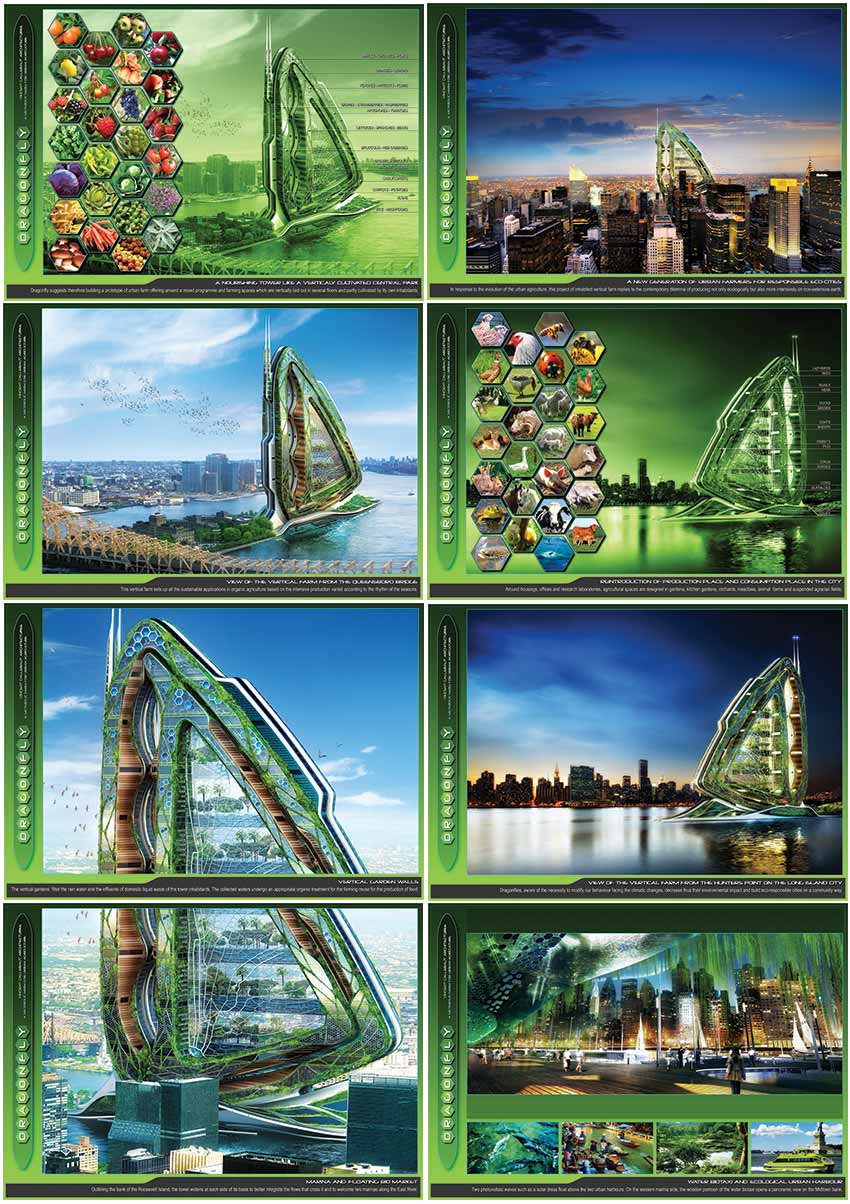
The architecture of Dragonfly prototype suggests reinventing the vertical building (that outlined the urbanistic booming of New York City since the 19th Century) as structurally and functionally as ecologically and energetically.
To ensure the social diversity and a permanent life cycle (24h/24) in the tower, the mixed plan is mainly laid out around two poles of housing and work places. Around housings, offices and research laboratories as well as the most private to the most public agricultural and leisure spaces are designed in gardens, kitchen gardens, orchards, meadows, rice fields, farms and suspended fields. The distribution of flows is made around a true safe spine spreading in loop the numerous elevators, the goods elevators and stair wells serving all the levels by separating simultaneously the inputs and the outputs recycled from plants, animals and human beings.
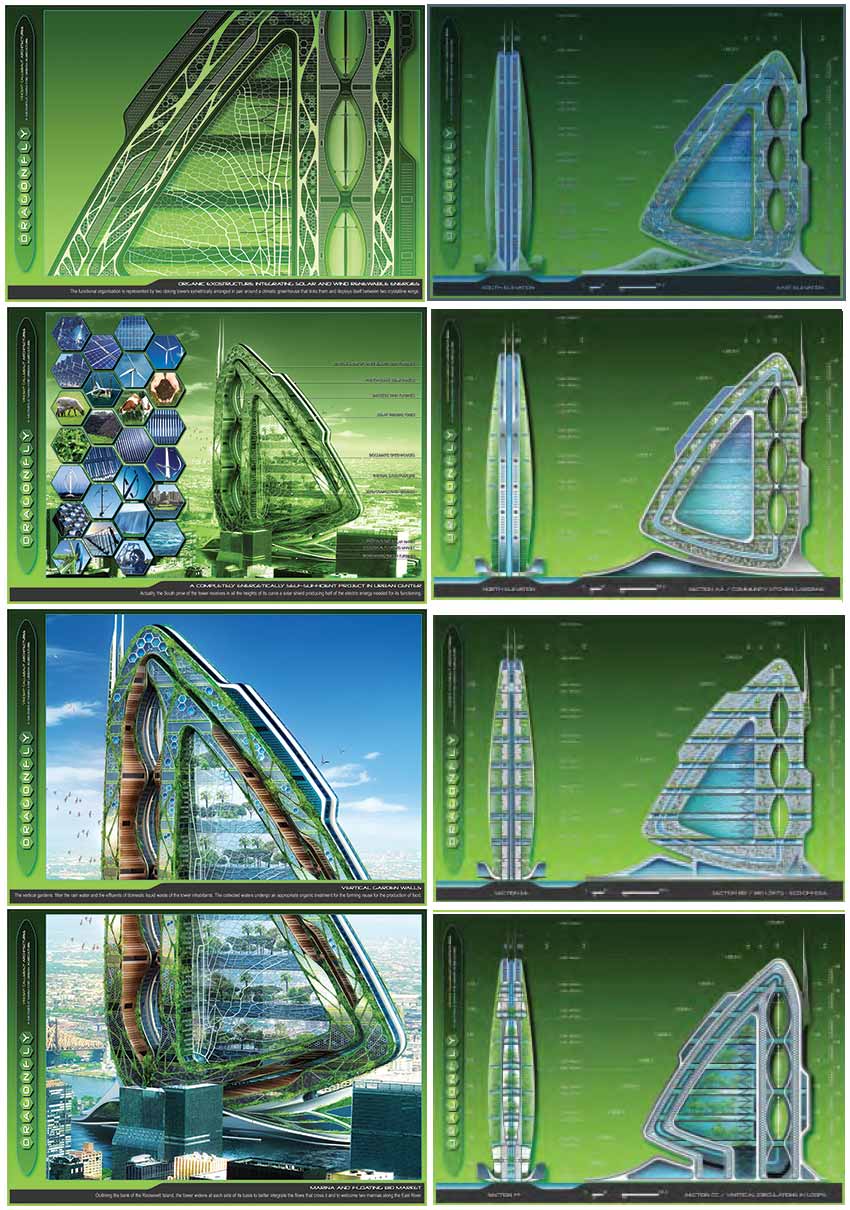
Architecturally, the functional organization is represented by two 600 m towers symmetrically arranged in pair around a huge climatic greenhouse that links them and deploys itself between two crystalline wings. These very light wings in glass and steel retake the loads of the building and are directly inspired from the structure of the dragonfly wingscoming from the family of "Odonata Anisoptera" whose transparent membrane is very finely nervured. Two inhabited rings buttress around these wings. Their organically chiseled exo-structure accommodates the inter-climatic spaces that receive the agrarian cultures.
The whole set forms double layer architecture in bee nest mesh that exploits the solar passive energy at its maximum level, by accumulating the warm air in the winter in the thickness of the exo-structure, and by cooling the atmosphere by natural ventilation and by evapo-perspiration of the plants in the summer. Protecting thus the cultures from climatic changes inNew York (from -25.5°C in the winter to +41°C in the summer), these plug spaces are useful to reflect on the agriculture not anymore in terms of surface area but really in terms of volume. Actually, whereas grounds nourish orchards, each wall and each ceiling are metamorphosed into three-dimensional kitchen gardens. The interior frontages of the housing and offices throw towards the skyline of New York the cantilever of their hydrophonic balconies with hexagonal section thanks to what it multiplies the culture layers by floors. The vegetation abounds, the earth is swarming of insects and animals are freely brought up in holding tanks by urban consumers with low income. The architecture becomes eatable!
In addition to this thermal called passive system, the integration of renewable energies has been thought from the design of Dragonfly to meet the needs of a completely energetically self-sufficient project in urban centre. Actually, the South prow of the tower receives in all the heights of its curve a solar shield producing half of the electric energy needed for its functioning. The other half is ensured by the three wind machines with vertical axes of Darrieus type that coils itself up in the three lenses hollowed in the North part of the micro-pearled shell towards dominated wind of New York. The exterior façades of the tower present a double personality. Actually, in the West of the Island near Manhattan, the façades are treated in planted walls, whereas in the East near the Queens’ district, the wet exterior walls are cultivated with tropical essences. These vertical gardens enable to filter the rain water and the effluents of domestic liquid waste of the tower inhabitants. The collected waters undergo an appropriate organic treatment for the farming reuse, bringing all the nitrogen and an important part of phosphor as well as potassium needed for the production of fruits, vegetables and cereals.
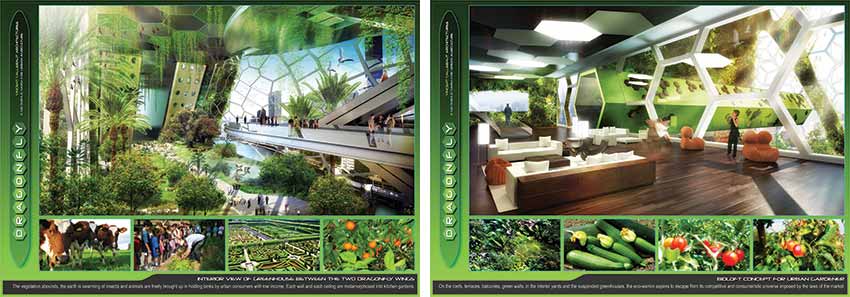
Outlining the bank of the Roosevelt Island, the tower widens at each side of its basis to better integrate the flows that cross it and to welcome two marinas along the East River. This widening out forms two huge photovoltaic vaults such as a solar dress floating above these two urban harbors: on the western marina side, the wooden pontoons of the taxi boats open panoramically on the Midtown bank and on the eastern marina side, the floating market oriented towards the Queens’ district is designed to distribute through the river the food production of this vertical farm to the heart of Manhattan and to its million and a half of city slickers. Moreover, these two marinas accommodate two huge aquaculture ponds, true tank of soft water filtered by the planted frontages and dedicated to be reinjected in the hydroponics network of the Dragonfly tower.
According to the evolution of the urban agriculture enhanced by the FAO (Food and Agriculture Organization of the United Nations) that has been realizing since 2007 that the organic agriculture on a large scale would be able to nourish the planet, the Dragonfly project challenges the city of New York to rethink its food production. In response, this project of inhabited vertical farm replies to the contemporary dilemma of producing not only ecologically but also more intensively on non-extensive earth. This by merging also directly production place and consumption place in the heart of the city!
| Project Details | |
| Project | : A Metabolic Farm for Urban Agriculture |
| Location | : Roosevelt Island, New York City, USA |
| Surface Area | : 350.000 m² |
| Heights | : Antenna=700m; Roof=600m; Top Floor=575m |
| Floors | : 132 |
| Agricultural Fields | : 28 |
| Model Studies | : Philippe Steels |
| Perspectives | : Benoit Patterlini |
| Architect | : Vincent Callebaut Architectures |
Valmy Footbridge An Architectural Marvel
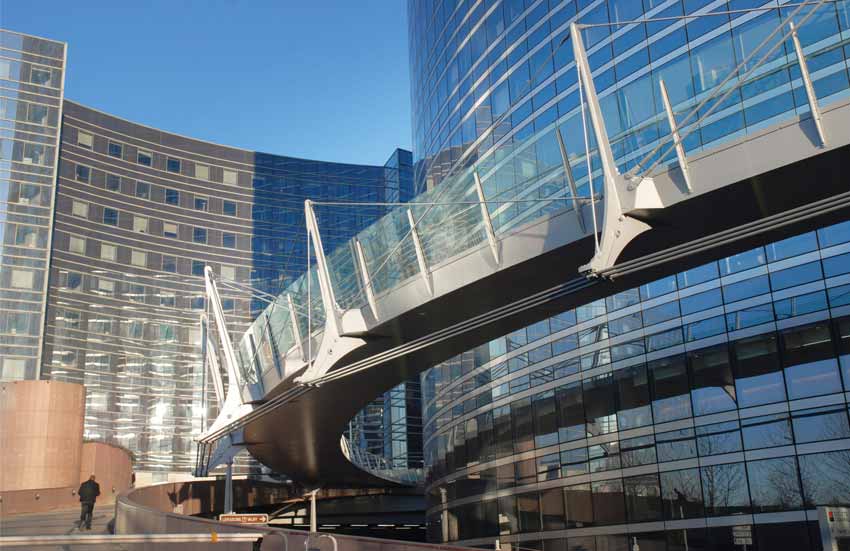
Linking the west part of the Parisian financial district La Defense with the city of Nanterre via the recently erected highrise building "Tour Granite", this 90m long footbridge winding through a dense architectural tissue is a modern urban promenade based on an ambitious structural concept.
The client – EPA Seine Arche – is an institution in charge of developing the public space between La Défense and Nanterre. During an architectural competition in Paris, the project of the architect Dietmar Feichtinger has been chosen. Dietmar Feichtinger is also an architect of the Simone de Beauvoir footbridge in Paris and the 3 countries bridge in Huningue. For the Valmy footbridge he was assisted by the engineers Schlaich, Bergermann und Partner (Stuttgart).
A suspended architecture between the buildings of La Défense
Starting off behind the Grande Arche as a ramp continuing the general level, the generous circumscription of the office building of the Société Générale Bank - visible in plan - asked for a specific solution. The architectural ambition for lightness and transparency is obtained by a balance of forces. The structural functions – tension and compression are clearly expressed. The dimension of each element is minimized. The organic and soft shape of the structure – close to the pedestrians – is in opposition to the monumental scale and the "cold" abstract expression of the highrise buildings.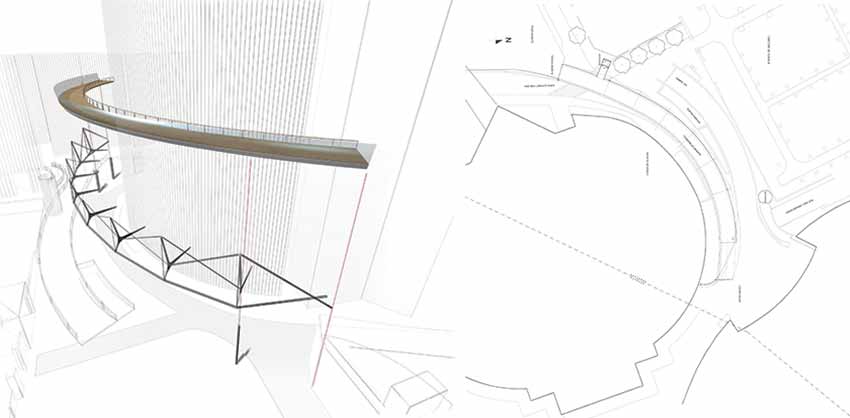
The bridge keeps a large distance with the building and the supporting structure has been transferred to the exterior curve. This allows obtaining a maximum of natural light for the offices and the cafeteria. The bridge attains the "Tour Granite" on the first floor. Escalators and stairs link up with the ground level in the city of Nanterre.
The rhythm of the structural elements assures the identity of the bridge. The main structural elements are the girders accentuating the bridge every 10 m as the "spinal column" of the bridge. The deck consists of a steel sheet box girder. The radiating "spine elements" are interconnected by pre-stressed cables. A system of cantilevers takes on the vertical forces. Resistance against torsion is assured by the deck and retaining cables below pre-stressed in the circumferential direction. The walking surface of the deck is covered with a uniform dark grey epoxy resin. The continuous surface opposes the stone pattern of the existing platforms and reinforces the impression of the bridge as a link.
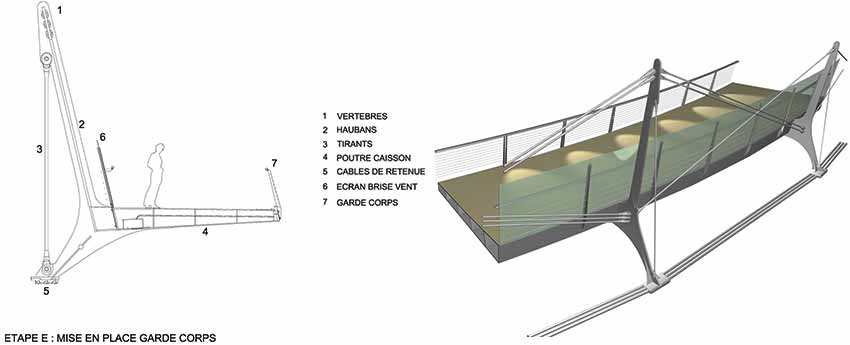
The railings are composed of pre stressed horizontal steel cables and a tube of stainless steel as handrail. The posts are made of 2 parallel steel plates including fixation for the light. Functional light is assured by fluorescent tubes vertically installed with each post and covered by a perforated stainless steel protection sheet. Glass screens as wind shields are fixed at the exterior curve so that the pedestrian may contemplate the cityscape. At night the illumination of the masts emphasizes the rhythmic structure of the promenade.
Structural Design
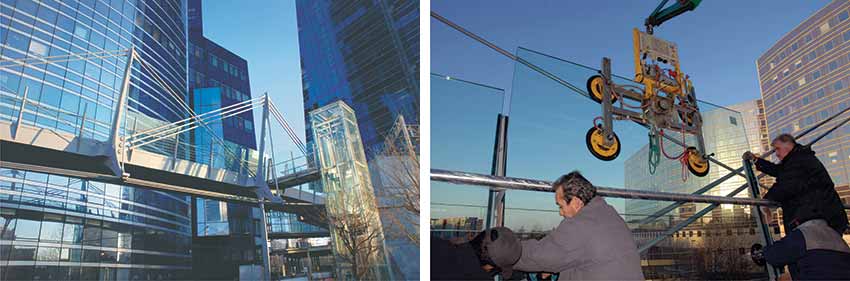
One can compare the structure of the Granite-footbridge with a spinal column: each element participates actively to assure stability creating a balance of tension and compression forces achieving maximum lightness: the spinal elements ("masts"), cables and the bridge deck.
The deck is formed by a steel beam, an element forming a trapeze in section - 4,5m large, 600mm high on the exterior and 300mm high on the interior edge. The beam is composed by welded steel plates, S355, reinforced with transversal stiffeners.
The spinal elements are made of steel plates, S460. They are oriented towards the center of the curved geometry of the deck. The main plates are stiffened by perpendicular plates welded to the main plate forming a cross section responding to compression forces.
The diagonal suspension cables link the spinal elements to the deck. All three elements compose the "spinal column" of the bridge. The retaining cables are anchored to the deck at the two ends. 3 monotoron cables of a diameter of 65mm are fixed to the spinal elements under the bridge deck. Prestress is induced during the mounting process.
Supporting Elements
The bridge is supported on each end by a combination of 2 anchoring elements fixing the beam: On one side the bridge is supported by a pile and anchored in the concrete slab of the existing platform, on the other side it is supported by 2 piles.The suspension structure – spinal elements and suspension cables – supports the vertical forces. It is positioned asymmetrically to the deck beam. Forces are being transmitted from the centre to the anchorage on the 2 ends. The closer one gets to the supports the stronger are the forces in the cables. This is why the number and the diameter of the cables as well as the height and the cross section of the spinal elements increase towards the supports.
Torsion is created by the curved geometry in plan and the asymmetrical layout of the supporting structure. Retaining cables are being installed under the bridge deck linking the spinal elements to balance torsion inducing a horizontal force. The curved layout and the inclination of the upper part of the spinal element demand transversal stabilisation. A vertical cable linking the two ends of each spinal element responds to this effort.
The bridge deck is as light as possible and responds to flexion and torsion. A lift gives additional access to the bridge linking the street level to the deck.
| Project Details | |
| Project | : Footbridge Valmy |
| Location | : France |
| Client | : EPA Seine Arche |
| Architect | : Dietar Feichtinger Architectes (DFA) |
| Team | : Christian Wittmeir, Guy Deshayes |
| Engineers | : SBP, Stuttgart |
| Aerodynamic studies | : PSP Aachen |
| Contractors | : Steel construction : VIRY SA |
| Fondations GTM | |
| Pre-stressing Electricity : Meurant | |
| Size and main features | : Length |
| Total length 90m | |
| Length without ramp Valmy 78m | |
| Clear Span 48m | |
| Width 4,5 m | |
| Weight | |
| Steel Construction 300t | |
| Reinforced Concrete 35m3 | |
| Excavation on Site 26m3 | |
| Tension Elements | |
| Tension rods 302m | |
| Section of Tension Rods 36~90mm | |
| Ring Cable / Cables 3x 75 m | |
| Strength of ropes 65 mm | |
| Height above street level 6 - 8 m | |
| Wind Screen (curved glass) 141m2 | |
| Time Schedule | |
| Competition | : 12/2003 |
| Start of Planning | : 2004 |
| Start of Construction | : 2006 |
| Completion | : July 2008 |
| Building Costs | : 2.8 Million € |
| Photo Credit | : Antonin Chaix |
Bridge Mounting
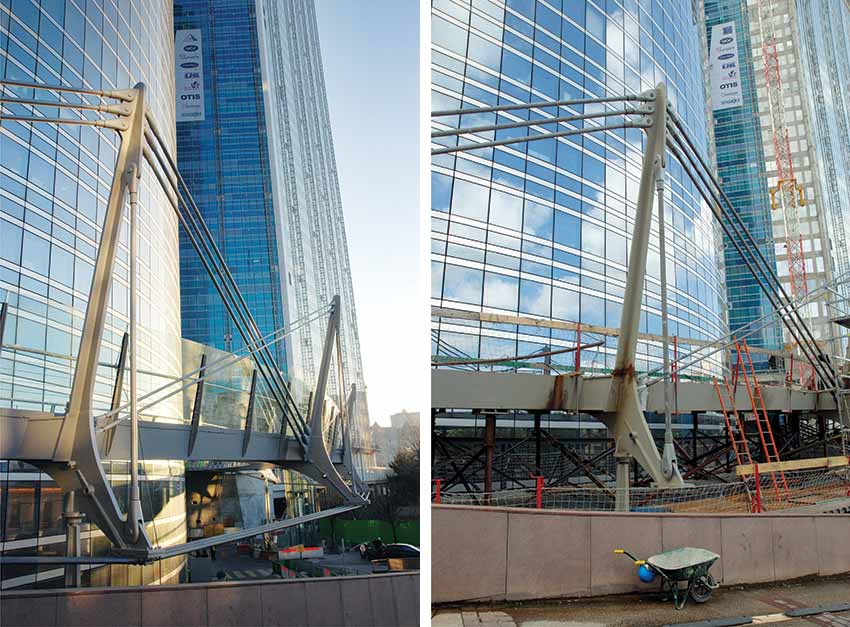
The bridge deck is composed by 26 prefabricated elements delivered on site by special transport. The elements are installed during the night on a temporary support, keeping the street on ground level accessible all time. The deck elements are positioned taking into account a counter curvature and welded one to the other obtaining a 90m long continuous deck.
The deck is positioned on temporary supports allowing readjustment of the geometry necessary due to deformation during the welding process.
Tension elements – suspension cables and retaining cables – are fixed on the spinal elements with connectors inducing tension and prestress. The retaining cables are tensioned by pulling the preinstalled cables towards the exterior curve. Special adaptors are fabricated to allow a step-by-step process. Jacks pull the cables into their final position. After positioning the retaining cables, the temporary support can by dismounted. The bridge takes its final structural state.
Trinity World School, Mumbai
| Project | : Trinity World School |
| Location | : Navi Mumbai |
| Site area | : 3930 sqm (excluding the playground) |
| Built-up area | : 9230 sqm |
| Clients | : NMMC |
| Architects | : THE FIRM |
| Principal Architects | : Sundeep Gwash, Vishal Shah |
| Project Team | : Kedar Dalvi, Trushali Gandre, Chaitali Amin |
| Sustainability | : Deepika Batra Gwash |
| Category | : Educational |
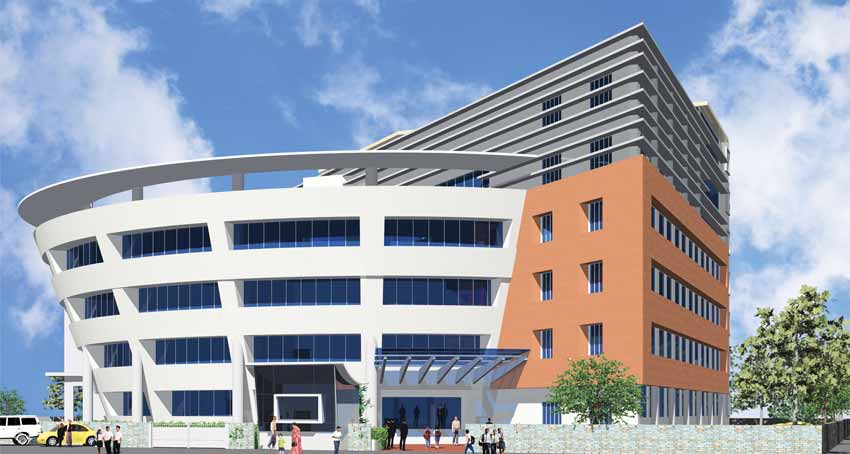
Located in Navi Mumbai this educational facility, Trinity World School is designed by THE FIRM for the client NMMC (Navi Mumbai Municipal Corporation). According to the client's brief, the facility had to be exemplary in terms of not only its facilities but also its level of design.
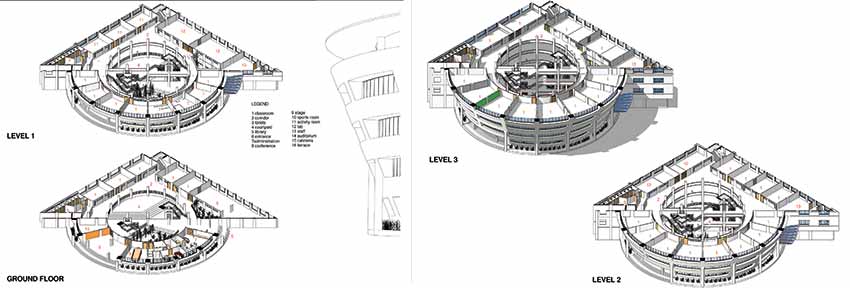
This facility is designed to provide learning spaces for children from kindergarten to high school, as well as the junior college of arts, science and commerce, and the state - of - the - art auditorium, besides many other activity zones.
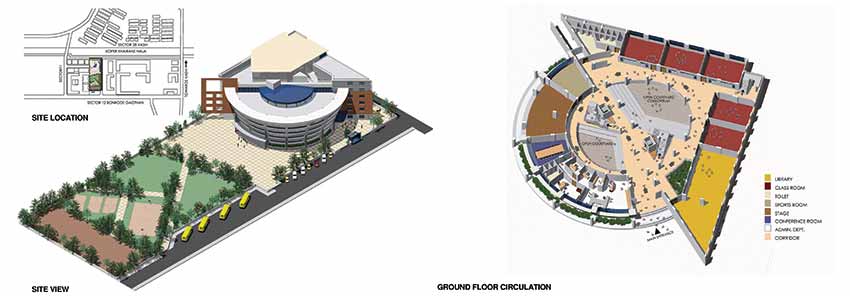
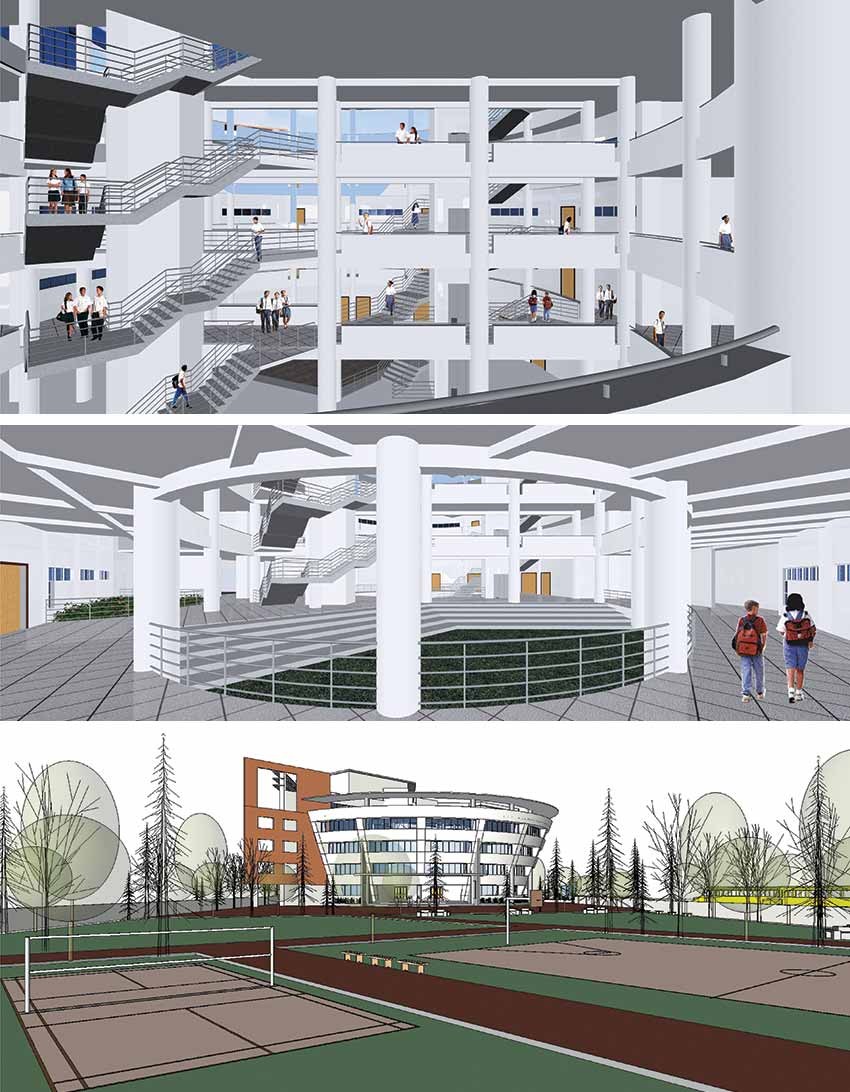
The courtyard - centric design of the educational architecture focused on creating the ideal environment for learning by lieu of spatial relationships, indoor - outdoor relationships, natural ventilation and daylight and hub - of - activity areas.
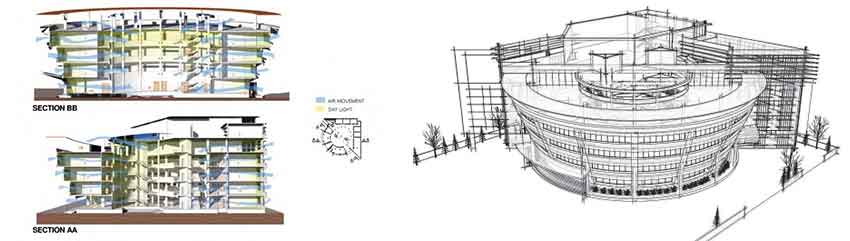
The building shape is derived to get maximum diffused light into the classrooms, and the resultant smaller footprint also lends more green area on the ground. The atrium brings in natural light to the courtyard and the scene witnesses various changes with the changing sun path during the day. The numerous solar studies at various important sections and courtyards views were being synthesized to improvise the design. The semi - open spaces on each level are intended to capture cross - ventilation, hence increasing the comfort level of the occupants. The micro - climate of the courtyard contributes to the visual appeal, and helps in creating better micro - environment at the same time.
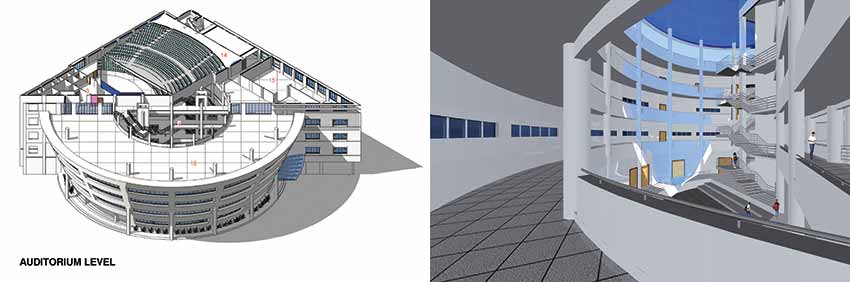
The school auditorium is designed to be available for use by the larger community; hence the need for additional facilities goes down; saving costs community - wide and decreasing the environmental impact of the community as a whole.
Signature Tower Mumbai
| Project | : Shah Signature |
| Location | : Navi Mumbai |
| Site | : 1800 sqm |
| Footprint | : 825 sqm |
| Built–up | : 13,000 sqm |
| Clients | : Shah Group Projects & Infraprojects Ltd |
| Architects | : THE FIRM |
| Principal Architects | : Sundeep Gwash, Vishal Shah |
| Project Team | : Kedar Dalvi, Trushali Gandre, Chaitali Amin |
| Sustainability | : Deepika Batra Gwash |
| Category | : Commercial |
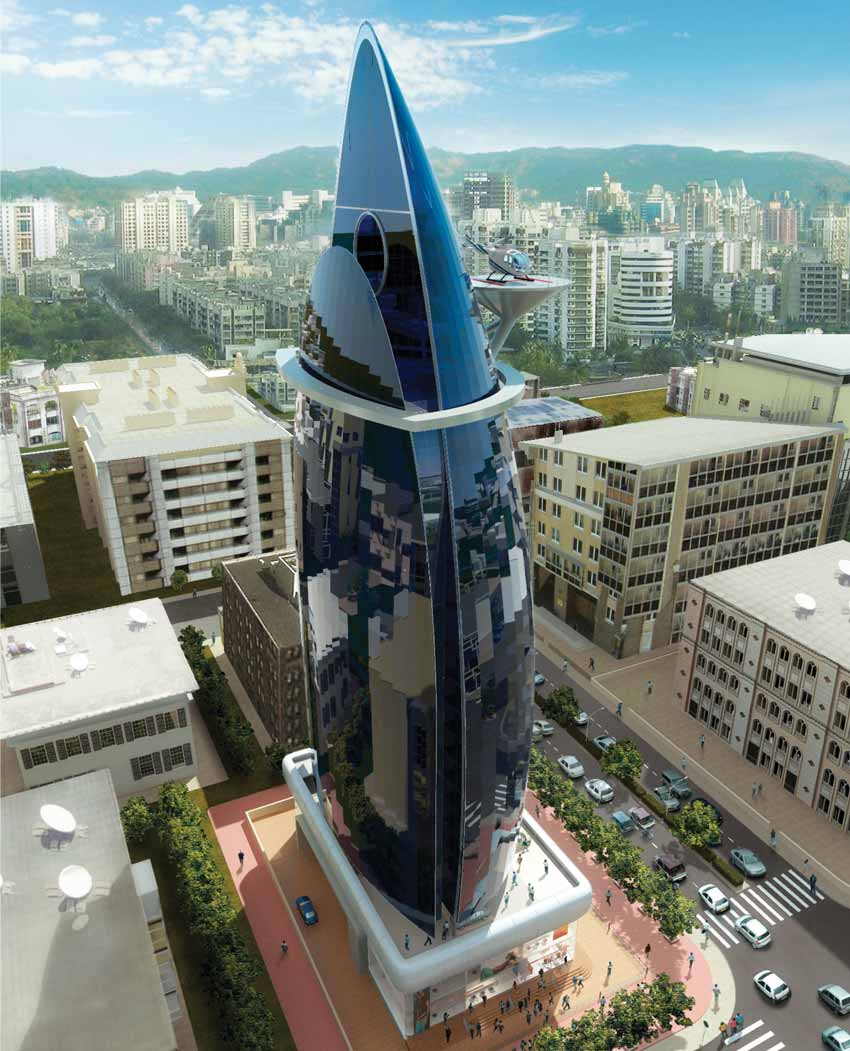
Designed by THE FIRM, the project 'Shah Signature' has been an interesting project in terms of its clients' ambitious design brief and the manifestation of the same into a very iconic architecture in the making.
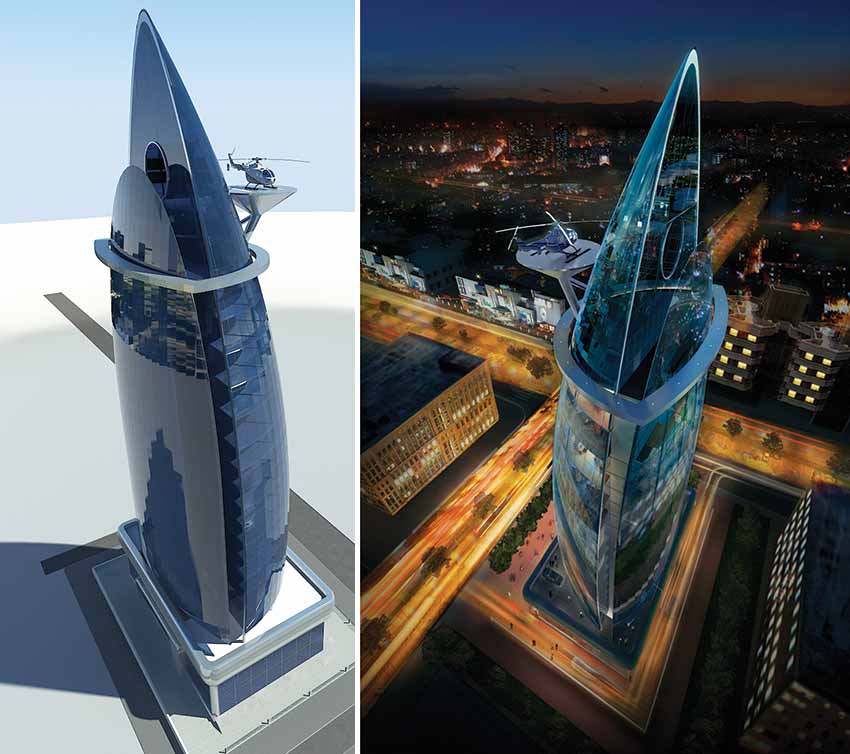
The iconic sail form of the building signifies the local context in past and its futuristic bend in present context for the project site located in the twenty - first century city of Navi Mumbai. The form centric design was conceptualized for the project and it appealed instantaneously to the clients.
Various options were considered in pre - design stage and the design was finalized on the basis of concept and better energy performance vis-à-vis orientation and form.
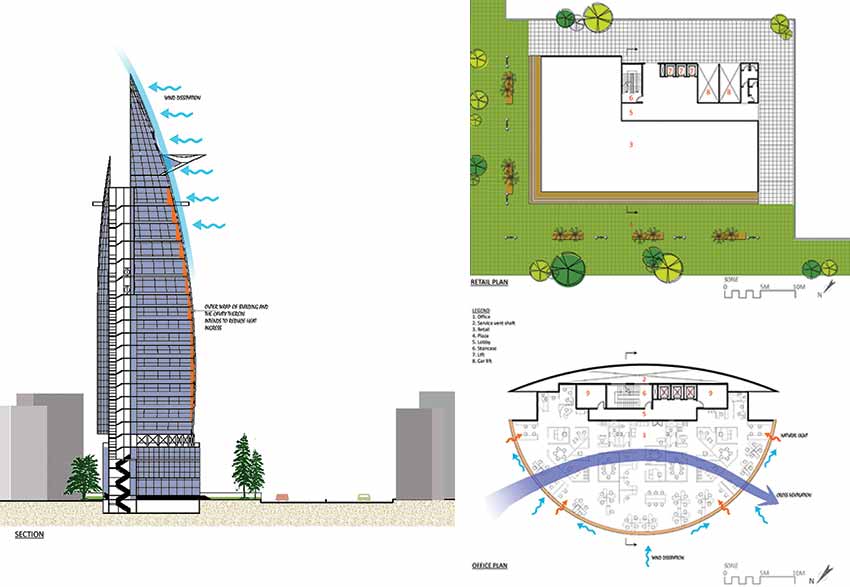
A mixed - use highrise commercial building, the 'Signature Tower' comprises offices on the upper floors and the retail shopping activity in the lowers floors and basement. Being situated on a corner plot, the open space on the ground is being well - utilized to act like an open deck for public spill - over from the retail mall - a pleasant change for the crowded vicinity. The ancillary program includes multi - level parking with car lifts and fine - dine restaurants and a gym.
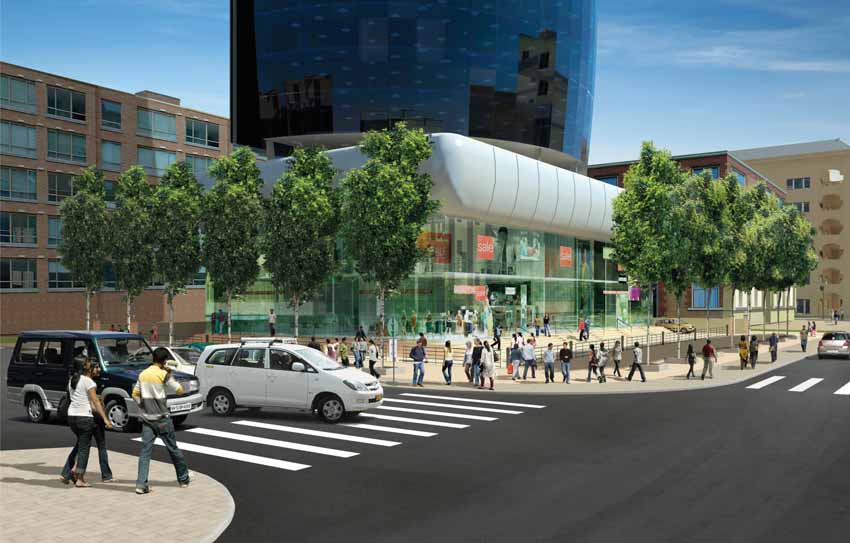
The salient features of the design include column - free spaces for offices, the high performance facade offering views and natural light deep into the office floors; and the exclusive roof - top office with the helipad.
The special façade structure is determined to be designed on a grid concept, lending it the two way curve form. The wrap form is also intended to act as an outer layer of building envelope, reducing heat ingress but not daylight; thus minimizing the load on air - conditioning. The form compared with the regular box building is imposing but not unwieldy; and is more appropriate to handle winds at higher levels. The visualization of the curve building façade which was reducing in plan on going higher was done at various stages, till the time the satisfactory outcome was not achieved. The team is currently trying if the unique façade grid could be made parametric so as to accommodate change if the higher FSI is approved by the development control authorities. The structural consultant and MEP consultants are sharing the information from the BIM model in the form of 3d files, to bring out the integrated design in services and structures. The MEP services of the building are defined to be designed to go minimal on energy and water consumptions.
Narrayan's Jayamurghan Project
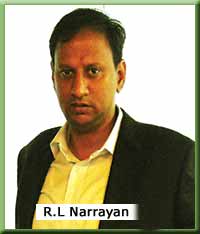
Architect Narrayan and Associates, a renowned architectural firm in Mumbai was started in 2000 by Architect R.L Narrayan with only two staff, has now grown into 70 professional staff within a span of 8 years only. Born in 1972 and completed his graduation diploma in architecture from Institute of Environmental Design, VVN, Mr. Narrayan commenced his career in 1997 with the firm Doshi and Bhalla.
Mr. Narrayan has won many prestigious awards such as 'Bhartiya Shiromanj Puraskar' in 2006 as an excellence for enhancing the image of India by Institute of Economic studies & development, New Delhi.
Also awarded as 'Architect for excellence (Business) award 2006' for his outstanding services to the society and excellence in the architectural field for Individual Achievement & nation building. In 2008, Mr. Narrayan has been honored by the award ''Bunts Sangha Mumbai' by honorable minister of agriculture.
The firm Architect Narrayan and Associates conceptualized, designed, and execute, projects ranging from corporate office, commercial, residential, malls, hotel & resorts, Institutional, hospitals and various other diverse fields in architectural/interiors. They are also involved in designing railway stations; urban planning and redevelopment projects and uses complete high technology and computer aided engineering tools.
The firm has completed many prestigious projects in and around the country. Some of its important clients are: Reliance Energy, Sahara Group of Companies, ICICI Bank, monster, Adlabs, Nelito, Kumar Builders, Business Solution Pvt Ltd, Writer, and so on. They are also doing many international projects in countries like Muscat, ShriLanka and UAE.
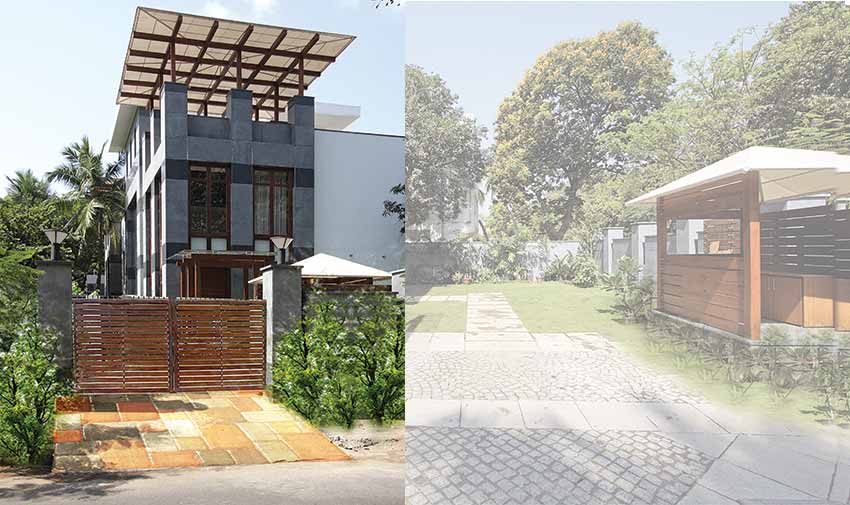
Architect Narrayan has recently completed a residential project in Chennai for the Client Mr. J.Jayamurghan who is professionally a businessman. According to Mr. Narrayan, when we first visited the site, the site seems to be in a complete scenic environment, with tall trees, greenery all across the neighborhood. Despite been in the middle of the city, it seems aloof from the city environment itself and to us it's a perfect plot for a villa, which should have this serene environment.
| Jayamurghan's Details | |
| Project | : J.Jayamurghan Villa, Chennai |
| Plot Area | : 1000 SM |
| Total Built-up | : 1600 SM |
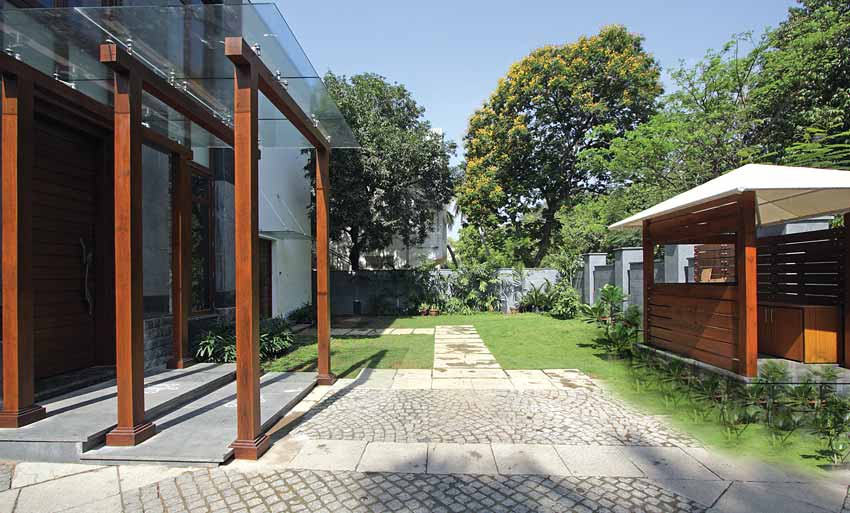
Before started working on the project, we first had the meeting with the client at his existing house. We have chosen the above said venue for meeting just to know the kind of environment he lives in, and we knew at the very offset that there should be a drastic change to the overall life style that he lives. We not only had to make sure that the traditional style of living should not be overlooked, but had to make sure that all the amenities of a modern and a high tech living had to be incorporated.
Design of Villa
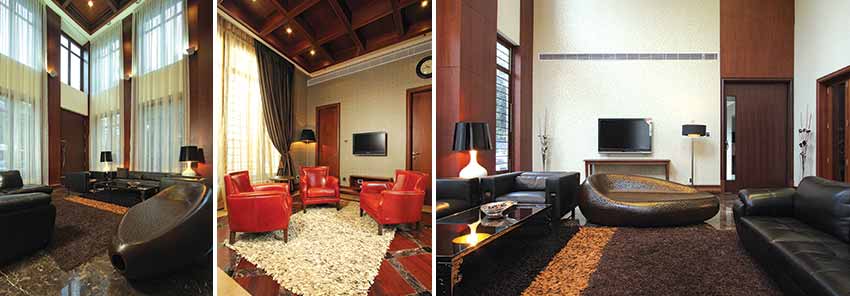
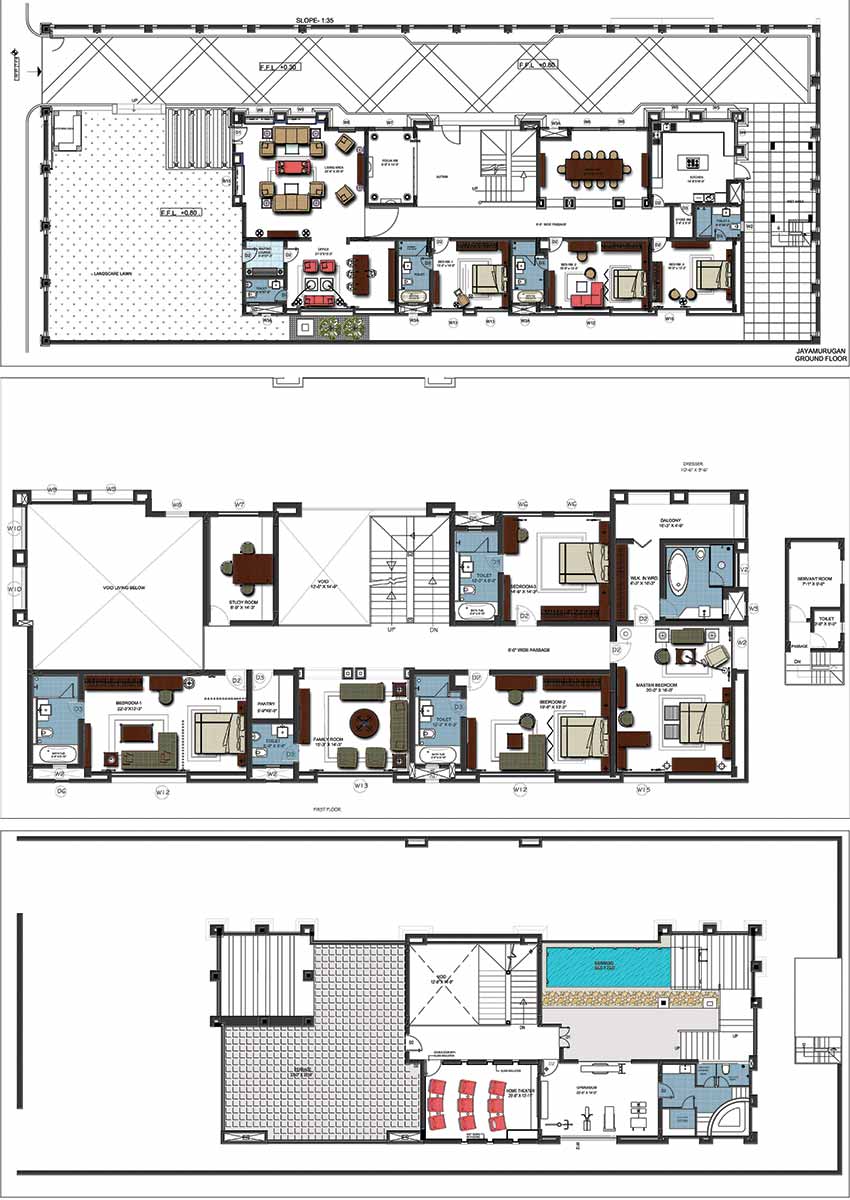
The plot was in a rectangular shape which had a narrow width; this affected the overall design, as the house became longitudinal in design, it was particularly difficult to save space from corridor. The brief given to us about the requirement of the inhabitants has to be completed fulfilled. The design of the villa should cater to all their needs. The space should have a lot of natural light, well ventilated and each room to be spacious. Most importantly, the house should be completely 'Vastu' compliant.
The building has been designed keeping the aspect of various flows of the privacies of the inhabitant. It has ground plus two upper floors. The ground has space for Formal living room, and an office attached to it. There is a formal dining area, family dining and kitchen, and it also has two bedrooms for senior citizen of the family. The whole layout revolves around the atrium in the middle of the house with an elegant metal / wooden staircase connecting the various levels. The first floor has four bedrooms with family room and a small study room, the whole space revolves around this atrium which has a tension rod patch fitted glass. So as this atrium is well lighted and looks spacious.
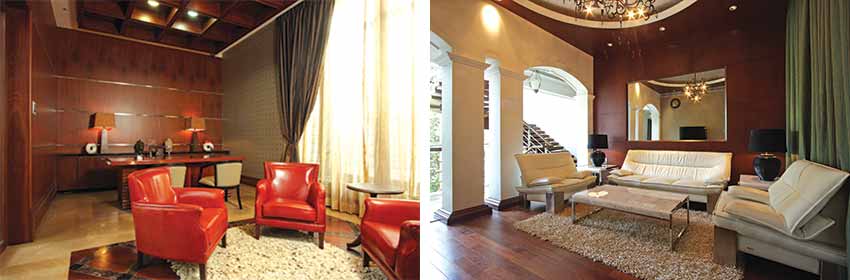
This atrium is more of a night space which has reflected light, and a lot of ceiling hanging lights, the whole space has a complete mood lighting system. As been a central space and the other rooms revolving around this, it has attraction which cannot be missed.
The second floor has been divided into terrace for parties and the recreational area such as theater room, gymnasium, a Small Spa which as steam and Jacuzzi, whereas the other half of the house has swimming pool attached with changing rooms.
Interiors
The interior has been designed to have a post colonial feel with a flavor of contemporary elements. The spaces in each area has high ceiling with quite a bit of diffuse lighting, this itself gave a very post colonial modernistic feel. The colors and textures been used in each area has a very versatile and a combination of traditional and modernistic feel, there has been use of lot of wallpapers which has floral as well as geometric design, keeping in mind the space that it envelopes, detail design in each room has been particularly looked at as an integral part of an overall design.
According to Associates Interior Designer Isha Narrayan, also the wife of Mr. Narrayan, "It was during the interiors that we had to look at the usages of the mix between traditional colors and modern aspect of the house. The house has a complete system of a BMS integration between, Air-condition, lighting, security and fire alarm system. It has also the most modern system in terms of efficiency of power consumption."
She further says, we have used centralized VRV system for the entire house, which has been specially designed and ordered from Japan, this has a complete integration with BMS System. The security system been used are of one of the most high-tech systems, with 14 cameras around the house, remote locking system and burglar alarm system.
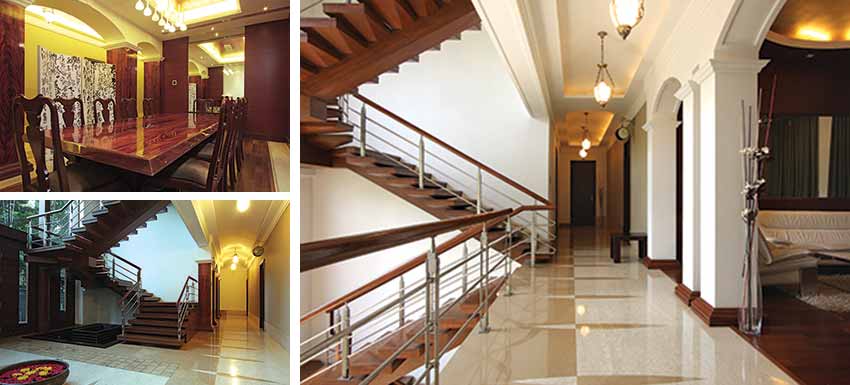
The Complete Villa was a minimalist design. Wooden Floor were used in all the Bedrooms which clearly reflects very warm, rich and spacious look.
The Pure wooden Stairs with Open steel railings depicts beautiful combination of classical and modern concepts— from the Ground Level, the Entrance view is breathtaking impressive as the complete staircase and 2 levels are viewed. The Open lobby gives a very inviting look with minimum seating on the entrance.
The wooden high ceiling with huge glass windows and high wall curtains in the family room creates a very welcoming ambience; the designed focus is on the wooden ceiling with interesting colors used in the family area maintaining the modern concept.
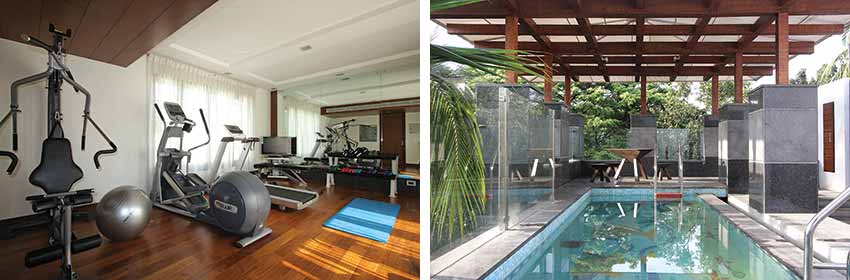
Isha says, "It is vital to understand Client's requirement for designing his House. We tried our best to clearly perceive his point of view. It is this practice that we always developed projects beyond the client's expectations."
The construction of the building took approx. one year for completion. The construction method has been a framed structure with usage of local material. The overall construction has been carried out keeping in mind the green building concept which has been applied at minute's details. The usage of shaded areas, the larger openings towards the east and the west side are kept with shading coefficient in mind.
EPA Studio - Superb Steel and Glass Architecture
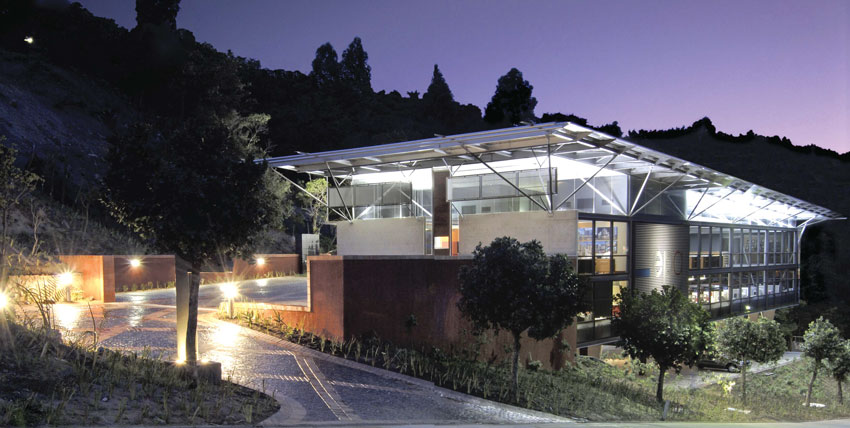
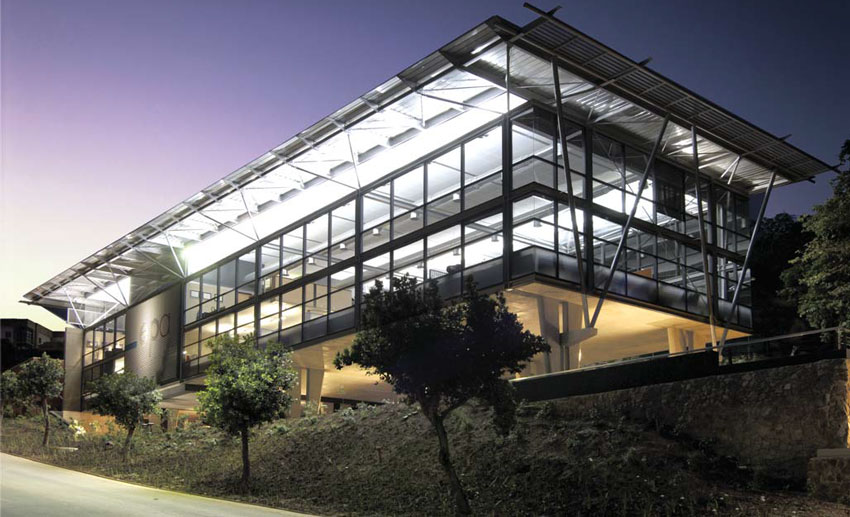
One of the finest works of glass and steel can be seen at EPA Studio in South Africa, designed by Elphick Proome Architects Inc (EPA) for their own use seeing the demand for a substantially larger and more technically sophisticated studio environment for them. Being described as a truly magnificent advert for glass and steel, the design of the studio has received several awards as Regional Institute award, SAISC National Steel award and SAIA Award of Excellence.
Located at Westway office park, Westville in South Africa, the steel and glass box of EPA Studio is crafted very carefully to its site and is comfortably fit with topography and nature. Being covered with a widely over-sailing roof, inclined in acknowledgment of the longitudinal cross-section, the building added a new name in the modern architectural vocabulary.
Site Survey & Design Philosophy
The site for the project was purchased in 2002 but the process of sub-division and environment approvals takes two and half year which resulted in to delay and hence construction on site started in late 2005. Prior to the formal sub-division of the larger site, the Studio was conceived as one of four proposed freestanding office structures positioned parallel to the contours of the steeply south-facing slope. The building footprint in the lowest portion of the site, adjacent to a wooded reserve, generated the largest floor area, which would allow the studio to operate on a single level. This position also allowed for separate street access and maximum exposure within the office park.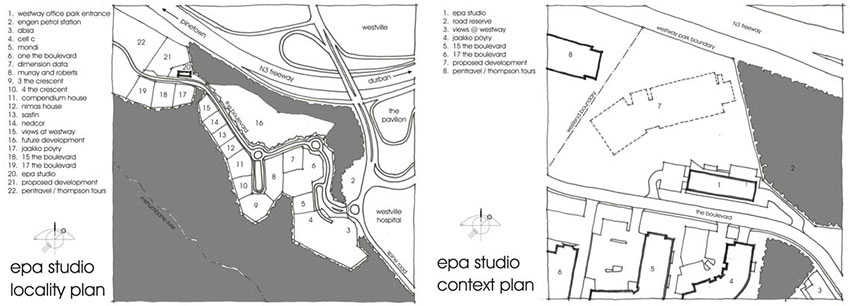
Detailed survey of the site highlighted the severity of cross-fall slopes, which would have hindered both street access and general build ability. With this information, the design was re-evaluated, which resulted in the repositioning of the building footprint at the most level portion of the site, closest and parallel to the street.
Other than the functional requirements for meeting areas and positioning of the building, a brief was collated from the staff regarding the Architectural philosophies that should generate the concept for the new Studio. Those philosophies were summarized here as a building to be set within a natural bush/indigenous landscaped environment:
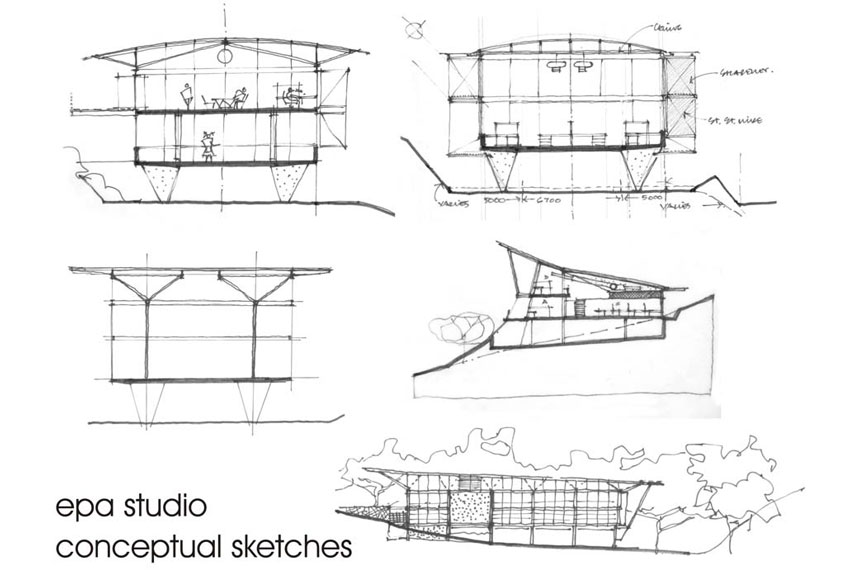
- To exude a bold and simple regional quality capitalizing on distant sea views
- Raw, natural materials to display honestly and visceral integrity
- Emphasis on creating and innovative deployment of materials and components
- Low maintenance finishes in a sensitive and a practical application
- Careful use of integrated climatic control elements
Structural Design
The EPA Architectural firm always strive to create buildings and spaces that respond to the unique nature of each project with integrity. Their design philosophy emphasizes an appropriate architecture that responds to function, context, region and climate.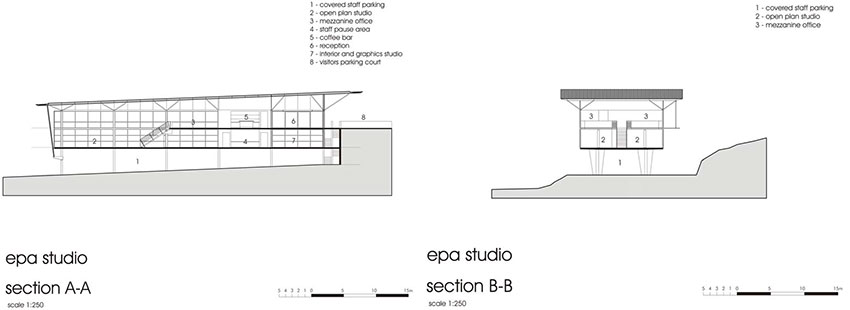
| Details | |
| Architects | : Elphick Proome Architects Inc. |
| Quantity Surveyors | : Francis Williams-Jones Kgole |
| Structural Engineers | : Young & Satharia |
| Electrical Engineers | : Ugesi Consulting |
| Mechanical Engineers | : BD&O Design Partnership |
| Landscape Architects | : Uys & White |
| Main Contractor | : Construction ID |
| Location | : South Africa |
| Structure | : Steel Structure, Curtain Warning |
| Site Area | : |
| Cost | : |
| Year of Completion | : 2006 |
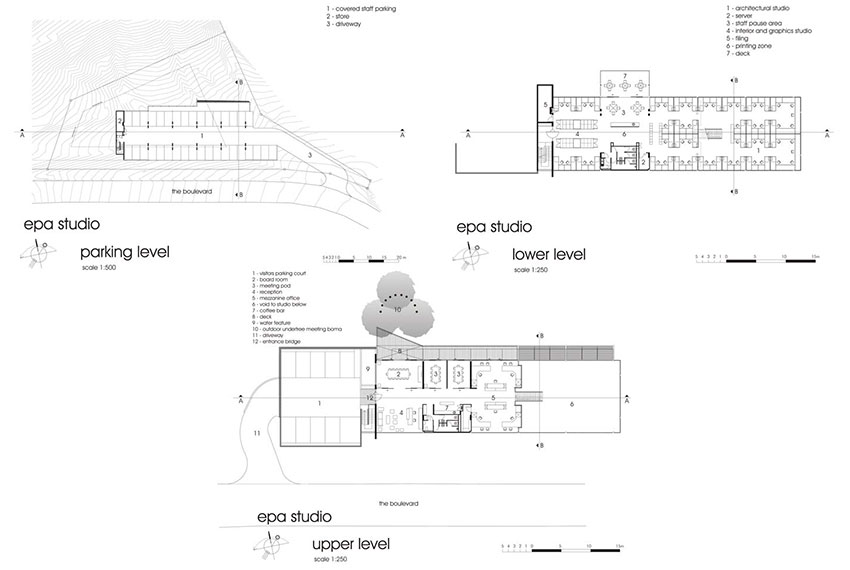
The architectural design of the studio re-evaluated by EPA has been able to capitalize on distant southern views, as well as the immediate environment of natural bush and indigenous landscaping to the east and north. The building form responds to this by becoming a rectangular glazed pavilion, elevated on tapering concrete columns that vary in height according to the slope of the site.
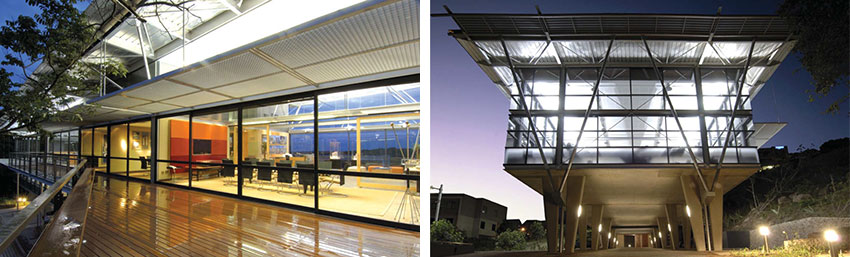
The west end of the longitudinal arrangement engages into the hillside which allows entrance into the highest level of the building through a five meter high front door. This floor accommodates reception, meeting rooms and Director's workspaces which overlook the double volume general workspace below.
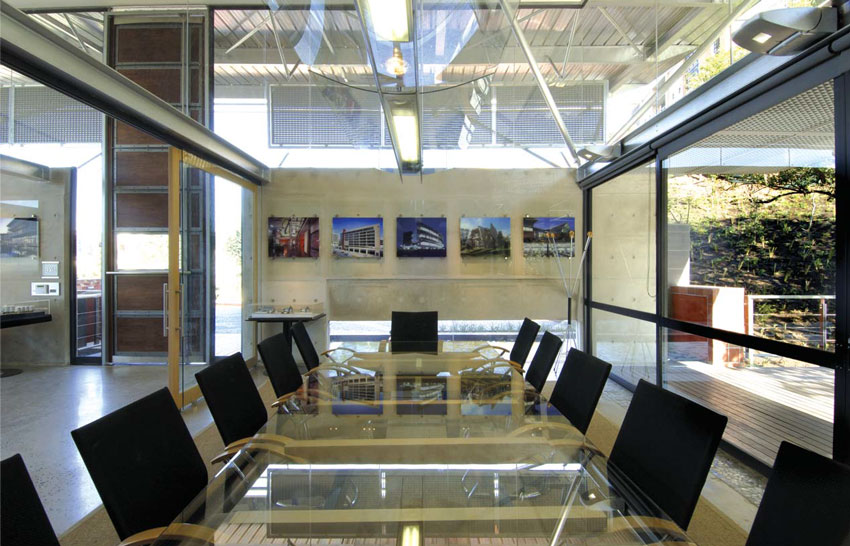
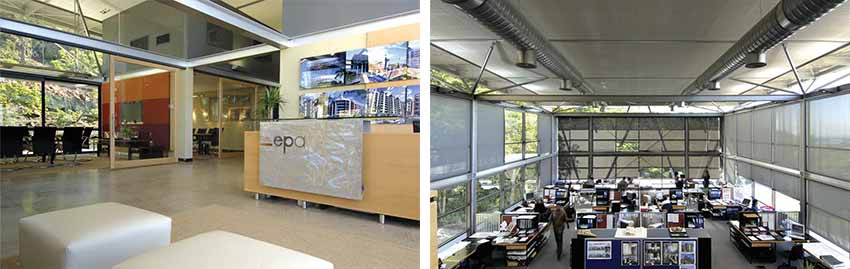
The design of the studio has generated a spatial organization allowing ease of circulation and a variety of meeting venues which has promoted communication and creative interaction between the users of the Studio. The rational layout of functions and integrated services, allows for future planning flexibility to respond to the ever adapting demands of the practice. The integration of spatial dynamics and structural expertise has created an inspirational environment for staff and visitors alike.
The parking area is located within the diminishing volume of the lowest level and surrounded by waist high walls, which draw the eye to the front wall. Water features to the left and to the front, and a wall cladded in part with concrete and in part with low-level glass, surround on either side and above. Within the garage area careful attention to materials, structure and lighting create a different but equally powerful staff arrival area. The full-height purpose-designed steel-framed wooden door covered with glass is the piece de resistance.
Materials Used
<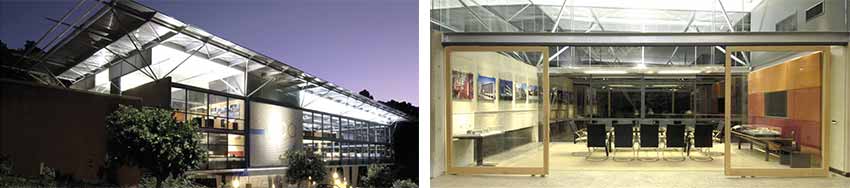
Structurally, the off-shutter finish concrete columns and wall elements support and brace the steel structure above. Inspired by the close relationship to the adjacent tree canopy, the roof evolved into an oversailing inclined plane supported by a steel structure of 'branch-like' brackets. Having no vertical members they allow the glass envelope to run unobstructed around the corners of the building and reach up to the oversailing roof above. The roof spans the longitudinal axis, pitching with the gradient of the adjacent street. This allows for generous internal volumes to the upper floor reception areas and creates an elevated scale appropriate to the main entrance of the studio.
The external experience of the building is enhanced by the timber-clad exposed steelwork of the external balconies, which are also surrounded by carefully detailed steel and wire balustrade. Another of those superbly detailed items, stunning in its simplicity, is the steel-supported staircase leading from the lower working areas to the upper reception areas. What makes this so special is the exquisite detail of the timber treads supported in steel pans to the staircase. A special effect has been created.
Besides its extraordinary aesthetic quality and brilliant workmanship, the studio has multi-adjustable blinds fitted to the windows that maximize natural light and eliminate glare. This is further supported by the external galvanized grating, which has been used both decoratively and as a sunscreen.
Other features relating to the outer impression is the louvred section of the wall, which hides the air conditioning plant. A neat set of letters 'epa' (for Elphick Proome & Associates) attached to the wall is the only clue as to who the occupants are.
Close teamwork, from the initiation of the project, between the architectural and the engineering and construction teams was an important factor in the successful completion of the project. This is evident in the neatness of the site-welded steel connections, the beam-to-column bolted connections, and the curved-plate pinned connections to the sloping tubular columns, which all played an important role in achieving this very special structure.
Magarpatta City Retail Mall Pune
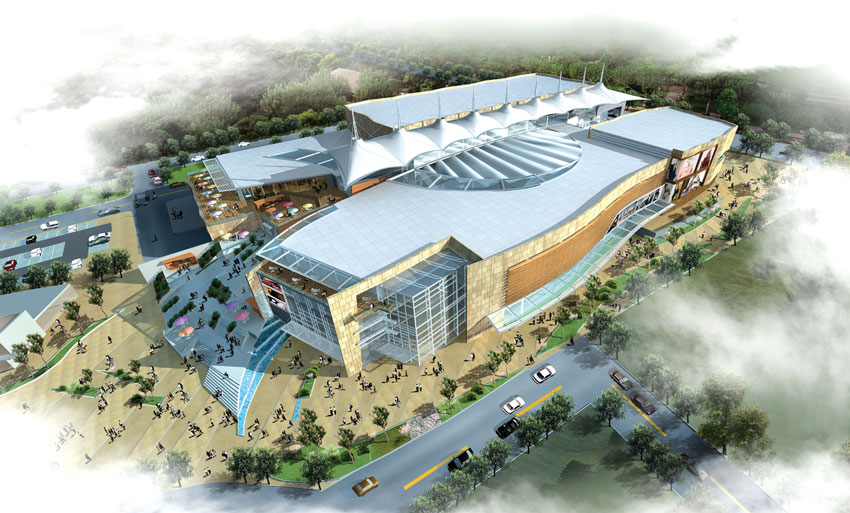
Magarpatta Township Development & Construction Co. Ltd. Approached to the architect Benoy to design their project Magarpatta City retail mall in Pune.
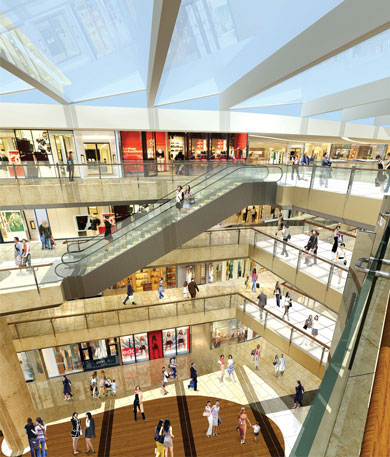
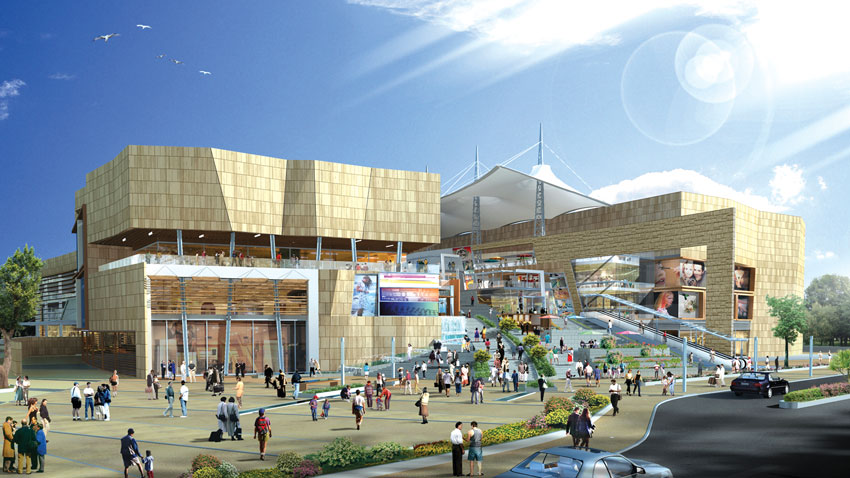
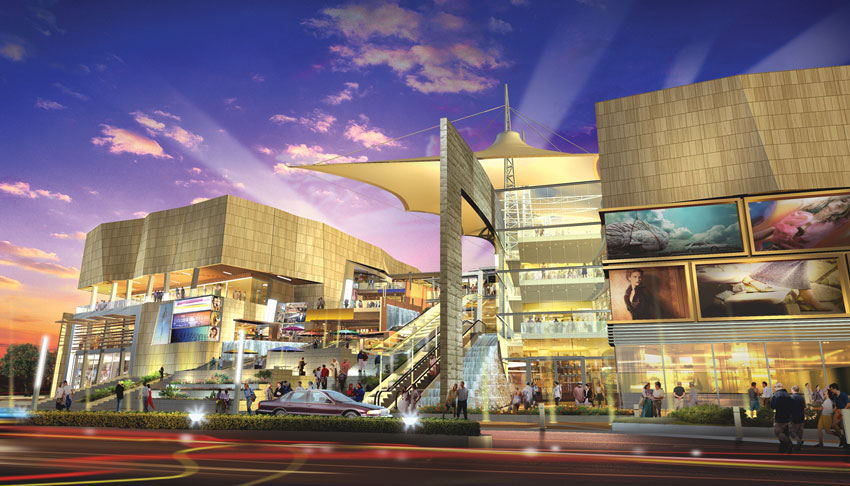
Thus, the innovative design of the first major retail offering within Magarpatta City takes into consideration the city's climate and integrates the landscaping with the building, harmonising indoor and outdoor environments at every level. Pockets of outdoor areas are inserted at various levels along the stepping landscapes to break down the generic massive retail box and also to allow visitors to enjoy the temperate climate. Together with the landscaping features merging into the mall, distinctive areas with F&B and entrances are incorporated to link the exterior and interior.
The stepping terraces introduce a stacked fenestration to bring cool air along the landscape effectively, and as a whole, they form an exciting puzzle made up of stepped greenery, waterscapes and dining terraces. To control excessive solar heat gain into the building and the landscaping areas, skylight locations have been carefully considered and a lightweight tensile roof partially spanning the landscape will encourage full use of the outdoor spaces.
Client/Owner: Magarpatta Township Development & Construction Co. Ltd.
| Design Architect | : Benoy |
| Local Architect | : Associated Space Designers Pvt. Ltd. |
| Principal Architect | : Prakash Deshmukh |
| Mechanical & Electrical Engineer | : Spectral Services Consultants Pvt. Ltd. |
| Structural Engineer | : Y S Sane Associates |
| Landscape Designer | : Ravi & Varsha Gavandi |
| Interior Designer | : Benoy Ltd |
| Other Consultant/ Project Managers | : CB Richard Ellis South Asia Private Limited. |
| Marketing Consultant | : Jones Lang Lassale Meghraj |
| Site Area | : 50,189 square metres |
| Total Retail Gross Floor Area | : 60,900 square metres |
| Building Height (metres) | : 21 |
| Building Height (storeys) | : 5 and 2 basement car parks |
| Construction Start Date | : November 2008 |
| Scheduled Completion Date | : 2010 |
The aim of the design was to create a destination for not only the township but also the entire city of Pune. In addition to the unique spaces and a focus on outdoor amenities, this four-storey retail complex will offer a range of different sized shops, cinema, entertainment facilities, department stores and a hypermarket, with 207,000m² of leasable floor area.
Zaha Hadid Architects Win Cairo Expo City Competition
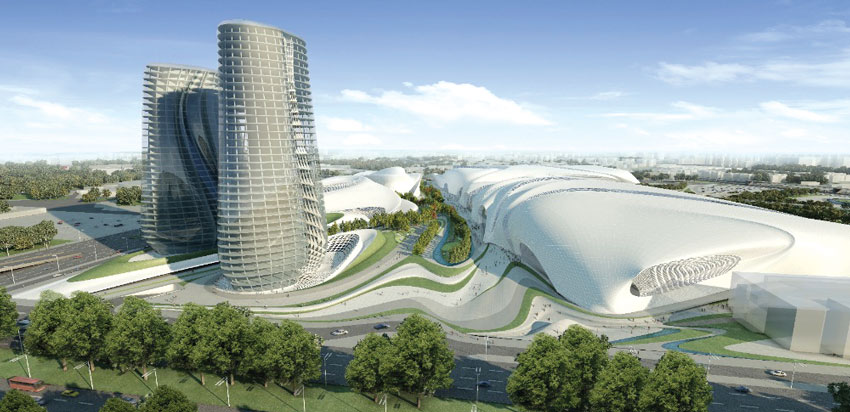
Renowned London based architect, Zaha Hadid has been selected to design the new Cairo Expo City, together with global multi-disciplinary engineering consultancy Buro Happold.
The winning design for Cairo Expo City delivers a unique facility for Cairo––a 450,000 square metre, state-of-the-art city for exhibitions and conferences, located between the centre of Cairo and the city's airport. The project comprises a major international exhibition and conference centre with business hotel. A further office tower and a shopping centre are also proposed.
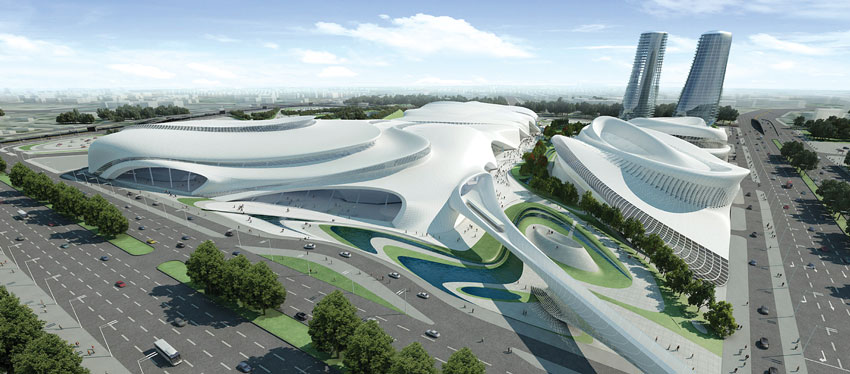
The project is one of great significance for Cairo, a city which is undergoing revitalization. "This is a truly national project for Egypt." said Sherif Salem, CEO of the GOIEF (General Organization of International Exhibitions and Fairs). "The current exhibition halls for Cairo do not meet the standards now required by the international conference and exhibition industry. With this exceptional design by Zaha Hadid Architects, Cairo will be among the world's top cities for conferences and fairs, able to cater for the widest variety and size of events."
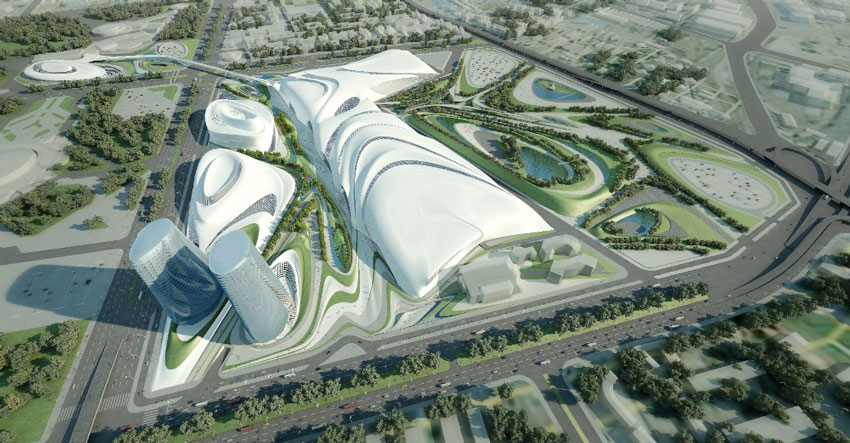
Architect Zaha Hadid explained, the undulating fluid forms of the Cairo Expo City design were inspired by the natural topography of the Nile valley. "As the exhibition spaces require the greatest degree of flexibility, we wanted to ensure that all the public spaces and formal composition of Cairo Expo City relate to the surrounding Egyptian landscape," said Hadid. "Along the great rivers of the region, most particularly the Nile, there is a powerful dynamic - a constant flow between the water and the land - which extends to incorporate the neighboring buildings and landscapes. For the Cairo Expo City design, we worked to capture that seamlessness and fluidity in an urban architectural context."
Carving and sculpting processes have been used to divide the very large exhibition and conference areas required for Cairo Expo City into clusters of individual buildings that have their own formal composition, yet each building relates to the overall design. A main north-south artery is carved through the design, with secondary streams converging at the centre to ease crowd traffic during event. The movement of people within these streams informs the building entrances on the site.
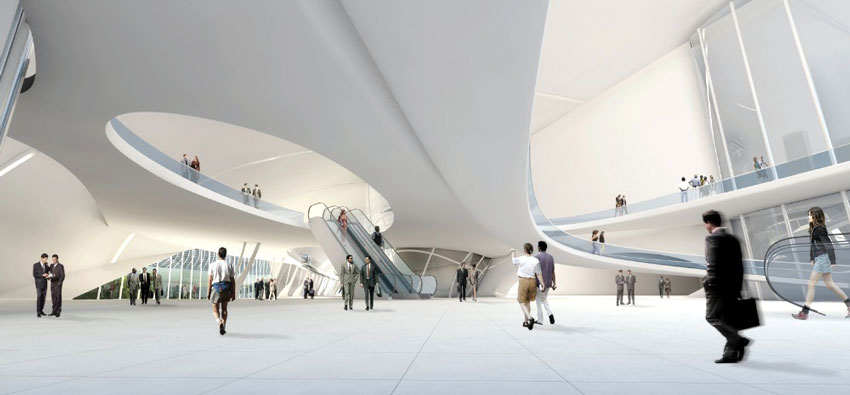
Zaha Hadid Architects was shortlisted with Norwegian architecture practice Snohetta for the second phase of the competition in April. Works will begin in October this year to clear the site.
Client: GOIEF (General Organization of International Exhibitions and Fairs), Cairo
| Design | : Zaha Hadid Architects |
| Engineering | : Buro Happold, London |
| Quantity Surveyor | : Gleeds, London |
| Traffic and Logistics | : Buro Happold, London |
| Built Area | : 450,000sqm (exhibition halls, conference center and mixed-use areas) |
| Height of Towers | : 33 and 31 stories |
Galeria Adriana Varejão, Brazil
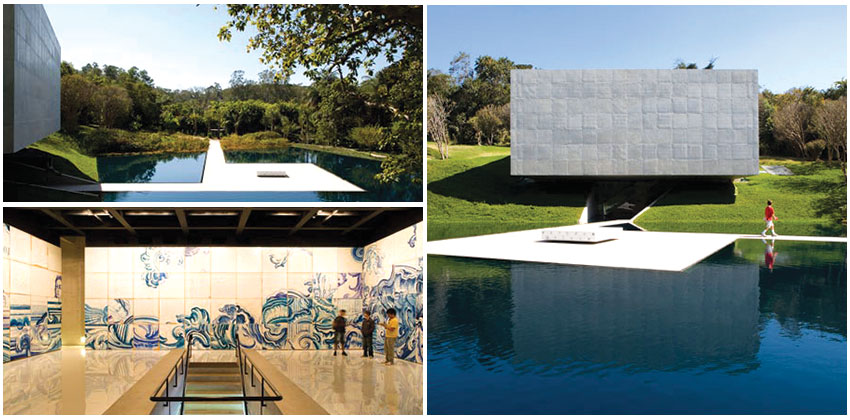
This is a "made for each other" case – a museum made up of multiple pavilions throughout the 35-hectare park designed to house a sculpture and polyptych by Brazilian artist Adriana Varejao. The Adriana Varejão Gallery was built to house two works of the artist the sculpture Linda do Rosário and the polyptych Celacanto Provoca Maremoto. The artist added four more works to the project as it developed.
Located in Brumadinho, Belo Horizonte, the capital of Minas Gerais is the Inhotim Centro de Arte Contemporânea. Inaugurated in March 2008, the museum is the personal initiative of the Bernado Paz, a mining industrialist. The entire museum is spread over several pavilions rather than a single unique building. The building, designed by the architect from São Paulo, Rodrigo Cerviño Lopes, covers an area of 477 sqm and creates a spiral path that starts in the middle of a shallow pond and then leads up to the second storey where there is a large open space. This terrace has a bridge which crosses over to an area to which Inhotim is expanding, a new lake.
Structural idea
The project occupies a hillside with a small slope that is typical topography of Minas Gerais, partially covered by the native forest. Formerly, the area was used to store containers, for which purpose the hillside was cut to create a horizontal plane. The orientation of the Galeria Adriana aimed to recompose the site's original topography and inserting the artificial element – in this case a regular block in reinforced concrete. An irregular retaining wall gains the space in the ground floor and bears the load of the block. At its deepest two beams and four columns are integrated in the wall to further spread the load.The path followed
Galeria Adriana includes a spiral path that connects two different levels of the park. The movement alternates moments of contraction depicted by the passage and expansion into the exhibition in nine phases. It goes from the ground floor in the middle of the water pond, as a narrow walkway away from the building thought the exhibitions to the terrace above the concrete block with the bridge as the final contraction.Surrounding the whole is the pool that quietly reflects light on the flat block face of the building brightening the exterior as the art works add glory to the interiors. A perfect match!
SymHomes MK–1 New Wave of Architecture in India
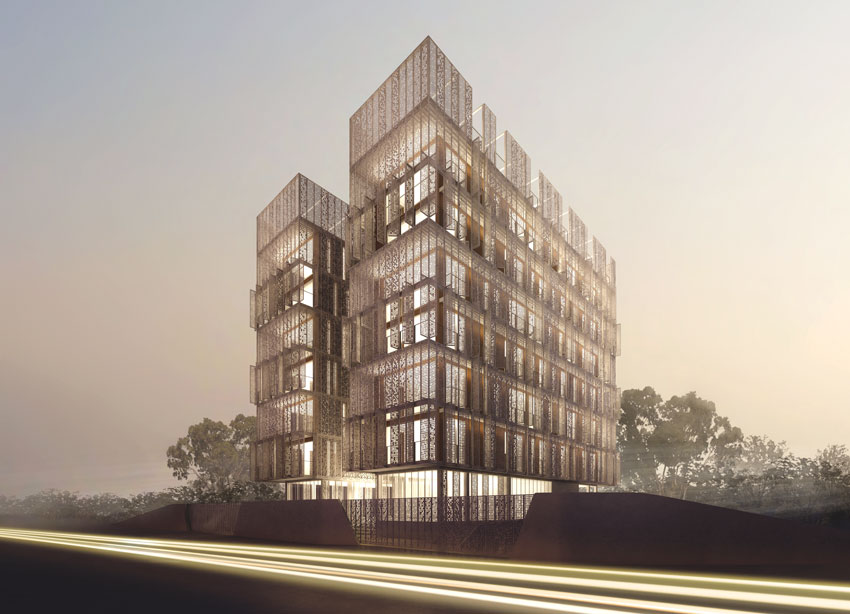
Constructing a steel apartment in a region where summer temperature can rise to 111Degree F is insanity, but Piercy Conner's award winning design for Indian apartment SymHomes Mk-1 makes the unthinkable solar solution sustainable, says Mariya Rasheeda.
Piercy Conner, one of a new generation of British architects create bespoke solutions by interweaving the poetic, the pragmatic and the materials to deliver distinctive and ambitious architecture. The young practice has a backlist of admired, imaginative projects where the old, high-energy, Newtonian assumptions of building geometry give way to more flexible and relativist concepts. So an award-winning Piercy Conner design for sustainable urban housing in Kolkata is especially interesting.
The Piercy Conner designs, known as SymHomes Mk1 intended to come at Rajarhat New Town in Kolkata soon as the application submitted for building sanction gets its approval. Works on it are scheduled to start in September 2009 and deadline for building completion is 2010. The buildings have a structure of elegantly proportioned steel boxes within steel boxes, manufactured elsewhere and trucked on to site. Distinctions between outside and inside are not absolute; at the same time, the perforated envelope allows air to circulate while providing adequate protection from monsoons.
SymHomes Mk1
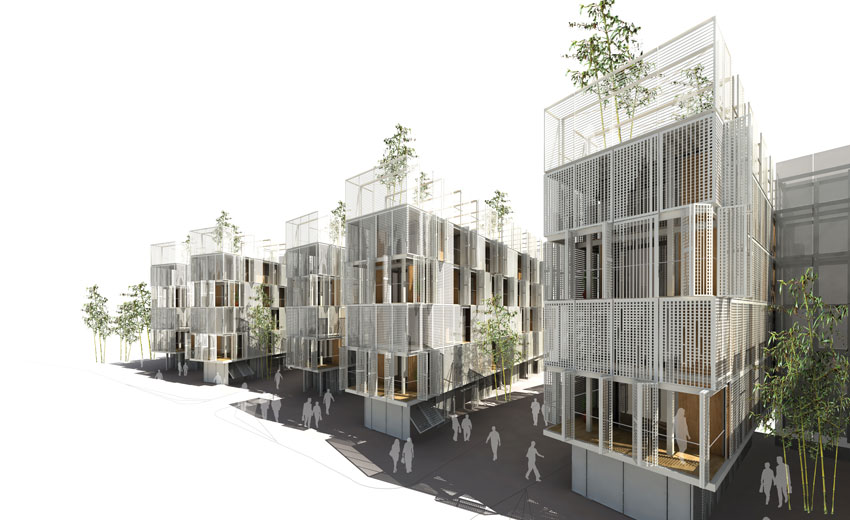
Piercy Conner's design of SymHomes Mk1 was the winning entrant of The Living Steel International Architecture competition in 2005 and went on to win the MIPIM AR Future Project Sustainability Award in 2007 for its imaginative and sustainable use of steel.
A steel box-within-a-box might not sound feasible in the hot Indian sun, but this innovative design boldly goes where no steel has gone before: not only does it succeed in fulfilling the brief to develop the use of steel in residential building but it also offers an imaginative and simple alternative to air conditioning units.
The outer perforated panels help cool the building with shade and airflow and also provide a rain screen during torrential rains. This environmental buffer zone, symbiotically linking the inner and outer spaces, conditions the climate naturally, minimizing the use of electric air-conditioning units. When needed, an inner skin can be sealed to allow air-conditioning units to be used in extremes of temperature.
Stuart Piercy, the director on the project, drew on vernacular architecture for inspiration. "Western architecture is dominated by the sealed environment whereas architecture in India is much more open and expressive," explains Piercy. "We wanted to create something that draws on the permeability of subtropical architecture which historically uses shade, sun-paths and wind channeling to control environmental factors with minimal impact on the planet."
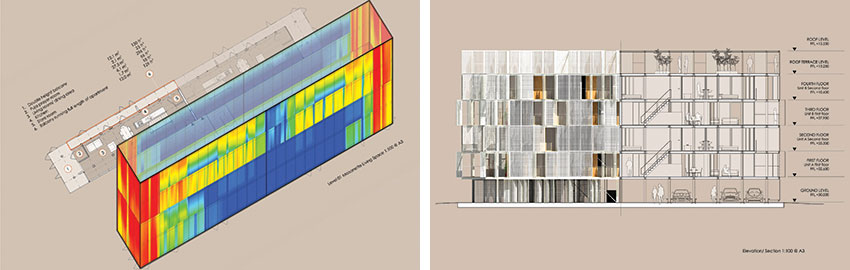
Inspiration also came from a development in the motor industry. At the time Toyota and Lexus were developing the Hybrid Drive Engine, a dual engine which offers an electric motor to minimize the role of the fuel-guzzling petrol engine. Similarly, the responsive double skin of SymHomes Mk1 means air conditioning units are only used in extreme conditions, thereby creating a highly sustainable environmental system for the project.
On a visual level, SymHomes Mk1 embraces both the demands of modern expansion and the cultural heritage of Kolkata, also known as the City of Palaces. The deep shaded terraces surrounding each apartment echo the arches and courtyards of the Mughal, Gothic, Baroque architecture of India's indo-islamic history, creating an aesthetic intrinsically linked to context and culture. The perforated steel of the shutters creates a filigreed pattern, reminiscent of the intricate stone work and metal work found in India's traditional buildings. "India is on the verge of a building explosion but we wanted to avoid the anonymity of Dubai-style development," says Piercy. "Instead we wanted to offer a culturally sympathetic yet environmentally intelligent building which retained an Indian identity and created a role-model for sustainable living."
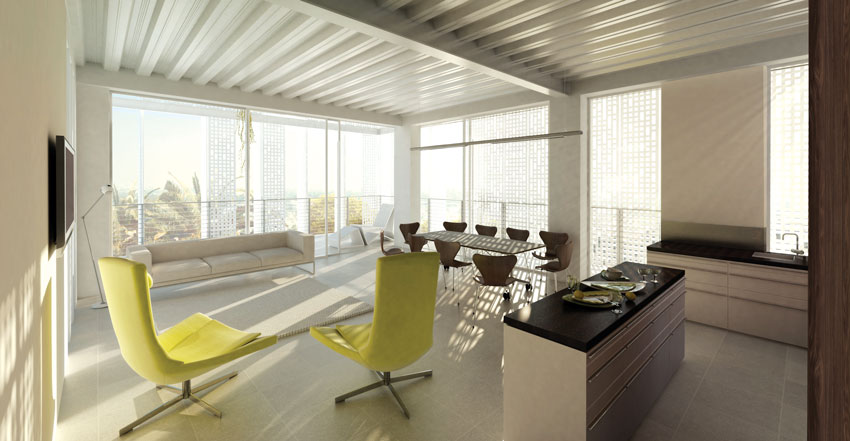
On a practical level, the steel allows the delivery of SymHomes Mk1 to be based on a ‘kit of parts' principle with each component being readily available through discussion and development with supply chain partners TATA Bluescope, whose steel factories are based in India. This increases the speed and accuracy of construction, reducing financing costs and allowing earlier occupancy. The dye for each panel can be kept to fabricate replacement panels with minimum financial and time impact.
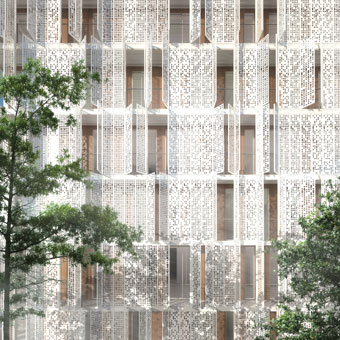
The Government of West Bengal, along with high profile private and public sector companies, is working on providing the township with the latest infrastructure and amenities to make it one of India's major industrial and technological hubs – a second ‘silicon valley' after Bangalore.
Targeted to young professinoal families, SymHomes Mk1 offers high-end specifications.
The development comprises six three-bedroom apartments (101m2 plus terraces) and six four-bedroom apartments (143m2 plus terraces), affording spacious and luxurious living for twelve families.
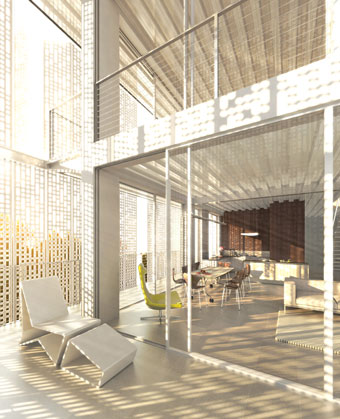
Joint clients Living Steel and Benhal Shrachi (local developers) are delivering the project in India offering valuable local and international knowledge. Works on site are being overseen by Kolkatan architects Sanon Sen.
This development is not only India's first sustainable steel residential building but also demonstrates how sustainable architecture can deliver inspirational design without compromise. SymHomes Mk1 sets the bar for India's New Wave of architecture.
Client: Living Steel
| Novated | : Bengal Shrachi Housing Development |
| Location | : Kolkata, India |
| Size | : 35,000 ft2 |
| Value | : £2,000,000 |
| Start | : September 2009 |
| Complete | : 2010 |
| Involvement | : Executive Architect |
| Team | : Richard Conner, Partner Nick Francis, Associate Architect Matti Lampila, Architectural Assistants |
| Structure | : Adams Kara Taylor |
| M&E | : Faber Maunsell |
| QS | Jackson Coles |
| Suppliers | Tata Steel |
| Awards | MIPIM Sustainability Award, Winner MIPIM Residential Award, Finalist EMVS Sustainability Awards, 2nd Place |
SymHomes Mk2
Recently, Piercy Conner launches second phase of steel home design. Hot on the heels of the award-winning Symhomes Mk1 comes Symhomes Mk2. Following Piercy Conner's work for the Living Steel steel housing programme in Kolkata, India, Symhomes Mk2 is a logical advancement in design. This high rise speculative building for mixed commercial and residential use takes the double-skin concept to the next level. The stacked, arched structure - a reference to the playful and expressive nature of Hindu temple architecture - facilitates a 360 degree open balcony offering unimpeded views from all aspects of the building.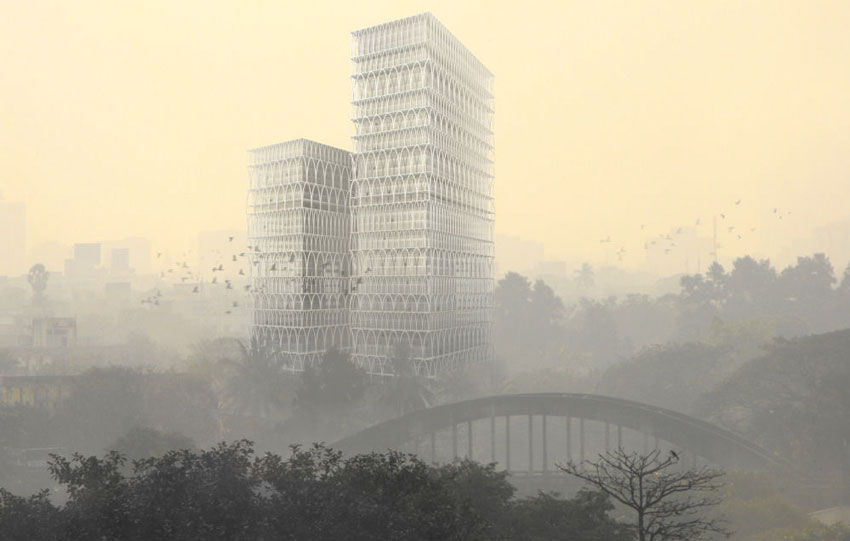
Living Steel is championing the cause for steel construction. Basing their campaign on the projected figures from the United Nations that the population will explode by as many as two billion people over the next 25 years and a general migration pattern from rural to urban centres, they claim that steel is the material that allow architects to keep up with the pace of demands allowing for buildings which can be rapidly constructed, also heralding its recyclability.
Swimming Pools The New Lifestyle Statement
Swimming Pools are often found as part of a larger leisure centre or recreational complex which takes you to an absolute different and serene world. Today's hard and fast life makes the people tired and irritating. They look forward for some measures which provide relaxation and peace of mind to them in a short period of time. And Swimming pool, is a solution for the same.
Pools may be both public and private i.e used for personal as well as for commercial purposes. Pools that may be used by many people or by the general public are called public, while pools used exclusively by a few people or in a home are called private. Many health clubs, fitness centers and private clubs have public pools used mostly for exercise. Hot tubs and spas are pools with hot water, used for relaxation or therapy, and are common in homes, hotels, clubs and massage parlors.
A pool is an artificially enclosed body of water intended for swimming or water-based recreation. It can be built either above or in the ground, and from materials such as metal, plastic, fiberglass or concrete. Ferrocement has been extensively used for making domestic swimming pools in the past there decade Having a swimming pool is certainly a lifestyle statement. Any piece of luxury real estate worth it’s salt will probably have a swimming pool on the property. With the demand for swimming pools on the rise, today swimming pools come in all sizes and prices - each to accommodate the taste, style, size, and budget of their buyers. They come in various size and shape depending on the availability of property.
Technology Pools- a single solution provider
One of the most and difficult aspects of swimming pool building process is the selection of a specialist builder. It is always advisable to go in for a specialist, who has the right intention to provide the best of the products and advice. Apart from selection, designing is another very important aspect that can either add to the beauty of the surrounding or spoil the beauty of it.
Here is a single solution provider to all your problems. Technology Pools, one of the leading luxury swimming pool design, consultancy and installation companies offers different types of pools—Outdoor Pools, Indoor Pools, Private Pools, Hydro Pools, Resort Pools, Water Parks, Society Pools etc—and the design for all these options are also quite different in nature. With over 25 years of cumulative experience and after immense success in U.K they are now in India. It offers you the renowned professionals and the best of workers that help in designing the pool as well as guiding you on minute details like—materials to be used, size and shape, maintenance, swimming pool safety, etc.
In India, the company provides latest pool filtration equipment from all over the world, extremely reliable advice and accurate technical specifications with effective project management. Its esteemed clientele include rich businessmen, five star hotels and international schools. Technology Pools also offers customized economic solutions for budget conscious buyers, and have been favored suppliers for a number of building society pools for that reason. It aspires to provide the best possible pool construction techniques for best water quality whilst maintaining comfortable and safe conditions. Apart from swimming pools, the company is also into the building of Spas, Jacuzzi, hot tubs and sauna and has already completed a number of projects in India as well as abroad.
Ultra-level Infinity Pools-a design marvel
Technology Pools has launched Ultra-level Infinity Swimming Pool, a concept coined by the company's CTO, Hemant Atrish in India. These pools are considered to be the most stunning pools and enhance customers' home and environment with a touch of luxury and elegance.Ultra Level Infinity swimming pools are lively and by swimming in an ultra-level swimming pool one enjoys the healthy resort lifestyle at home. These swimming pools have no edges or walls and the edge of the water blends into the horizon. These blue fresh Ultra level swimming pools are eye catching and beautiful. "Ultra Level Infinity pools come in a variety of shapes and sizes. Apart from the standard sizes, they can be further customized to meet the exact specifications. Whether the customer wants to extend the length of the pool, add radius corners, or create a unique shape, Technology Pools has the expertise to crate a pool that suits the exact requirement of the customer," commented Hemant Atrish, CTO, and Technology Pools.
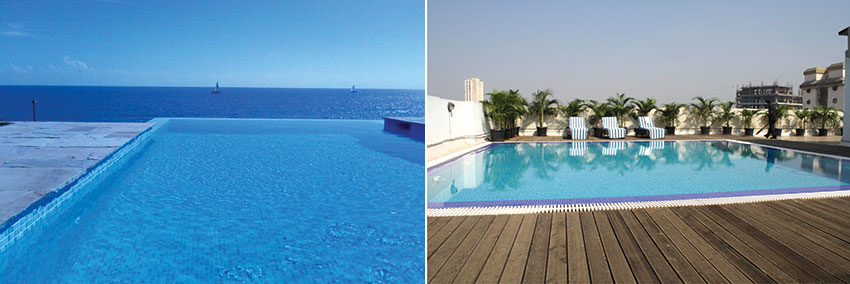
These stunning beauties create the illusion of water reaching past the edge of the pool edge and meeting the horizon. But it's really not. Ultra level infinity pool is a design marvel. These pools have usually a minuscule basin surrounding the perimeter, which catches the water when it falls over the side. From there the water is pumped through a secondary filtration system which brings it back into the pool. And, because usually they are built on cliffs and hills, the effect of the water going over into nowhere is quite entrancing.
With infinity pools one also has the option to choose the most striking materials and exotic designs that exist. There is also the option of including relaxing spas and other luxuries. These swimming pools have already captivating residential customers across the globe and the company is looking at repeating the same success in India as well.
Roof Top Swimming Pools
The company has recently started the services of Roof Top Swimming pool in India. Rooftop swimming pools offer some of the most spectacular design opportunities but at the same time some of the greatest challenges also. And here Technology Pools Rooftop swimming pools will meet these challenges with state-of-the-art pools that are lighter in weight than conventional construction and faster to install.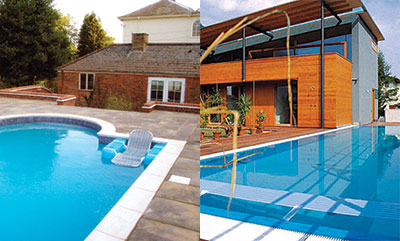
There is a lot of creative and technical designing for the structural engineers and pool designers to come up with detailed top roof pool plans. To handle the weight of the water, the pool sits atop the building's structural concrete columns. The pool shell is made watertight by elaborate waterproofing methods to prevent leakages associated with inferiorly designed pools that can prove extremely costly to repair. Its decking is supported by a steel frame and lightweight concrete.
Technology Pools has the expertise and capability to design an ultra level infinity swimming pool for almost any location, one does not necessarily need to have a sea view property. Even a sloping garden would do just fine. The company's attitude, education, training, experience and vision to help in making the customers' aspiration come true by developing a swimming pool design that maximizes the returns on the money spent and simplifies the entire swimming pool construction process.
New Library & Learning Centre in Vienna
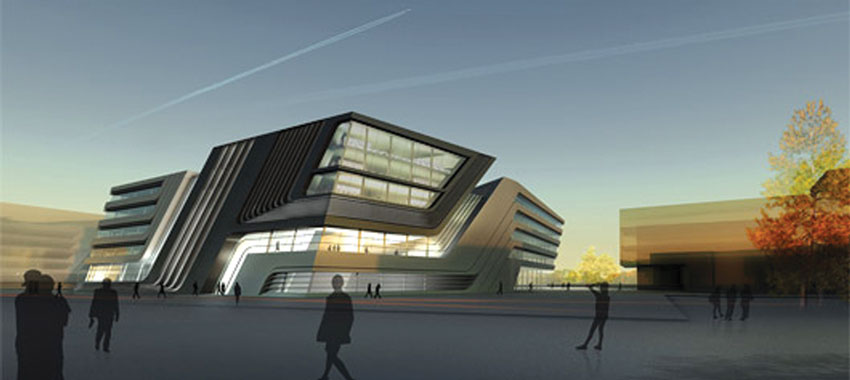
The University of Economics & Business, Vienna will soon have a new Library and Learning Centre that will be the centerpiece of the University's new campus and provide a significant upgrade to the University's services. Designed by a famous architect Zaha Hadid, the design is described as a 'Polygonal Block' with both inclined and straight edges.
Structural Design
Zaha Hadid has been selected as the architects of a library and learning centre (LLC) for the University of Economics & Business in Vienna. Hadid beat Pritzker Prize winner Thom Mayne's US practice Morphosis and Italian architect Massimiliano Fuksas during a competition to win first place, which was judged by a jury headed by Austrian architect Wolf Prix.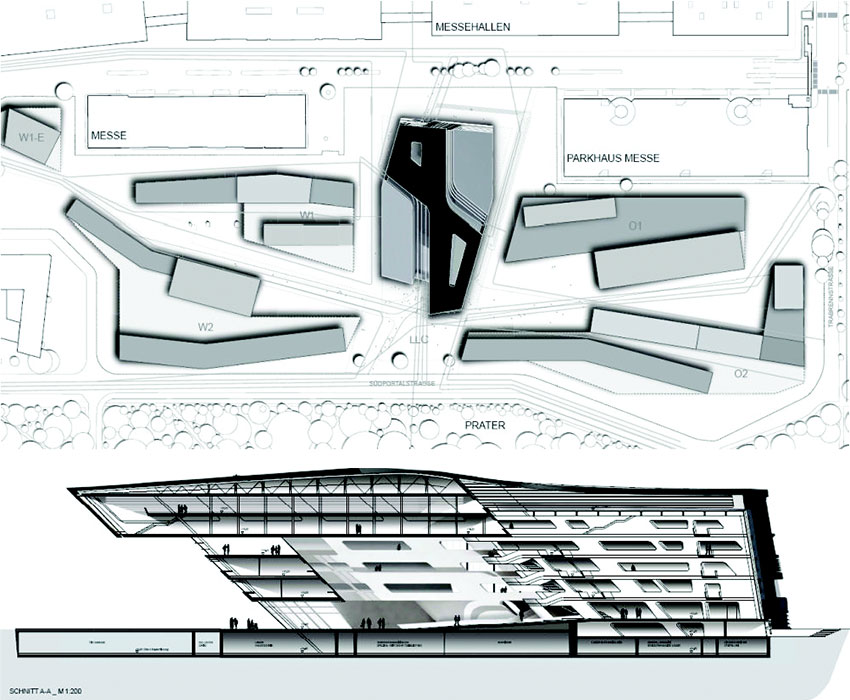
According to Zaha's design the new Library and Learning Centre rises as a polygonal block from the centre of the new university campus. The LLC's design takes the form of a cube with both inclined and straight edges. The straight lines of the building's exterior separate as they move inward, becoming curvilinear and fluid, generating a free-formed interior 'canyon" that serves as the central public plaza.
All the other facilities of the LLC are housed within a single volume that also divides, becoming two separate ribbons that wind around each other to enclose the glazed gathering or central space.
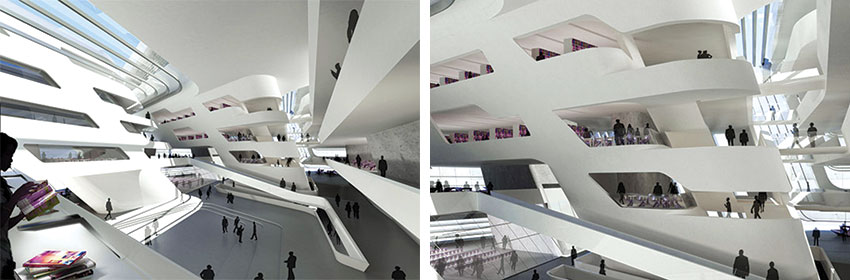
'I am delighted to be working in Vienna as I have a close affiliation with the city. As a centre of research, the Library and Learning Centre is forum for the exchange of ideas. It is very exciting for us to be part of the University's expansion,.' states Zaha Hadid.
Covering an area of 42,000 sq m, the winning design is 136m long, 76m wide and 30m high, five storey building that will house learning centre as well as training rooms, administration offices, a library, clubroom, auditorium, book shop and ancillary services areas.
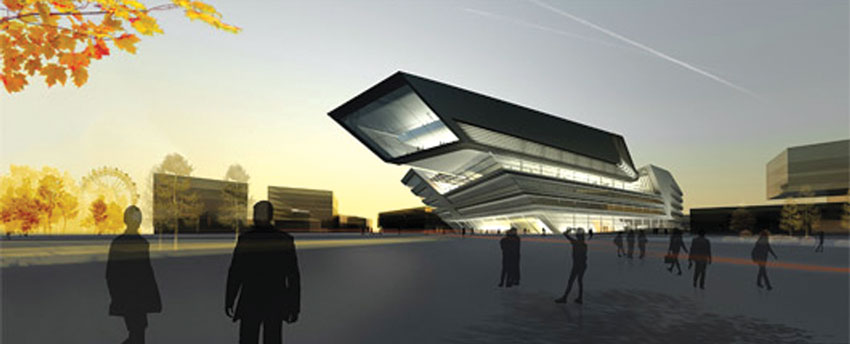
Rector of the University of Economics & Business, Christoph Badelt said "A library and learning center should be more than a mere library in the classical sense: it is a research and a service facility, a workplace and lounge, a place of communication and a traffic hub, at one and the same time. With its breathtaking architecture, the design byZaha Hadid manages to combine all the key functions of study in a most wonderful way. It is a vision that embodies this innovative concept of a university."
Program
The LLC comprises a "Learning Center" with workplaces, lounges and cloakrooms, library, a language laboratory, training classrooms, administration ofûces, study services and central supporting services, copy shop, book shop, data center, cafeteria, event area, club room and auditorium."Arup's Berlin office will be responsible for engineering the building and the project architect is Cornelius Schlotthauer. The project is expected to be completed by the end of 2012.
| Architect | |
| Design | : Zaha Hadid with Patrik Schumacher |
| Project Architect | : Cornelius Schlotthauer |
| Project Team | : Marc Philipp Nieberg, Kristoph Nowak, Enrico Kleinke, Stefan Rinnebach, Niels Kespohl, Jan Hübener, Romy Heiland, Richard Baumgartner |
| Consultants | |
| Structural Engineers | : Arup Berlin |
| M&E Engineers | : Arup Berlin |
| Façade Engineers | : Marc Philipp Nieberg, Kristoph Nowak, Enrico Kleinke, Stefan Rinnebach, Niels Kespohl, Jan Hübener, Romy Heiland, Richard Baumgartner |
| Fire protection | : HHP West, Bielefeld |
| Render Studio | : Vectorvision, Leipzig. |
The Blue Planet: Denmark's Most Modern National Aquarium
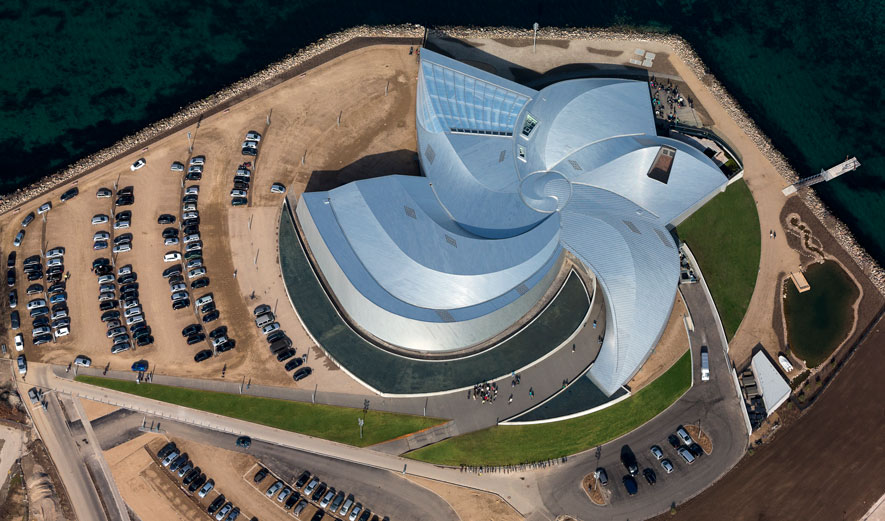
North Europe recently gets its largest and most significant whirlpool-shaped aquarium 'The Blue Planet' in Denmark which is expected to become an internationally acknowledged destination attracting guests from all over the world.
Located on the shores of Øresund, only eight kilometres from the Copenhagen City Hall Square, The Blue Planet is a building of high complexity with a welcoming and fascinating framework for the guests' encounter with both animals and nature while it houses a well-adapted ecosystem suited for some of the world's most sensitive animal species.
Being inspired by whirlpool and with its location next to Øresund, the aquarium brings land and sea together and pulls both nature and visitors down into the depths. It is equipped with the latest advanced AV technology to create a complete experience which pulls the visitors into an atmospheric underwater universe that can fascinate and seduce both adults and children alike. The swirl shape creates different sections and is a practical answer to the desire to expand the aquarium as one can expand in the swirl shaped arms.
The Blue Planet is Northern Europe's largest aquarium with room for over 20,000 fish and marine animals. The circular foyer is the starting point for the tour around the aquarium. From here one can select which river, lake or ocean to explore. He/she can get close to the animals both below and above water in the humid and hot rainforest. In addition, they can visit the Faroese bird cliff and meet colorful puffins and Nordic icy sharks. In the ocean, tank one can see a bunch of hammerhead sharks and elegant rays.
| At a Glance | |
| Project | : The Blue Planet, Kastrup, DK |
| Prizes | : The prize 'In-Situ Prisen 2013' awarded by the Danish concrete association, Dansk Beton. |
| Client | : The Blue Planet Building Foundation (Realdania, Knud Højgaards Fond, Tårnby Kommune) |
| Function | : Aquarium |
| Gross Floor Area | : 9,700 m2 |
| Completed | : 2013 |
| Architect | : 3XN Role |
| Engineering | : Moe & Brødsgaard |
| Exhibition Design | : Kvorning Kommunikation og Design |
| Landscape Architect | : Henrik Jørgensen LANDSKAB |
| Picture Courtesy | : Adam M¢rk |
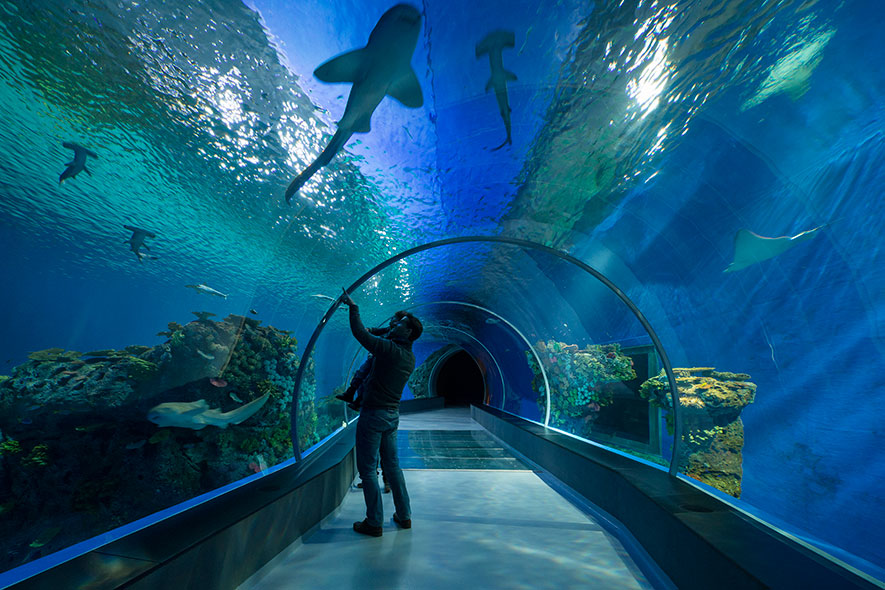
The whirlpool
Inspired by the shape of water in endless motion, Denmark's new National Aquarium, located on an elevated headland towards the sea, north of Kastrup harbor, is shaped as a great whirlpool, and the building itself tells the story of what awaits inside.Its distinctive shape is clearly visible for travelers arriving by plane at the nearby Copenhagen Airport. The facade is covered with small diamond-shaped aluminum plates, known as shingles, which adapts to the building's organic form. Just as water aluminium reflects the colors and light of the sky and thus the buildings expression varies with the changes in its natural surroundings.
Out of the World Experience
Visitors reach the entrance by following the first and longest of the whirlpool's whirls. With a smooth transition, the landscape surpasses for the building, while the outdoor ponds mark the unique experience that awaits the aquarium visitors as they enter The Blue Planet: the whirlpool has pulled them into another world - a world beneath the surface of the sea.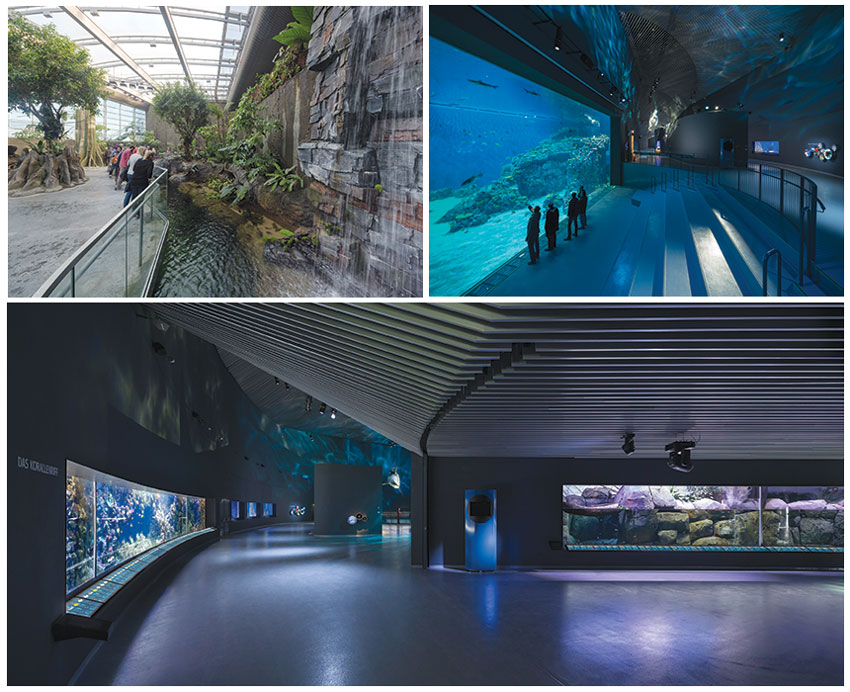
According to Kim Herforth Nielsen, Creative Director, 3XN and architect of the building,"Our wish was to bring our visitors all the way down to the world of the fish. Therefore, the design of The Blue Planet is based on the story about water and life under the sea. We visualise the construction as a whirlpool which draws visitors into the depths to the fascinating experiences waiting among fish and sea animals from all over the world."
Flexible Movement Between Exhibitions
The circular foyer is the central point of navigation in the aquarium. Here visitors choose which river, lake or ocean to explore. By enabling multiple routes the risk of queues in front of individual aquariums is reduced. Each exhibition has its own theme and entrance from the foyer, where sound and images are used to introduce the atmosphere of the different exhibition areas. The restaurant enjoys a magnificent view of the sea, which begins just a few meters away.Chairman of Denmark's Aquarium, Professor Flemming Frandsen, is looking forward to The Blue Planet as a centre for new experiences in the Øresund region. He stated, "Our ambition is to welcome 700,000 guests each year, thus being one of Denmark's five largest tourist attractions. Now, we have an aquarium, which compares to the world elite of aquariums and that brings us close to the biology of the sea and strengthens our interest in natural science".
During a tourism conference "A New Way to Grow" 2012, the Blue Planet was chosen as Denmark's best lighthouse project within experience economy, because of its potential for growth, influence on regional development, innovation, realization as well as its uniqueness and 'reason to go'.
3XN’s Wonders. . .
Eight Pointed Star-Shaped UN City, Copenhagen
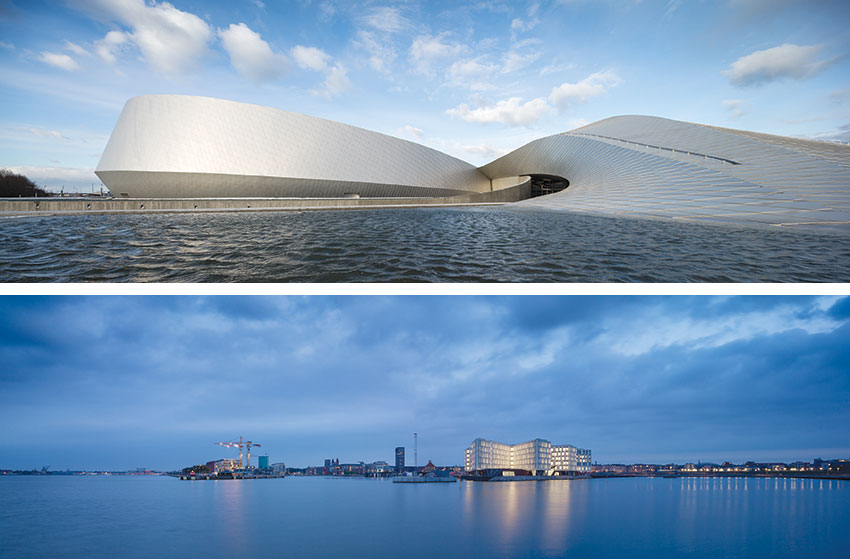
3XN, founded as Nielsen, Nielsen and Nielsen in Aarhus in 1986 by the architects Kim Herforth Nielsen, Lars Frank Nielsen (partner until 2002) and Hans Peter Svendler Nielsen (partner until 1992), the studio, today, is famous for two things--their preference for social and humane architecture, and projects demanding a high level of detail and employing workmanship of the highest quality.
The studio emphasizes on curiosity, originality and poetry and creates architecture for people through a complex approach tailored to users and clients. They translates visions into reality and is continually committed to making today's work tomorrow's architectural heritage.
Based on their this design philosophy, the Studio designed many prestigious projects including its latest projects 'The new regional head office of the United Nations in Copenhagen' and The Blue Planet in Denmark that have won many accolades and recognition worldwide.
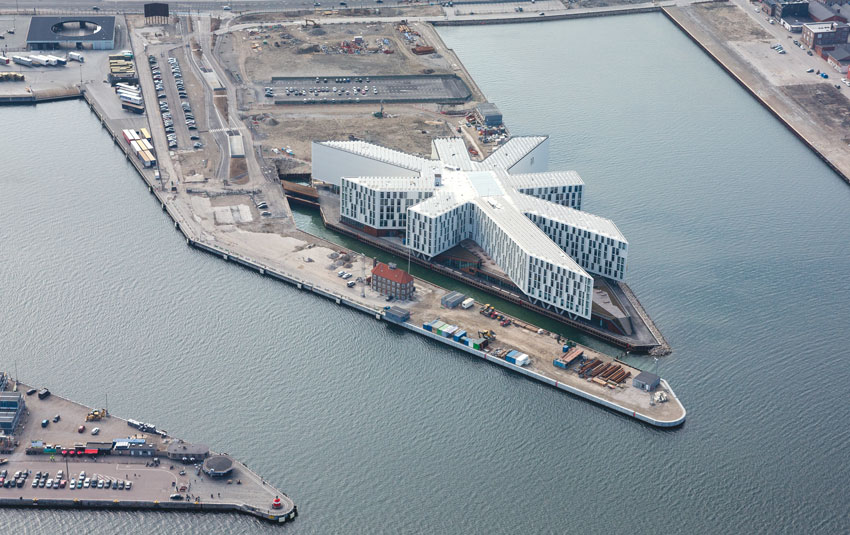
UN City has been designed with clear references to the UN's identity and values. It is a building that physically reaches out to all parts of the world, while the sculptural staircase in its core reflects the UN's work to create global dialogue. Being completed and delivered in two phases: Phase 1 in 2012 and phase 2 in 2013, the project was officially inaugurated on July 4 2013 with the participation of the General Secretary of the UN.
Bringing together the various agencies and functions of the United Nations regional offices in Copenhagen, the new UN City is located at Marmormolen (The Marble Pier) north of Copenhagen's city center. 3XN's design is a response to the UN's wishes for an iconic building expressing the organization's values and authority. More specifically, the design reflects the independent, efficient and professional nature of each UN unit, while at the same time clearly rooted in a mutual set of values - Delivering as One.
High security and accessibility standards have been central considerations in the design of the new main office building. The UN City must live up to the most stringent requirements, providing a protected and safe environment, while at the same time appearing open and accommodating to the city.
Located on an artificial island, the building is naturally separated from its immediate surroundings, while still being highly visible from both the city and the water.
The Star
From above, the eight-pointed star shape is a clear visual reference point, which, like the UN, reaches out to all corners of the world. Similar to the surrounding rusty pier edges, the UN city has a dark burnished steel base from which the white main building rises. This is a reference to the elegant white ships that characterize this part of the Copenhagen harbor.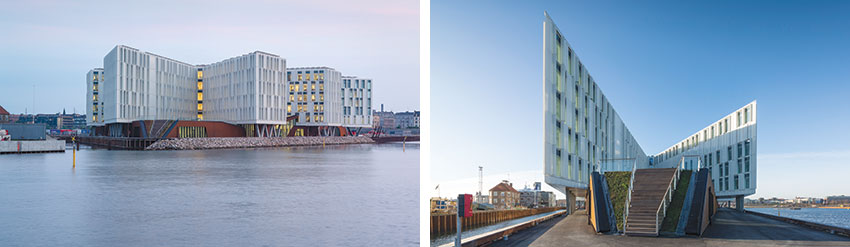
The building has a façade cladding of white perforated aluminum shutters, developed by 3XN and contractor Pihl specifically for the UN City. The shutters ensure solar shading without blocking the view or the daylight. Since the facade is divided into three meter long modules, it is possible for the employees to control the sunshade from their computers. The result is an improved indoor environment, and a dynamic façade expressing a building full of life.
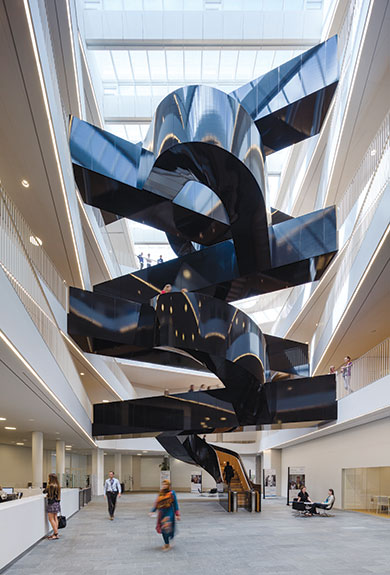
From the atrium a central staircase binds all levels together. 3XN has created the staircase as a dramatic spatial sculpture, which is to be seen as a symbol of the UN's work to create dialogue, interaction and positive encounters between people in all parts of the world. In the daily life, the sculptural form inspires the UN employees to use the stairs, and thus the staircase also forms the basis for dialogue, cooperation and informal meetings between the various UN organizations.
The main office building has more than 90 meeting rooms including a number of flexible rooms on each floor that staff can use for various purposes. The auditorium is a conference facility with a total capacity of 450 people. For smaller conferences and meetings, the auditorium can be divided into smaller rooms by using specially designed partitions.
Sustainability
Air quality - The building has been designed to limit the use of chemicals and pollutants during both its construction and its use. The building is entirely ventilated with filtered outside air. This ensures that only clean, fresh air is present in the building and helps balance the interior humidity level.
Solar panels - more than 1,400 solar panels are lining the roof of the building to support the goal of generating renewable energy onsite. With an estimated total production of 297,000 kWh/year, the solar panels significantly reduce the need for electricity from the grid.
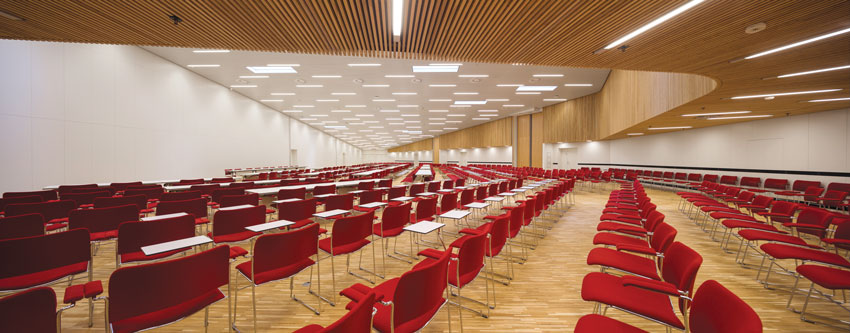
| At a Glance | |
| Project | : UN City, Copenhagen |
| Client | : FN Byen p.s. (Copenhagen Port & City Development) |
| Architect | : 3XN |
| Engineer | : Orbicon a/s |
| Landscape | : Schønherr |
| Contractor | : Pihl A/S |
| Interior Design | : PLH / UN Common Services |
| Size | : 45,000 m2 office and public facilities + 7,000 m2 archives and secondary facilities |
| Capacity | : 1700 employees |
| Budget | : Approx. 134 mio. EURO |
| Picture Courtesy | : Adam M¢rk |
Sea water cooling - Cold seawater pumped into the building's cooling system, almost entirely eliminating the need for electricity to power the cooling cycle.
Water efficiency - Innovative aerators have been placed in the taps in kitchens, toilets and showers throughout the building. The low-flow taps reduce water usage. In addition, pipes on the roof capture almost 3,000,000 litres of rainwater annually, which is almost enough to flush the toilets of the entire building without using potable water.
Solar shades - Sophisticated solar shades on the building's facade can be opened and closed to either trap or reflect the sun's heat.
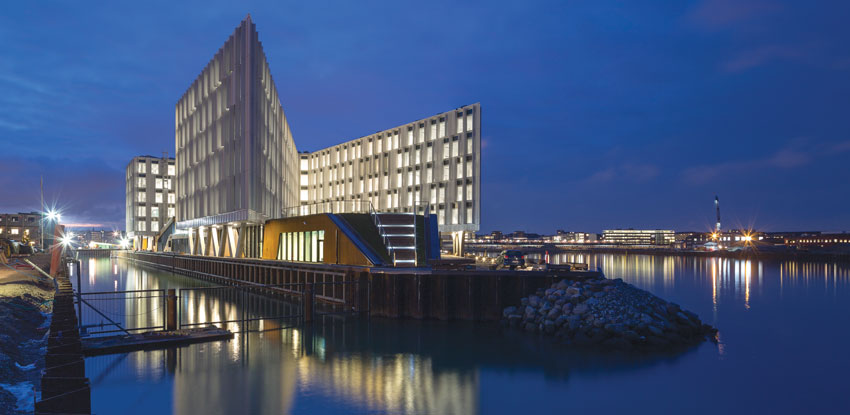
Reflective roofs - The roof of the building has been coated with a white, recyclable membrane, made from plant-based materials. The environment–friendly coating reflects sunlight and reduces the solar warming of the building.
The UN City is expected to become one of Denmark's most energy efficient buildings with an annual energy consumption of less than 50 KwH per m2 (Danish Energy Class 1). The UN City is registered with the LEED sustainability ratings system with the certification goal of LEED® Platinum. UN City has been awarded the prestigious Green Building Award 2012 by the European Commission.
Swimming Pools Are Here to Stay, but at What Cost?
We do understand the aspirations of those who have enough disposable incomes to demand such super luxurious supersized designer apartments. We also are aware of the new demand created by those who would want to reconstruct their old-style villa to match the latest lifestyle trend.
What we don't understand is the lack of awareness amongst these people about a sustainable living. One should be conscious of certain facts like how a badly constructed house that consumes more than the required amount of electricity and the water guzzling swimming pools inside them can cause great imbalance to the natural resources of the already crowded urban areas.
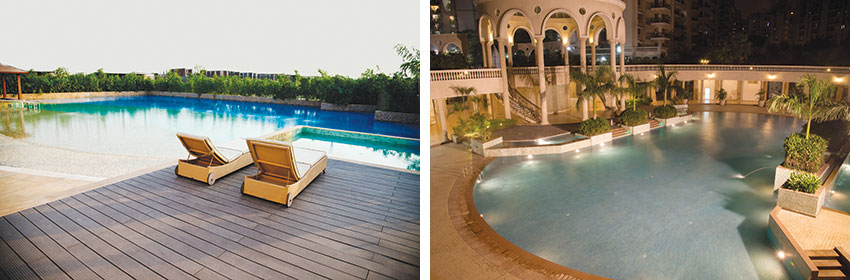
Talking about the most important component of life; water, is already an area of contention amongst many Indian states. While the government is trying its best to regulate usage, we all must understand that water is too precious to be wasted.
While we tap water for leisure, we should know that a badly constructed swimming pool can prove too expensive for the environment as well as for you, as a consumer. Each one of us needs to be better aware to demand quality.
The Indian Plumbing Association, in collaboration with the US-based International Association of Plumbing and Mechanical Officials (IAPMO), has drawn up a code for swimming pools in India.
One such code was the need of the hour as the National Building code never had any norms for swimming pools at present. In March 2011, the ‘Uniform Swimming Pool Code – India' was documented. The code provides information on materials to be used, water heating, vents, chlorinators and the piping standards that ought to be followed.
While the manufacturers and construction organizations shall refer to this code, we as consumers should also make sure we do not compromise on quality and standards.
They still don't issue licenses to practice swimming pool construction in India. There are many players crowding the market who commit to projects without knowing the scope of what they are undertaking. Then in order to quote less to bag the project, they mindlessly compromise on quality. The worst part is, they keep the consumer in the dark and by the time your pool is up and working, your costs go up by almost 50%.
For instance, if there are constant problems with filtration, then though the maintenance charges would take care of it, the fact remains that the quality was compromised right at the outset. But, the customer had incurred all the cost for it.
Environmentally, a malfunctioning filtration system proves disastrous. Where the plumbing and filtration cannot efficiently handle the cleaning of pool water, one is stuck with water that is always riddled with dirt and potential disease causing germs. Now cleaning this, would consume high amounts of electricity as the pump for the filter is required to run for a longer duration.
One may decide to sanitize the pool, ending up dumping too many chemicals into the water. This will bring in its own set of problems, and at last you would have no option but to change the pool water. This is what makes you deplete the ground water levels in your area, for your leisure.
The repercussions of not having chosen the right pool builder, is not just limited to frequent draining out of pool water, of late this has resulted into much fatal consequences. Most of us are aware of a recent accident where a gentleman lost his life to electrocution in the pool.
Use of energy efficient lighting is also important. Hardly any one of us is aware of the fact that in an ideal situation there shouldn't be any electrical device operating at more than 12 volts in the entire pool surrounding area. One can ensure safety by adhering to quality standards.
Let's not blame the pool owners alone. We need to be better aware to demand the best quality and ensure that our lifestyle in urban India is not becoming a threat to the other half.
Premium Pool's innovative approach towards sustainability
Be assured that achieving sustainability doesn't mean loss of luxury. It's all about creating a demand for sustainable homes of which innumerable benefits accrue by the way of reduction in water and electricity bills.With pools, a simple way to ensure happiness is by taking care of durability, comfort and long-term cost benefits. This can only be done by choosing the right builder at the onset.
We at Premium Pools are confident of being an unrivalled pool design and construction company that has helped several green buildings achieve better energy and water efficiency.
World over, this industry is operating within stipulated guidelines and following strict standards with respect to safety and quality. In India, surprisingly, what gets the least attention is safety itself.
With our commitment to make any and every swimming pool safe and clean, we decided to partner with international experts.
Having the distinction of collaborating with America's No. 1 pool builder – Premier Pools and Spas in addition to a tie-up with Europe's largest swimming pool builder, Albixon, for the state-of the art equipment, we have always been inspired to deliver projects that have distinguished themselves in numerous ways.
We are also confident of a great team on board that has to its credit, hands-on experience with some of the prestigious projects internationally, making it easier for us to stick to our commitment to quality.
Working close to such standards, every year, we have turned down projects looking on to the psyche of Indian customers and people involved with a swimming pool. Sadly, the mindset remains restricted to treating a pool as a commodity. In fact, we can go on to the extent of saying that it's better not to have a pool than end up having something which is a great financial as well as environmental burden.
This industry remains unregulated with no entry barrier and it is upon us to help streamline things to help the industry gain a proportionate capital share to help every business concern sustain itself to offer the best of swimming pools that are a good investment in every respect.
Currently, the industry can't look within to compete as there is lack of expertise and hardly would you find someone living upto the claims of making a good pool.
In fact, a great way to help the industry see new heights is by coming at par with other industries where people are tapping luxury in every way looking on to the kind of incomes at their disposal.
Unique Projects Undertaken
Aahana Resort
Jim Corbett National Park situated at Nainital district Uttrakhand is one of the oldest Tiger Reserves known for the preservation of the endangered Bengal tiger enjoys unique geographical features that have made it one of the most sought after tourist destinations in Asia. It is just a 4 hour drive from Delhi NCR. Tourists apart from exploring the beauty of the jungle through nature walks, jeep or elephant safari also enjoy the world class human innovation i.e. the resorts.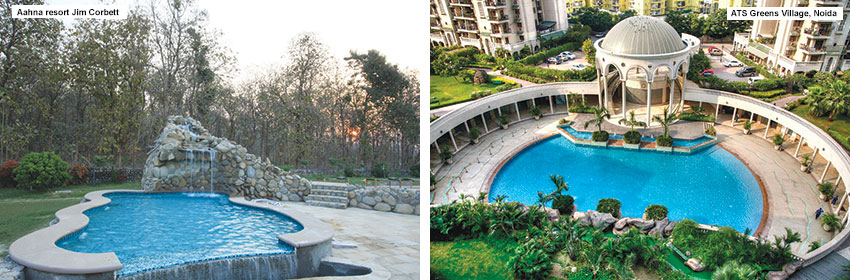
While you have almost all the resorts along the river, Ahana – The Corbett Wilderness broke the conventional tradition as it touches the forest of Corbett all along its entire length on the north-eastern boundary. The founder of the property Mr. Kamal Tripathi while creating his resort had in mind to make it a spa destination incorporating in it all the five elements of nature i.e air, water, sky, fire and earth, and hence ensuring it to be at par with any world class spa destination. Therefore, the challenge before Premium Pools was to design the entire Landscape in a way that the pool completely blended with the forest in the backdrop, giving an impression like it always existed there and is not a man-made structure.
With the innovative approach that Premium Pools follow, the end result has been that the pool completely blends with the jungle creating a reverse infinity effect on its back, and the vanishing edge of the pool towards the side facing the restaurant gives it a floating restaurant effect.
Pools at The ATS Village, Noida
The ATS Village pool brought out our best in terms of our creative efforts. This pool, like many others, has certain distinctive features.The ATS Village mega pool is a sunken pool. This means it is built below the land level. We planned everything down to the tiniest detail, including the kind of plantation that would surround it, the colours that would best go with the spirit of the housing group, the way sunlight would fall on the structure and so on and so forth.
We also brought in tiny twists that would make the pool a conversation piece in its own right-the bubbling water, for instance. Water bodies are equally loved for the distinct bubbling sound they make as for providing refreshing coolness. At ATS, we built little bubblers into the pool and constructed a stone set-up to have waterfalls cascade.
So, just sitting by the poolside relaxes busy people back from a hectic day at work.
We also built 39 individual pools for penthouse and row house owners. These pools are family hangout junctions which add an exotic element to the living space. At night, the pools provide a party point for the residents and add luxury to everyday living.
The ATS Village pool was a turning point in the Premium Pools story, as it catapulted us into a different creative zone.
Mr. Gitambar Anand's faith in our abilities helped us push many creative boundaries. With this project, Premium Pools started functioning on a wider orbit.
Wave Pool at Paramount Golf Foreste, Greater Noida
A wave pool is a swimming pool with wave generator fixed at the deeper end, that creates waves in the water by compressing the water beneath, with the release of air through air compressor. With the wave being generated at regular intervals the swimmers in the pool get a tacit feel of swimming in ocean. The earliest wave pools date to the 1940s in the United States, and the concept has since spread widely across the world.Now we have a few of these being done in India as well, with the latest one being at Paramount Golfforeste which was a big challenge in itself, as we had to do away with the conventional funnel shape [funnel shape is given to the wave pool as the wave is generated at the narrow end of funnel and it terminates at broader shallow end] but still had to have the wave of same intensity. The shape of the pool was a constraint as this was the first wave pool in the country, which was to be used as group housing pool, hence apart from the technical prerequisites, even the aesthetic aspects of landscape were not to be compromised with. This pool is spread over an area of 8000 sqft and boasts of one of the finest landscape architecture.
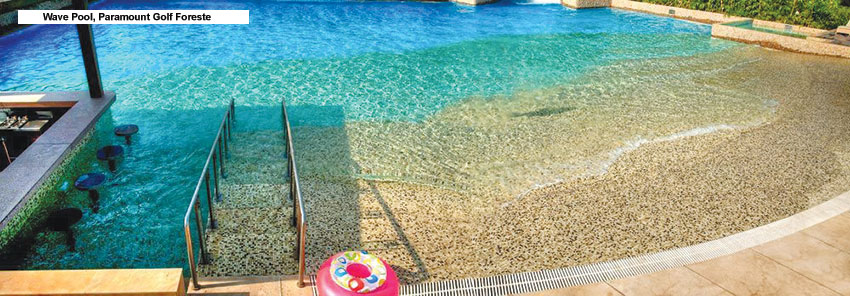
Apart from creating the waves in the pool, various other features like having sunken bar attached to the pool, having a small pool for toddlers which had to remain immune from the waves that were generated, and incorporating all this, given in the shape which we had been restricted to, was a task to reckon with.