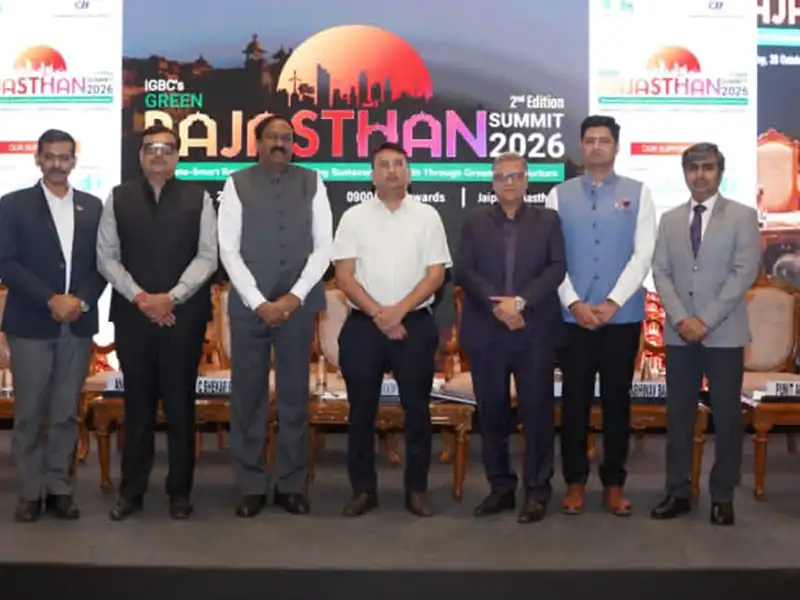
The summit examined how Rajasthan could embed sustainability across its expanding urban centres, industrial zones, commercial developments and public infrastructure while strengthening long-term economic competitiveness and environmental resilience. The deliberations underscored the need for coordinated action by government, industry and the real estate sector to develop future-ready communities, improve building performance, reduce carbon emissions and use resources more efficiently. The programme included an inaugural session, a panel discussion on sustainable infrastructure and climate-smart growth, a technical session on net-zero buildings, and a stakeholder consultation on accelerating the adoption of low-carbon cement in India’s built environment.
Shri Om Prakash Kasera, IAS, Commissioner, Jaipur Municipal Corporation & CEO, Jaipur Smart City Limited, highlighted the role of sustainable urban planning and municipal infrastructure in building climate-resilient cities. He said, “Sustainability must become the foundation of urban development, not an afterthought. As Rajasthan advances its growth ambitions, green buildings, resource efficiency and climate-resilient infrastructure must be integral to every city’s planning and development. Strong collaboration between the Government, urban local bodies, industry and IGBC will be key to creating cities that are not only economically vibrant but also environmentally responsible and livable for future generations.”
The inaugural session, titled “Climate-Smart Rajasthan: Vision, Leadership and the Road Ahead,” set the context for discussions on sustainable development, green buildings and resource-efficient urban growth. It featured welcome remarks and an opening address by Mr. Sunil Jain, Co-Chairman, IGBC Jaipur Chapter ; a theme address by Mr. M Anand, Executive Director, CII–IGBC; and perspectives from real estate and industry leaders on sustainable communities, competitive growth and India’s green building movement.
Addressing the summit, Mr. C Shekar Reddy, National Chairman, CII Indian Green Building Council, said, “Rajasthan has the opportunity to set a national benchmark by integrating sustainability into the very foundation of its growth story. With over 750 registered IGBC projects covering more than 230 million sq. ft., the State has built strong momentum in green development. The next step is to scale this ambition across industrial parks, urban infrastructure, housing and townships. IGBC remains committed to working with the Government of Rajasthan and industry stakeholders to transform this vision into measurable impact and position Rajasthan as a frontrunner in sustainable, climate-resilient development.”
Mr. Sunil Jain, Co-Chair, IGBC Jaipur Chapter, in his welcome address set the context when he said, “The future of sustainable development will be shaped by how effectively we translate green building principles into large-scale action. With over 750 registered IGBC projects spanning more than 230 million sq. ft., Rajasthan has made significant strides in advancing the green building movement. The focus must now shift towards sustainable communities, low-carbon construction and Net Zero buildings, backed by scalable pilot projects that demonstrate tangible environmental and economic benefits. The 2nd Green Rajasthan Summit provides an important platform to accelerate this transition through collaboration, innovation and decisive action.”
Mr. M. Anand, Executive Director, CII Indian Green Building Council while giving the theme address said, “Green buildings are essential to creating a sustainable built environment, offering tangible benefits through energy efficiency, water conservation and reduced environmental impact. By integrating sustainable design, resource-efficient technologies and responsible construction practices, we can significantly lower operating costs while enhancing occupant well-being. The focus must be on making green buildings the norm rather than the exception across residential, commercial and institutional developments.”
The panel discussion, “Building Tomorrow’s Rajasthan – Green Buildings, Sustainable Infrastructure and Climate-Smart Growth,” examined how government, industry and the real estate sector could work together to integrate sustainability into the state’s expanding urban centres, industrial zones and commercial developments. Representatives from the Public Works Department, real estate, architecture, academia and the hospitality sector discussed approaches to creating future-ready communities and sustainable infrastructure while reducing environmental impacts. The deliberations emphasised cross-sector collaboration in planning and implementing green building practices and climate-responsive development solutions.
The technical session, “Net Zero Buildings and Future-Ready Infrastructure: Technologies Shaping the Built Environment,” focused on practical solutions to improve building performance, reduce carbon emissions and enhance resource efficiency. Chaired by Dr Sudipti Arora, Chairperson, CII–IWN Rajasthan, and Research Scientist & Director, Dr B Lal Institute of Biotechnology, the session featured presentations on net-zero frameworks, benchmarks and India’s roadmap; materials for decarbonisation and resilience; and smart rainwater systems for water-positive infrastructure. Mr Naveen Jain, Counsellor, CII–IGBC; Mr Gopinath U, Manager – Sustainability, Saint-Gobain India Private Limited; and Mr Siddharth Srivastava, AVP – Government Business & Strategic Alliances, Retas Enviro Solutions Pvt Ltd, contributed technical and industry perspectives.
The stakeholder consultation and panel discussion, “Accelerating the Acceptance of Low-Carbon Cement in India’s Built Environment,” addressed the need to reduce embodied carbon in buildings and infrastructure without compromising performance, affordability or scalability. Representatives from government, cement manufacturing, real estate, infrastructure agencies, architecture, consulting and academia examined market readiness, identified barriers to wider adoption and discussed a way forward for low-carbon cement. Ms Shashi Kala Agrawal, Senior Counsellor, CII–Green Business Centre, delivered a context-setting presentation on reducing embodied carbon in buildings and infrastructure, followed by deliberations among experts from the cement, real estate, architecture and construction sectors.
The Green Rajasthan Summit 2026 strengthened dialogue among policymakers, industry stakeholders and sustainability practitioners on advancing green infrastructure and climate-smart development. Its focus on green buildings, net-zero technologies, water-efficient solutions and low-carbon construction materials highlighted the importance of collaborative action to create a resource-efficient and environmentally responsible built environment. The discussions explored practical approaches to sustainable urban and industrial growth and ways to encourage wider adoption of green building practices across Rajasthan.