Manoj Kumar, Sr. VP, Operations & Technical, ModDwell, shares the essential challenges of designing and constructing façades for super-tall buildings.
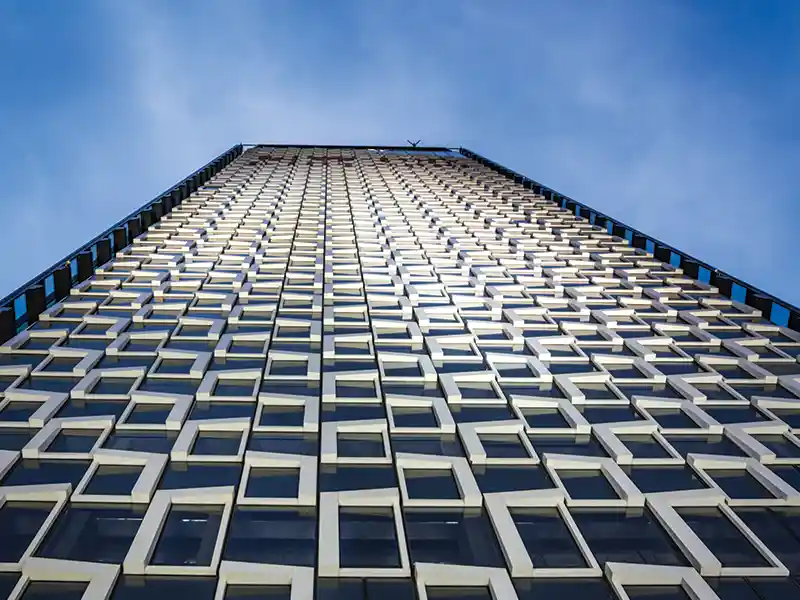
Design Challenges
Designing the façade of a very high-rise building is one of the most technically demanding responsibilities in contemporary architecture. Beyond aesthetics, the façade becomes the building’s structural shield, thermal regulator, acoustic barrier, and first line of defense against weather and fire.As towers rise higher, the challenges grow exponentially. Systems that work at 20 storeys cannot be assumed safe or efficient at 80 or 120. Every decision—material, geometry, anchorage, and detailing—carries far greater consequences at altitude.
Wind Movement and Structural Behaviour
Wind dominates high-rise façade engineering. At higher elevations, buildings experience stronger positive and negative pressures, rapid pressure fluctuations, and dynamic responses such as vortex shedding and inter-storey drift. These movements can easily overstress aluminium profiles, damage gaskets, or cause glass failure if not adequately addressed.Unitized curtain walls are the preferred solution, but they must be engineered for high wind loads, panel weight, and the building’s movement profile. Slotted anchors, heavy-duty brackets, and carefully sized mullions prevent load transfer to the glass. In towers with twisting or tapering geometries, maintaining panel alignment and weatherproofing becomes a demanding exercise in tolerance management.
When done well, the façade becomes a long-term asset: efficient, durable, resilient, and visually defining, but a poorly performing façade locks the building into decades of inefficiency

Material Selection: Climate, Orientation, and Durability
Material choices for high-rise façades are highly climate dependent. Glass selection must balance solar control, natural lighting, and glare. Hot climates require low-SHGC, spectrally selective coatings, while cooler climates may require advanced double- or triple-glazing. South and west façades require stronger solar control than north-facing façades. At high altitudes, temperature gradients and wind-induced deflections place additional stress on the glass, making thickness, laminate composition, and heat treatment critical.Aluminium framing must balance strength, durability, and thermal performance. High-strength alloys, large section depths, and reliable thermal breaks are essential to control heat transfer, condensation, and structural deflection. Expansion and corrosion risks rise significantly with height and exposure.
Sealants and gaskets are exposed to extreme UV radiation, wind-driven rain, and continuous temperature cycling. Only premium silicones and EPDM gaskets deliver the decades of performance required. A weak seal at height can compromise the entire façade.
Hardware, Anchors, and Component Engineering
Anchoring a façade hundreds of meters above ground requires engineering precision. Anchors must withstand uplift, suction, cyclic loads, and potential seismic forces. Slotted connections and adjustable brackets allow the façade to move with the structure without transferring unwanted load to the glazing.Within the façade system, pressure plates, setting blocks, cleats, and gaskets must perform under high wind pressures. Minor installation errors at lower floors can be magnified significantly by upper levels, making quality control non-negotiable.
Installation equipment such as BMUs, hoists, spider cranes, and specialised lifting rigs, must operate safely within narrow wind limits. High winds routinely interrupt installation sequences, affecting timelines and logistics.
Energy Efficiency, Acoustics, and Indoor Environment
The façade is the primary driver of energy performance in tall buildings. High-performance glazing, adequate thermal breaks, and airtight frames reduce cooling loads and stabilise indoor conditions. A poorly performing façade locks the building into decades of inefficiency.Acoustic performance is equally critical. High-rise environments are exposed to wind, city, and mechanical noise from neighbouring towers. Laminated glass, asymmetric DGU configurations, and strong façade airtightness are essential for achieving a 40–45 dB reduction.
Indoor air quality depends heavily on airtightness. Stack effect intensifies with height, causing powerful upward airflow that can draw in dust, warm air, or pollutants through small gaps. Precision in gaskets and sealants ensures stable indoor air.
Ventilation is challenging. Operable windows are typically restricted due to safety and pressure concerns. When natural ventilation is required, it must be provided through controlled façade vents or restricted openers.
Fire Safety: A Critical Constraint
Fire safety in high-rise façades demands absolute discipline. Continuous fire stops, mineral wool insulation, fire-rated spandrels, and intumescent sealants prevent vertical and horizontal fire spread. Any discontinuity can become a rapid-fire path.Non-combustible materials, especially insulation and cladding,are mandatory. The façade must integrate seamlessly with pressurisation and smoke-control systems to maintain fire compartmentation.