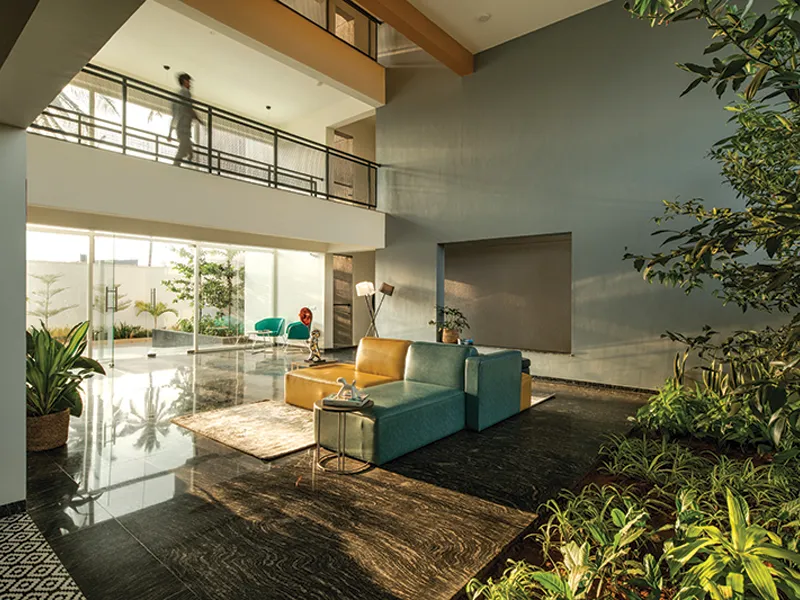
Crease House is an inward sanctuary shaped by folds in stone, light, and space, its curves accentuated in black Indian stone, contrasting against the muted textures of cemento and ossidare renders.
Vaibhav Dimri

Tucked into a densely packed neighbourhood and adjoined on three sides, Crease House rethinks the urban infill typology through a series of deliberate curvilinear interventions. The house is both an architectural experiment and a nuanced response to site constraints—integrating structural innovation with intimate spatiality.
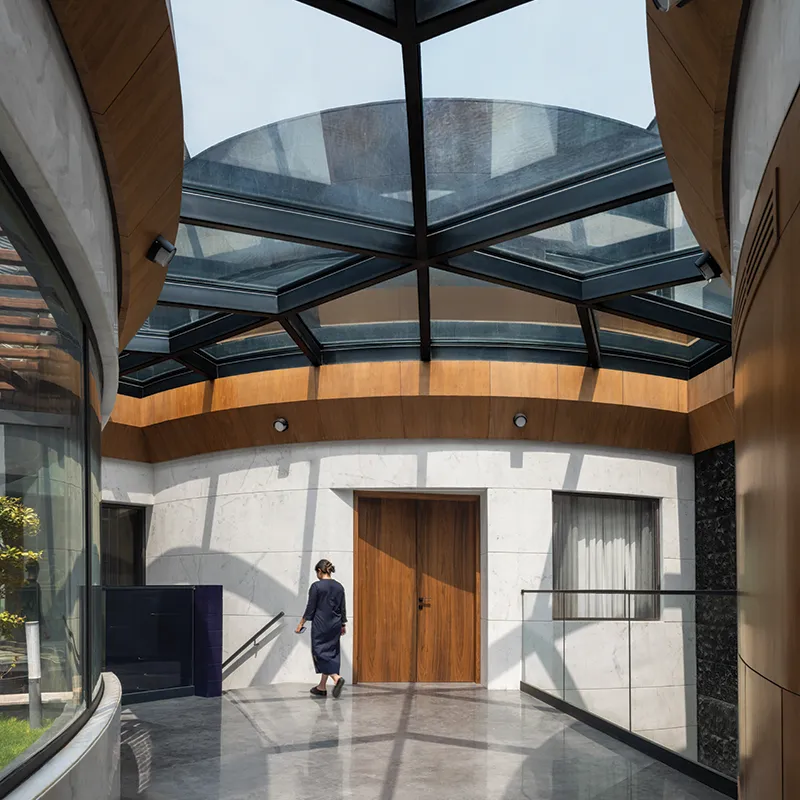
It is organised around three sweeping curves that traverse its vertical volume. These arcs divide each floor into three distinct zones, while simultaneously enveloping a central void that acts as a light well, visually and spatially binding all levels. In doing so, the design inverts the typical sectional hierarchy of Delhi homes, drawing daylight and visual relief into the depth of the plan.
Fact File
Location: Delhi
Built-up Area: 630 sqm
Plot Size: 8150 sqm
Civil Contractor: Adhunik Infrastructures
Electrical: Electropower
Plumbing: Suved Encon
Landscaping: Greentech Landscape
Photography: Studio Lokesh Dang
Sanitaryware: Kohler
Flooring: Kota, Cemento
Wall Finishing/Brick Cladding: Greenheart
Furniture: Gulmohar Lane, Dtale Modern
Lighting: Purple Turtles, Clay Mango, Ledos
Ceiling: Vox India
Outdoor Furniture: Home Canvas
Where the arcs meet the plot’s edges, they open creases—narrow interstices that allow light, air, and glimpses of green into the building. Toward the front, they extend outward to create balconied niches that frame views while protecting privacy. These folds, at once functional and formal, give the building its defining identity.
Materially, the curves are accentuated in black Indian stone, contrasting against the muted textures of cemento and ossidare renders on the rest of the façade. This play of light and dark, rough and smooth, reinforces the tectonic dialogue of the house. Inside, the palette softens with Banswara white marble, which enhances the passage of natural light while offering a sense of restraint and calm.
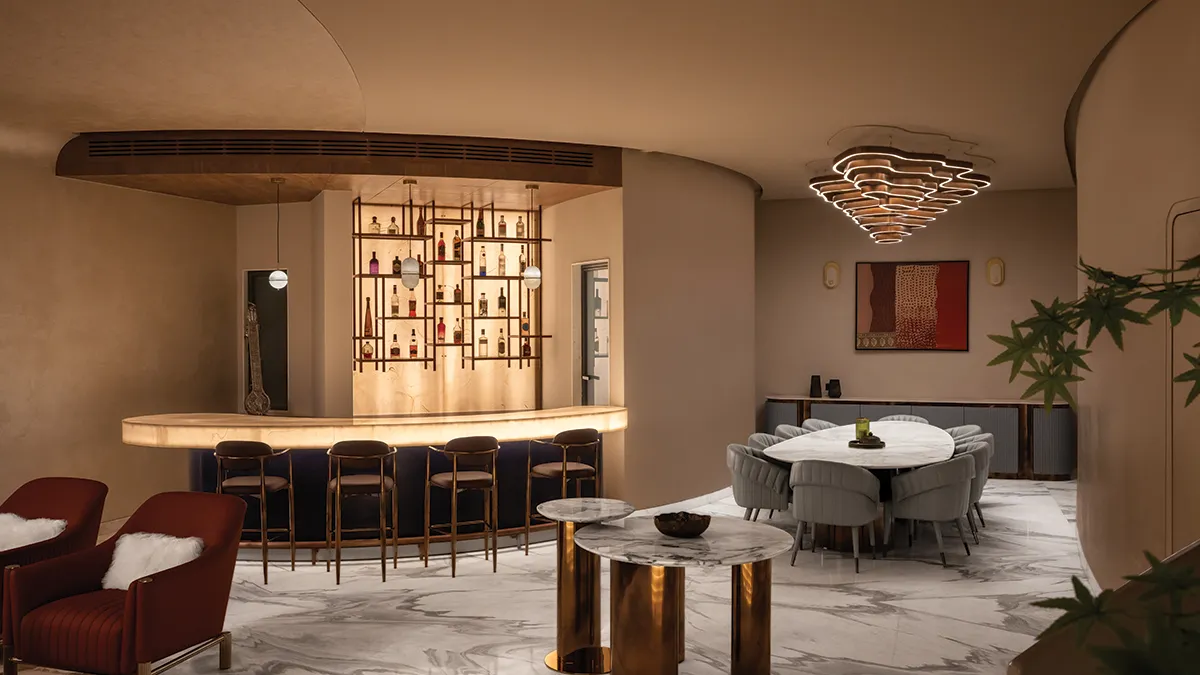
The central atrium culminates in a skylight above and spills out into three small courtyards at its base—dispersing light across all levels and facilitating natural ventilation. These voids extend the life of the home into small pockets of nature, while the angular interstitial spaces—natural byproducts of the curving walls—are claimed as green corners distributed across the house.
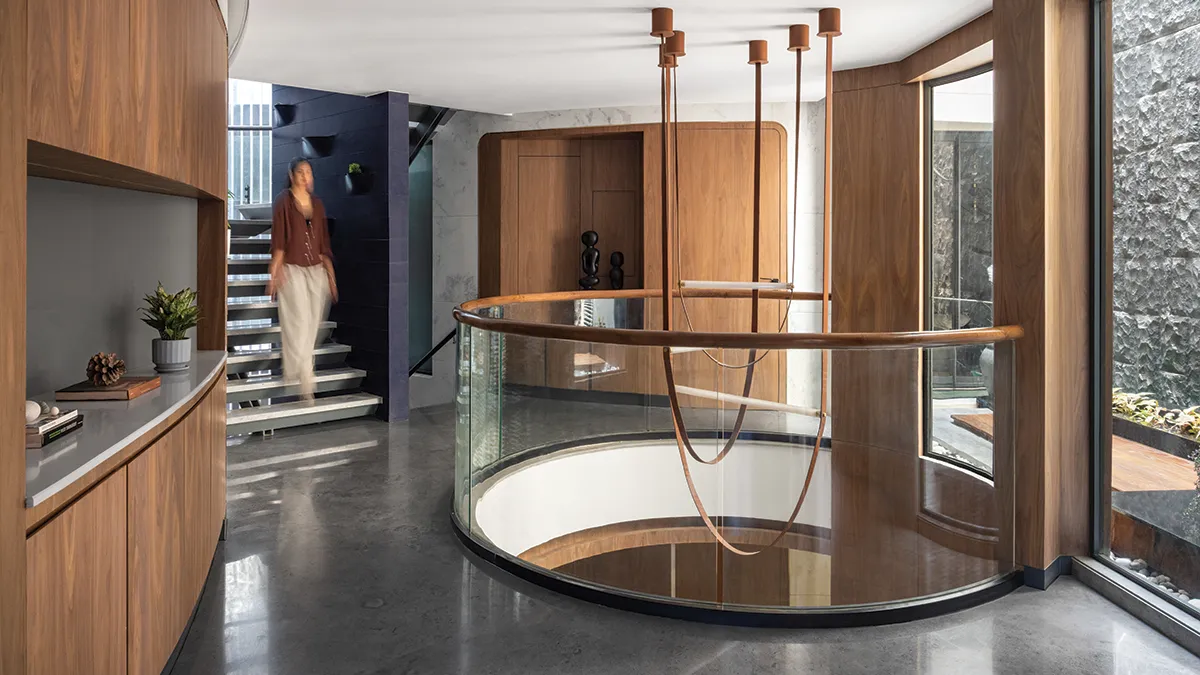
In a cityscape defined by rectilinear constraints and party-wall typologies, Crease House offers an alternative: a fluid geometry that carves space rather than assembles it, and one that blurs the threshold between enclosure and openness, precision and softness, nature and form.