As India’s cities expand, redevelopment projects are rapidly reshaping our city skylines, but this transformation invariably brings some serious challenges, particularly to the natural ecosystem of the areas being urbanized.
Akash Pharande, Managing Director, Pharande Spaces
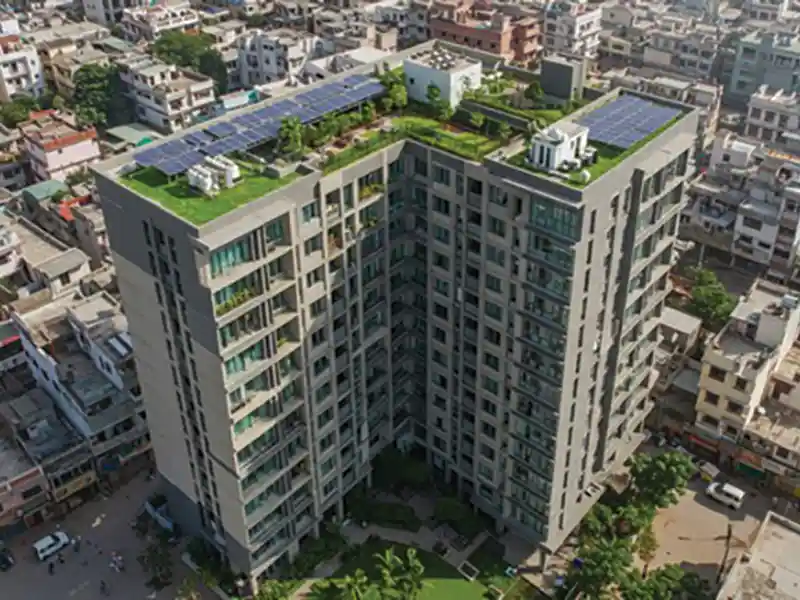
If done right, sustainable real estate uses less than half the water and energy of regular, older buildings. This reduces their environmental footprint, which is crucial in a time and place where climate change and increasing resource scarcity are serious concerns.
India has been at the forefront of the Paris Accord on climate change, which makes sustainability a national responsibility – not only of real estate developers but also consumers of real estate. Responsible building practices and insistence on sustainability features in the spaces we occupy are no longer optional.
Redevelopment While Respecting Nature
The Ministry of Urban Development issued its Model Building Bylaws in 2016, which are compulsory for all plots above 100 square metres, and cover a significant chunk of redevelopment projects. Under its provisions, one tree must be planted for every 80 square meters being developed; three new trees must be planted for every tree chopped down; and the development must retain a minimum of 20% of unpaved land for open or recreational green space.This is a critical measure to protect biodiversity amid densely urbanized areas. It is also important because redevelopment is driven by a clear profit motive, and the first instinct for precious space in city centres is to build up every available square foot as marketable real estate.
The Ecological Toll of Construction
Despite these and other related mitigation measures, there is no getting completely around the ecological consequences of construction, which involves clearing of vegetation, deep excavation work, and the use of heavy machinery. This has a direct impact on the natural habitats of birds, insects, and smaller animals. At the same time, the use of fossil fuels, paints, solvents, and volatile organic compounds in construction and development releases heavy pollutants that seep into the soil and groundwater.Particulate matter severely impacts the air quality in a construction site even as toxic effluents play havoc with the aquatic ecosystems. At any construction site, the local flora and fauna are the silent victims.
We need to realize that sustainability is not just a construction strategy and the responsibility of real estate developers, rather, it is a responsibility we all share to build and inhabit a nation whose progress does not come at the expense of the environment.

Green Construction Lessens Ecological Impact
When any development or redevelopment is done from a sustainable construction perspective, it will involve materials that are gentler in their ecological impact. Greener construction materials include bricks made of fly ash, bamboo, autoclaved aerated concrete panels, and less dense concrete. Not only do these materials put less pressure on the environment, but they are also largely recyclable.Sustainable development also involves better insulation materials, which reduce the need for power-intensive climate controls like Acs (which also use very harmful coolant gas), and reduce overall emissions. At the same time, technologies like solar panels and passive solar designs reduce reliance on fossil fuels, while “cool” roofs treated with reflective paint help counteract the harmful urban heat island effect. Redevelopment, therefore, must coexist more respectfully with the ecology.