India’s success of its high-rise developments will depend on developers who look beyond glass and steel and see towers not just as vertical structures, but as living ecosystems.
Avneesh Sood, Director, Eros Group
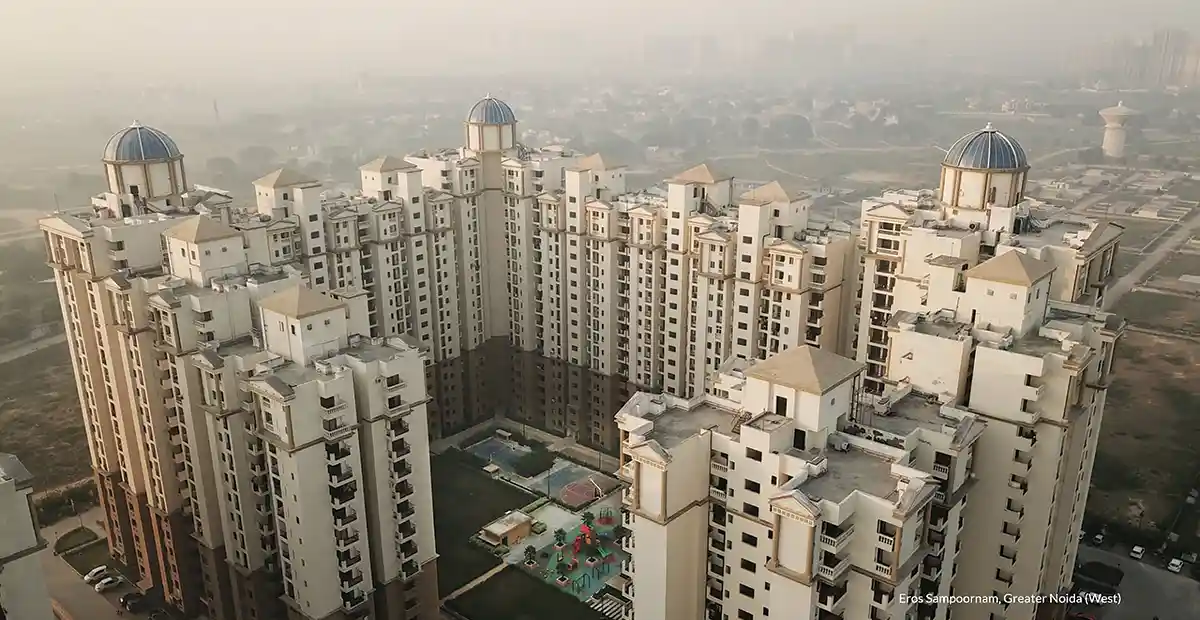
As cities run out of horizontal land, high-rise developments have emerged as the most viable response to rapid urbanisation and population density. From Gurugram’s shimmering commercial towers to the skyline of Greater Noida West, vertical construction is not merely a design preference but an economic necessity.
Yet, these buildings also bring complex infrastructural and sustainability challenges such as ensuring uninterrupted water supply, managing waste efficiently, guaranteeing power, providing mobility, and integrating green architecture. These are no longer secondary considerations but central to a high-rise’s long-term liveability and investment value. Water scarcity, periodic power fluctuations, and pressure on civic infrastructure have made developers rethink how vertical communities can function as self-sustained ecosystems.
Water: The Foundation of Vertical Sustainability
Water supply remains the most technically demanding aspect of skyscraper management. In tall towers, gravity becomes an adversary, and maintaining pressure from basement to penthouse requires precise engineering. Developers address this through multi-zoned pumping systems, on-site storage, and pressure regulation mechanisms. Underground reservoirs, overhead tanks, and dedicated fire water systems ensure uninterrupted supply.However, what distinguishes forward-thinking developers is how they move beyond supply to conservation. Integrating rainwater harvesting and on-site sewage treatment plants (STPs) into the project’s master plan, and allowing treated water to be reused for irrigation and flushing, not only ensure resilience but also compliance with evolving local mandates.
Power
Reliable power infrastructure is the lifeline of a high-rise. The challenge is not just supplying enough electricity to power elevators, HVAC systems, and lighting, but doing so efficiently and sustainably. Projects need to be equipped with 100% backup for lifts, safety systems, and essential utilities, ensuring uninterrupted operation even during outages.A conscious effort to balance comfort with conservation is now an increasingly important factor for both regulatory compliance and investor preference. As energy costs rise and ESG-linked financing gains traction, such efforts can enhance a project’s operational efficiency and valuation. What makes the approach noteworthy is the gradual shift from resilience to efficiency.
At Eros Group, our approach to high-rise development reveals how the company has adapted to the changing demands of urban India by combining traditional reliability with a commitment to integrated infrastructure and sustainable design.

Waste Management
Waste management is among the most defining aspects of liveable vertical communities. In high-rise developments, poorly designed systems can quickly lead to health and hygiene challenges. Developers are implementing segregated garbage chute systems and waste collection zones in their projects.Eros has explored circular-economy collaborations, encouraging reuse of waste material across sites and conducting resident awareness campaigns on recycling. While automation technologies such as pneumatic waste disposal may still be aspirational in India, the direction Eros has taken, towards structured, hygienic, and segregated waste systems, sets an important baseline for urban sustainability. The company’s construction practices also reflect environmental responsibility by reducing material wastage through modular construction and reusing debris where feasible.
Mobility
Efficient movement, both vertically and horizontally, is critical for any high-rise. High-speed elevators equipped with modern access controls and energy-regenerative drives enhance safety while reducing power consumption. In a tower, where elevator downtime can paralyse operations, such precision matters immensely.The integration of multi-level parking and provisions for electric vehicle (EV) charging shows foresight in catering to changing mobility preferences. By designing high-rises that are transit-oriented rather than car-dependent, align with the evolving vision of sustainable, connected urban communities.
Landscaping
Central gardens, jogging tracks, thematic green zones, and meditation courts transform the complex into an oasis amidst concrete surroundings. These green spaces also serve an ecological function: vegetation mitigates the urban heat-island effect, improves air quality, and supports groundwater recharge. Vertical greenery and rooftop gardens align with global biophilic design trends. Modern urban planning increasingly recognises that landscaping is not just an aesthetic asset, but a climate solution.Sustainability as Strategy
Globally, investors are rewarding developers who demonstrate measurable sustainability outcomes. In India too, institutional buyers and end-users are showing a clear preference for energy-efficient and environmentally responsible developments.For the Eros Group, sustainability is transitioning from a CSR philosophy to a business imperative. By integrating green materials, such as fly-ash-based cement, recycled steel, and low-VOC finishes, it has begun embedding sustainability across the construction lifecycle. The Group’s alignment with the Indian Green Building Council (IGBC) and exploration of green certification for new projects mark an evolution in its brand identity.