TCHOBAN VOSS Architekten introduces Timber Hybrid Office Ensemble EDGE Suedkreuz Berlin, Germany’s most sustainable building.
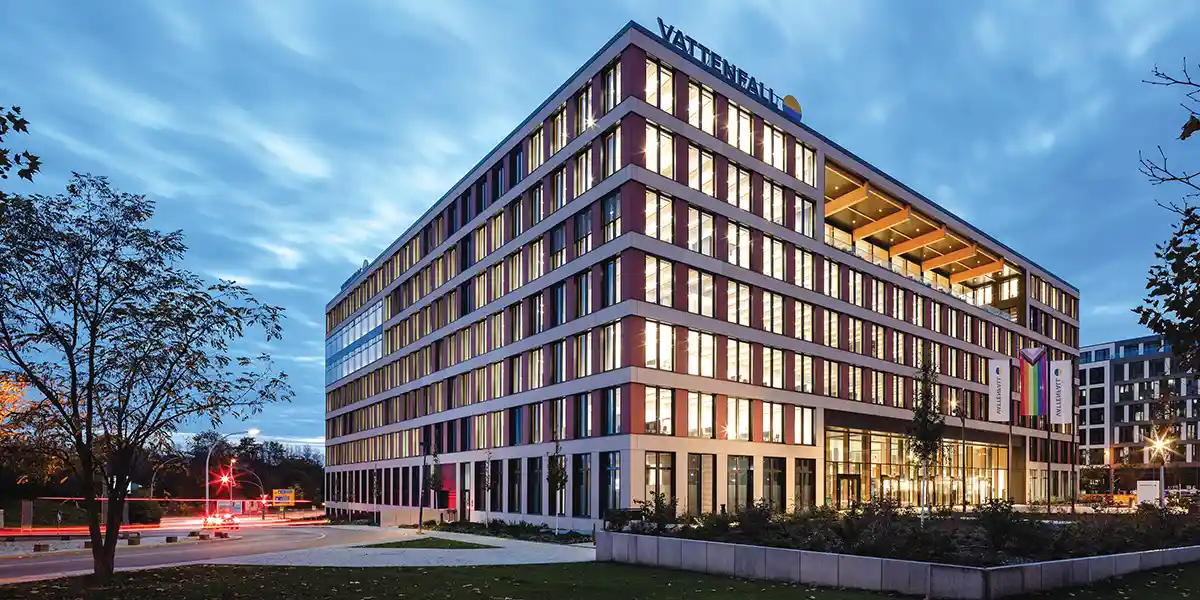
The seven-storey office complex consists of two buildings with a total floor area of approximately 32,000 m². The complex stands on an approximately 10,100 m² site and has been built using sustainable, climate and resource-saving techniques, as well as modular hybrid-timber construction techniques. The larger of the two freestanding buildings contain approximately 20,000 m² of floor space, making it the largest hybrid-timber building in Germany, and one of the largest in Europe.The office complex is part of a new urban district. The smaller of the two buildings (the ‘Solitaire’) is an elongated freestanding building which continues the line of the façade of the larger office building. The latter is a quadrangle-type structure (the ‘Carré’) with an irregular trapezoidal footprint. The two buildings form a street front and create a new urban plaza with green spaces and seating.
The Carré Building
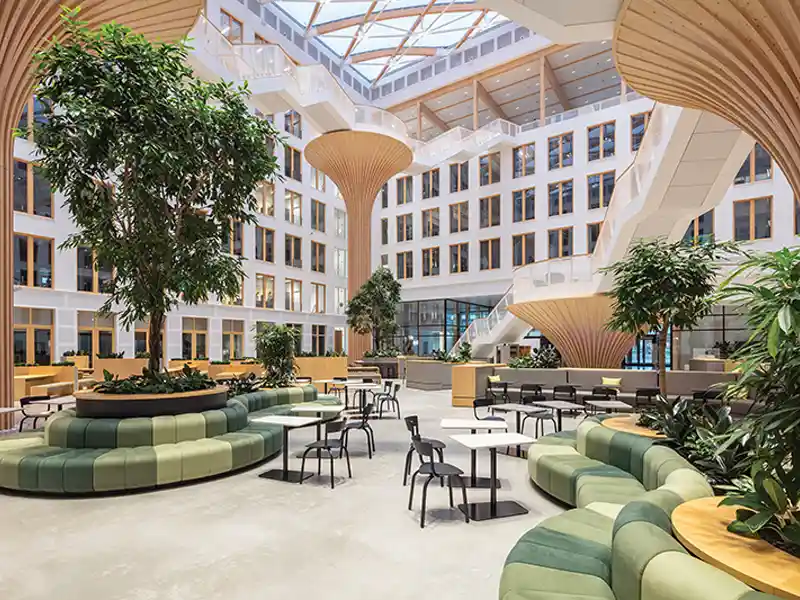
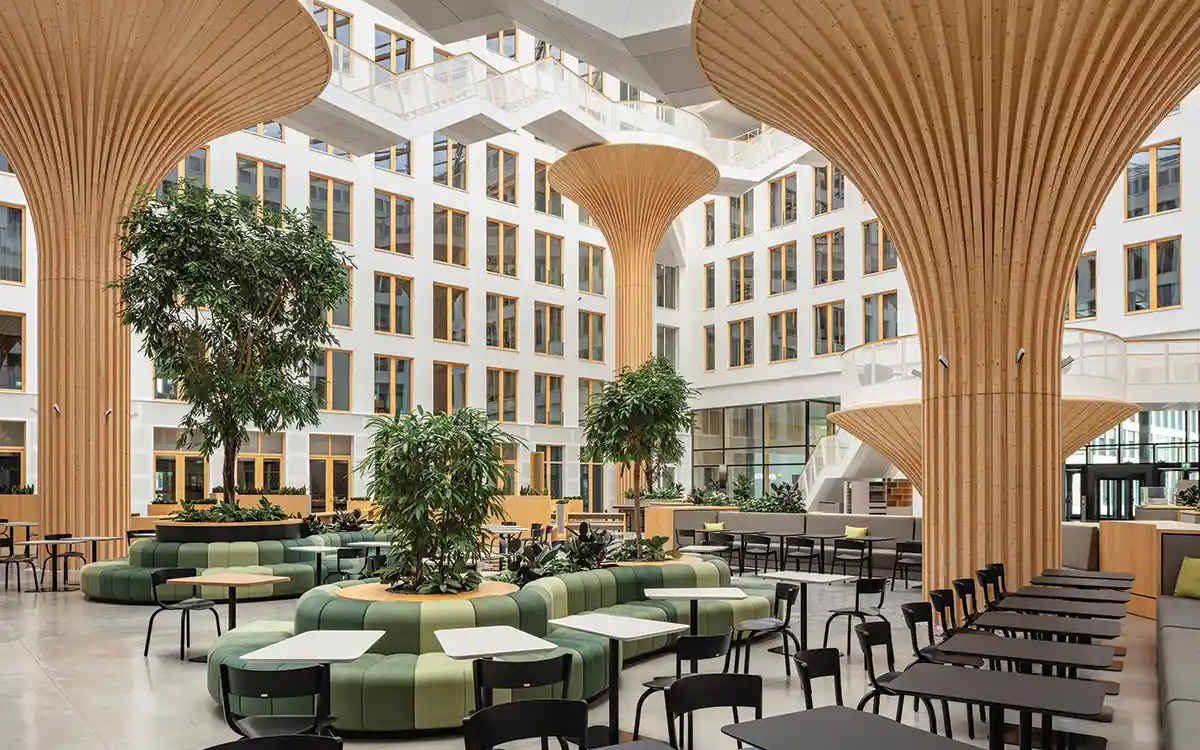
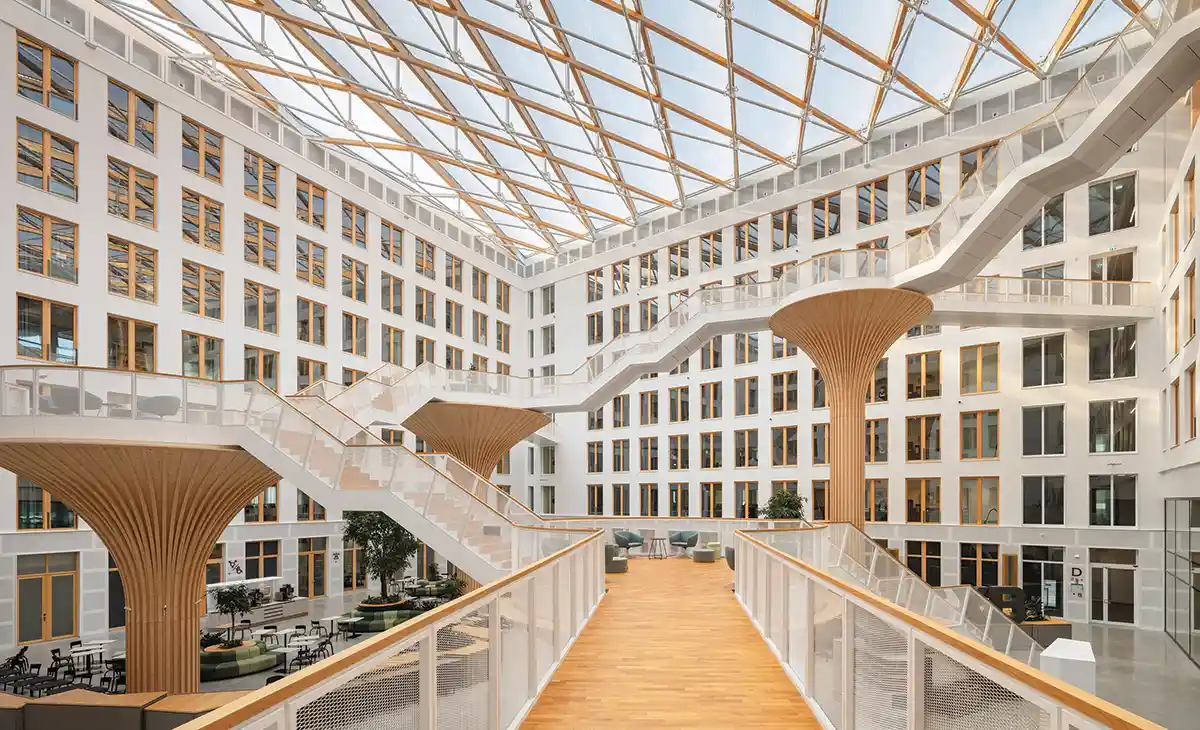
The heart of the Carré building is a spacious, light-filled atrium. A two-storey entrance lobby with a clear height of seven metres facing the plaza in front of the building opens up the massive, strictly gridded volume, and directs the gaze firmly towards the building’s impressive interior. The 26-metre-high atrium is covered by a transparent ETFE foil roof carried by a wooden-truss construction. The continuous floor-to-ceiling windows in the offices, the glazed entrance area, and the large panoramic window in the building’s lounge contribute to the abundance of daylight.A central highlight is the four treelike shapes of different heights which grow skywards under the foil roof as if in a greenhouse. Their lamellate spruce-wood structure gives them a resemblance to gigantic mushrooms. The atrium is additionally enlivened by community and food areas. The fifth floor has a sky lounge with panoramic windows and a spacious external terrace.
In every part of the building – from the supports, beams, windows, and doors, to the claddings and railings – wood is visible in all interior areas. Each of the building’s inner corners contains a building core with a safety staircase and elevators.
The Solitaire Building
Both the Carré and the Solitaire building have a flexible modular ground plan on all levels. This can be adapted to individual requirements. With an extensive deconstruction concept, the issue of circularity was integrated into the planning at a very early stage.
The flexibility and reusability of the building is ensured, among other things, by avoiding load-bearing interior walls, a room height of at least 3m, a well thought-out arrangement of the staircases, and the zoning of the technical building equipment.
The four main pillars of the buildings’ energy supply are sufficiency, efficiency, combined heat and power, and load management. In the process, conditions were created to sensitize users to a conscious, efficient use of energy. The office spaces are air-conditioned by suspended smart ceilings. A sufficient amount of daylight in the offices minimizes the need for artificial lighting.
The two buildings in the office complex share a basement garage, with 218 e-mobility spaces for tenants. The bicycle room contains approximately 100 bicycle places, including for e-bikes; there are 32 additional spaces in outside areas.
The office areas, as well as the associated ancillary and circulation areas, are barrier-free, and all outdoor areas are also designed to be accessible.
Facade
The façades have a regular grid consisting of weather-resistant glass-fibre concrete panels. The grid is articulated by horizontal strips and coloured vertical panels. Pylons structure the façades vertically. Glass-fibre pilasters visually reinforce the socle section. The rhythmic façades have a restrained colour scheme with two different shades for each façade.The sustainable façade elements of the two buildings weigh only 30 kg per m², and are also recyclable. In addition, the façade absorbs CO2 from the air due to the thinly ground cement top layer, thus giving it a decarbonizing effect. The glass bays with fixed glazing and MicroShade solar protection additionally accentuate the façades; these are one-storey in the case of the Solitaire building, and two-storey in the case of the Carré. The remaining windows are fitted with anti-glare protection and external sun protectors.
The construction of the buildings focused on reducing the CO2 footprint as much as possible, especially in terms of the weight of the complex, and on using sustainable materials that can be recycled.
The wooden elements, such as wall and ceiling modules, were prefabricated, then assembled and adjusted on the building site. This ensured a precise construction schedule and an especially time-efficient and economical construction process. Altogether, 1190 wood-hybrid ceiling elements, carried by 1280 glulam façade supports, and 445 multibox wall elements with a total area of 16,000 m² were made.
Sustainable Materials
Natural material wood is everywhere in the interior and office spaces. Wood possesses a high heat-storage capacity, but limited thermal conductivity. Existing heat is retained for longer in the room than heat from other construction materials, while delayed cooling reduces the amount of energy required. Wood is also lighter and more energy-efficient to transport than mineral construction materials. This project used approximately 3500 cbm of PEFC-certified spruce.Through the intelligent combination of wood with concrete, the modular hybrid solution from CREE-Buildings can save up to 50% CO2 per m² of floor area. Low construction weight, short shell construction times, high reliability in planning and costs, and long durability are other advantages of this construction method.
Reinforced-concrete construction elements were kept to a minimum, being used for fire compartment separation or to stiffen the building. Wood and hybrid-timber elements were installed as the load-bearing framework, especially in the interior; concrete was used for the foundations and basement. The wooden supports and beams carry the building’s overall vertical loads. Compared to conventional reinforced concrete construction, the weight of the building could be reduced by up to 50% through the timber hybrid construction. This also reduced the use of concrete for the foundation slab, which had an additional positive effect on this new office complex’s CO2 balance.
The stairs in the atrium of the Carré are designed as a metal construction in order to avoid unnecessary material consumption with high timber cross-sections and costly metal substructure. The design of the components responds directly to the strengths and qualities of the respective materials, promotes the saving of the resources used, and reduces the weight of the components. The roof structure weighs only 45 kg per m² due to specially developed metal nodes, ETFE foil, as well as filigree wooden components, and ensures greater lighting in the atrium below thanks to narrower cross-sections. At the same time, the roof construction can withstand wind loads of up to 100 kg, as each bar can not only bear tensile, but also compressive forces.
Certifications
EDGE Suedkreuz Berlin received the DGNB Platinum certificate with the highest score ever achieved in Germany of 95.4%. In addition, the ensemble was certified with DGNB Diamond for its outstanding design and architectural quality, and the project has also received a WELL v2 Platinum certification.Photo credit: HG ESCH
Source: V2com