Held under the theme "Green Varanasi: Preserving Heritage, Building a Sustainable Future," the conclave served as a collaborative platform to explore strategies to accelerate the adoption of green buildings, sustainable infrastructure, climate resilience, water conservation, clean energy, and resource-efficient urban development while safeguarding the city's unparalleled cultural and architectural legacy.
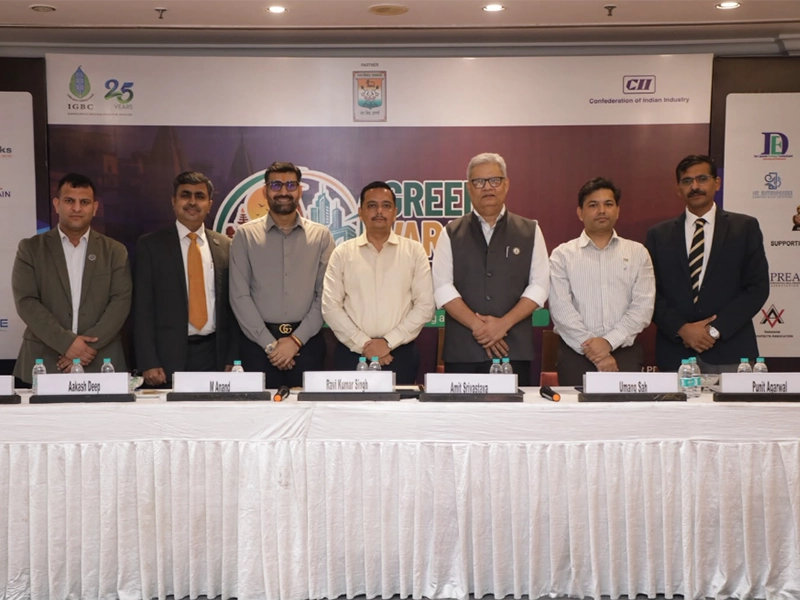
The inaugural session was graced by Shri Himanshu Nagpal, IAS, Municipal Commissioner, Varanasi Municipal Corporation; and Dr. Ravi Kumar Singh, IFS, Member Secretary, SEAC, Department of Environment, Forest & Climate Change, Government of Uttar Pradesh, who shared their perspectives on integrating sustainability into Varanasi's urban development while preserving its rich heritage.
The session also featured Mr. Amit Srivastava, Chairman, IGBC Lucknow Chapter & COO, BBD Viraj Constructions Pvt. Ltd., who welcomed delegates and set the context for the conclave; Mr. M. Anand, Executive Director, CII – Indian Green Building Council (IGBC), who presented the vision for a sustainable heritage city; and industry perspectives from Mr. Aakash Deep, Chairman, CREDAI Purvanchal, and Mr. Umang Sah, Chairman, CII Varanasi Zone & Managing Director, UP National Manufacturers Ltd. A key highlight of the conclave was the launch of the IGBC Student Chapter at IIT (BHU), Varanasi, reaffirming IGBC's commitment to nurturing the next generation of sustainability leaders.
Uttar Pradesh has emerged as one of India's fastest-growing green building markets. The state has 1,736 IGBC registered green building projects covering 1.83 billion sq. ft. of registered green building footprint and 692 certified green buildings encompassing over 201.3 million sq. ft. of registered green building footprint. Across sectors including commercial, residential, industrial, logistics and transit infrastructure, the adoption of green buildings is helping reduce energy consumption, conserve water, improve occupant health and contribute towards India's Net Zero aspirations.
Shri Himanshu Nagpal, IAS, Municipal Commissioner, Varanasi Municipal Corporation, said, “Sustainability must be at the core of future development projects. We need to focus on mitigating the challenges such as declining groundwater levels, rising energy demand, and shrinking green spaces… I urge the developer community to adopt sustainable and green-building practices and resource-efficient solutions.’’
Varanasi itself is steadily emerging as an important destination for sustainability. The city currently has 38 IGBC-registered projects covering 5.73 million sq. ft. and 15 IGBC-certified green buildings, demonstrating how one of the world's oldest living cities is embracing sustainable development while preserving its timeless heritage.
Dr. Ravi Kumar Singh, IFS, Member Secretary, SEAC, Department of Environment, Forest & Climate Change, Government of Uttar Pradesh, quoted, “Green building is not merely a certification objective but a commitment to environmental stewardship, water conservation, energy efficiency, and responsible use of local, low-carbon materials. He noted that collaborative efforts among government, industry, and institutions are essential to driving sustainable development.’’
Mr. Umang Sah, Chairman, CII Varanasi Zone & Managing Director, UP National Manufacturers Ltd., said, “Green infrastructure, such as parks, ponds, wetlands, urban forests, and solar energy systems, play a vital role in enhancing urban resilience and improving quality of life. He called for sustainability to be integrated into every future development from the planning stage itself.”
The conclave featured a high-level panel discussion on 'Sustainable Urban Transformation of Varanasi – Policy, Planning, Green Infrastructure & Sustainable Tourism,' bringing together experts from Lal Bahadur Shastri International Airport, IIT (BHU), Larsen & Toubro, CREDAI Purvanchal, SIPL Group, the Varanasi Architects Association and CII–IGBC to deliberate on integrated planning approaches that balance rapid urban development with environmental sustainability, responsible tourism and heritage conservation. Technical sessions showcased best practices in high-performance buildings, low-carbon construction technologies, sustainable concrete, next-generation glass technologies and eco-friendly building materials for heritage cities.
Mr. M. Anand, Executive Director, CII–Indian Green Building Council (IGBC), said, “Varanasi has a unique opportunity to demonstrate how ancient wisdom and modern sustainability can coexist harmoniously. He stressed the need to protect rivers, improve air quality, strengthen urban ecosystems, and accelerate the adoption of green buildings across every building typology.”
An interactive stakeholder dialogue concluded the conclave, resulting in recommendations on policy support, capacity building, collaborative initiatives and wider adoption of green building practices to accelerate Varanasi's transformation into a sustainable, resilient and globally admired heritage city.
Mr. Amit Srivastava, Chairman, IGBC Lucknow Chapter & COO, BBD Viraj Constructions Pvt. Ltd., said, “The ideas and discussions emerging from this conclave should help shape a development model that balances growth with heritage conservation, ecological protection, and inclusive prosperity. He urged all stakeholders to work collectively towards creating a sustainable and future-ready Varanasi.”
Mr. Aakash Deep, Chairman, CREDAI Purvanchal, highlighted, “The importance of green buildings in the real estate sector is increasing rapidly. Sustainable construction is not only environmentally responsible but also economically beneficial, delivering greater efficiency, lower operating costs, and long-term value. I would like to reiterate CREDAI Purvanchal’s commitment to promoting responsible development and collaborating with IGBC and other stakeholders to expand green-building adoption.”
The conclave concluded with a shared commitment to making Varanasi a national model for sustainable urban development. Participants reaffirmed that future growth must be guided by green building principles, climate resilience, environmental responsibility, and the preservation of the city's rich heritage.