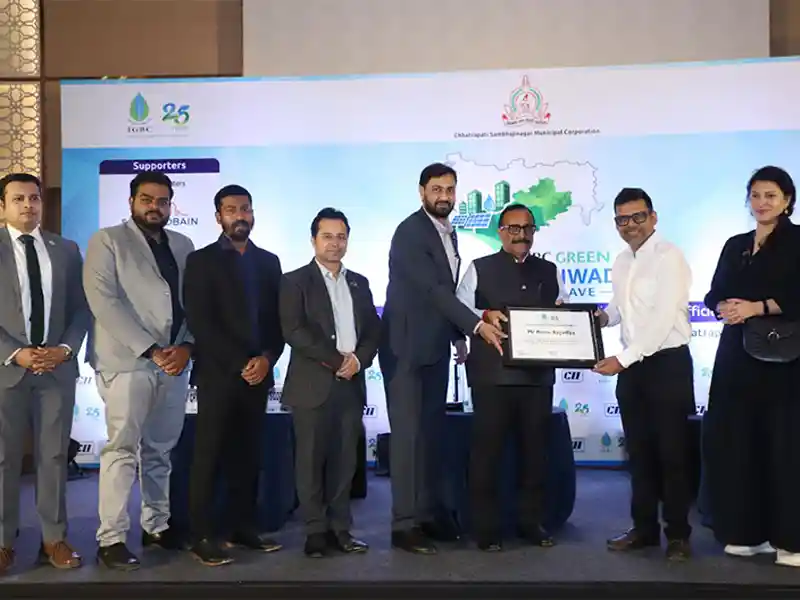
The conclave’s inaugural was graced by Shri Atul Save, Hon’ble Minister of Renewable Energy, Government of Maharashtra; along with Ms. Natasha Zarine, Co-founder, EcoSattva Environmental Solutions; Mr. Navin Bagadiya, Immediate Past Chairman, IGBC Aurangabad Chapter and Ar. Hares Siddqui, Chairman, IGBC Aurangabad Chapter who addressed the gathering.
In his inaugural address, Shri Atul Save, Hon’ble Minister of Renewable Energy, Government of Maharashtra emphasized that Maharashtra was emerging as a frontrunner in sustainable development, driven by progressive policy frameworks and increasing industry participation. He noted that the state’s green building movement was contributing to environmental conservation while focusing on enhancing economic competitiveness and quality of life. He highlighted the importance of scaling renewable energy integration, water efficiency, and low-carbon infrastructure across emerging regions like Marathwada. He said, “Maharashtra is committed to accelerating its clean energy transition by fostering an ecosystem where sustainability and economic growth go hand in hand. Through progressive policies and targeted incentives, we are enabling industries and urban infrastructure to adopt energy-efficient, low-carbon solutions at scale. Marathwada is witnessing significant industrial investments, and it is imperative that this growth is anchored in sustainability to ensure long-term resilience and resource security. Rooftop solar presents a powerful opportunity for buildings to become decentralized energy generators, reducing dependence on conventional power, lowering costs, and contributing meaningfully to our renewable energy targets. The shift towards green infrastructure is not just an environmental necessity, but a strategic imperative for a future-ready Maharashtra.”
The conclave highlighted Maharashtra’s leadership in India’s green building space. Ranked #1, the state has a total of 4,208 IGBC-registered projects, accounting for a massive 4.78 billion sq. ft. of registered green building footprint, with 1,425 projects already certified. Sector-wise, commercial projects lead with 1,924 registrations, followed by residential projects at 1,715. Industrial and logistics projects accounted for 195 projects, while transit infrastructure (238), built environment projects (64), and net zero projects (75) reflect the increasing diversification of green initiatives across sectors.
Focusing on regional progress, Marathwada emerged as a promising growth hub, with 121 registered green building projects spanning 100.57 million sq. ft., of which 60 projects had achieved certification. The sectoral distribution in the region showed strong momentum in commercial projects (82), followed by residential (34), with emerging contributions from industrial, transit, built environment, and net zero categories.
Aurangabad division further demonstrated localized progress, with 50 registered projects covering 15.78 million sq. ft., including 25 certified projects. The division’s growth was driven primarily by commercial (29) and residential (18) developments, supported by industrial and built environment projects. This trajectory highlights Chhatrapati Sambhaji Nagar’s strong potential to evolve into a prominent Tier 2 city. The steady influx of investments across commercial hubs, residential developments, and industrial infrastructure reflects growing investor confidence and strategic urban expansion. As businesses establish operations and housing demand rises, the region is positioning itself as a balanced growth center.
Ar. Hares Siddqui, Chairman, IGBC Aurangabad Chapter, in his address stated that Marathwada was steadily transitioning toward a structured green growth pathway, supported by increasing awareness, policy support, and industry participation. He emphasized that IGBC would continue to work closely with government bodies, developers, and industry stakeholders to accelerate the adoption of green buildings and net zero concepts across the region.
The conclave featured multiple technical sessions focusing on green buildings, low-carbon industrial infrastructure, sustainable construction practices, and innovations driving the net zero transition. Experts discussed critical themes such as water conservation, energy efficiency, waste management, and the role of startups and indigenous technologies in enabling scalable sustainability solutions.
The conclave also focused on the significant economic implications of delayed sustainability adoption by the logistics industry. Experts highlighted that the cost of not going green for logistics and warehousing businesses is substantial, with annual avoidable inefficiency costs between ₹10–₹30 crore under business-as-usual scenarios. For high-intensity, multi-tenant logistics parks and cold-chain infrastructure, this can escalate to ₹30–₹60 crore annually. Over a typical 10–15 year asset lifecycle, this translates into a potential value erosion of ₹150–₹500+ crore. It was further noted that green-certified logistics assets are increasingly commanding a market premium, with rental uplifts in the range of 12–24 percent, alongside faster lease-up cycles—reinforcing the strong business case for integrating sustainability into logistics infrastructure planning.
The panel discussion on Shaping Marathwada’s Net Zero Future Together brought together a diverse group of industry leaders and experts, including Moderator Ar. Hares Siddiqui and speakers Ar. Laxmikant Surve, IIID, Chairman: Mr. Utsav Machhar, CMIA President; Mr. Amit Patil, ISHRAE Chairman; Mr. Sangram Patare, CREDAI Chairman; and Ar. Shyam Shelar, Chairman, IIA CSN representing key organizations across architecture, industry, HVAC, and real estate. The discussion saw active exchange of ideas on advancing Marathwada’s Net Zero goals, with participants sharing insights on renewable energy integration, sustainable building practices, and policy support. The session fostered a collaborative dialogue, highlighting the need for cross-sector partnerships to drive practical, scalable solutions for a low-carbon and resilient future in the region.
The Green Marathwada Conclave underscored the critical role of urban local bodies in embedding sustainability into city planning and infrastructure development, with municipal corporations actively integrating green building principles, resource efficiency, and climate resilience into their growth strategies. It was noted that Maharashtra’s emergence as a high-investment destination necessitates robust, future-ready infrastructure, with sustainability and integrated planning across energy, urban development, and industry forming the backbone of this growth. Cities like Chhatrapati Sambhaji Nagar are at a pivotal stage of transformation, where aligning rapid urban expansion with environmental responsibility is essential. The adoption of green building practices will be key to enhancing livability, reducing resource stress, and strengthening the city’s position as a sustainable investment destination.