For decades, the architectural envelope has been treated as a static barrier, a defensive shield of glass and concrete designed to seal the interior off from the world. However, in the face of escalating climate volatility, this defensive model is failing. To move forward, architecture must transition toward biological facades which are living, breathing membranes that function less like walls and more like the metabolic organs of a building.
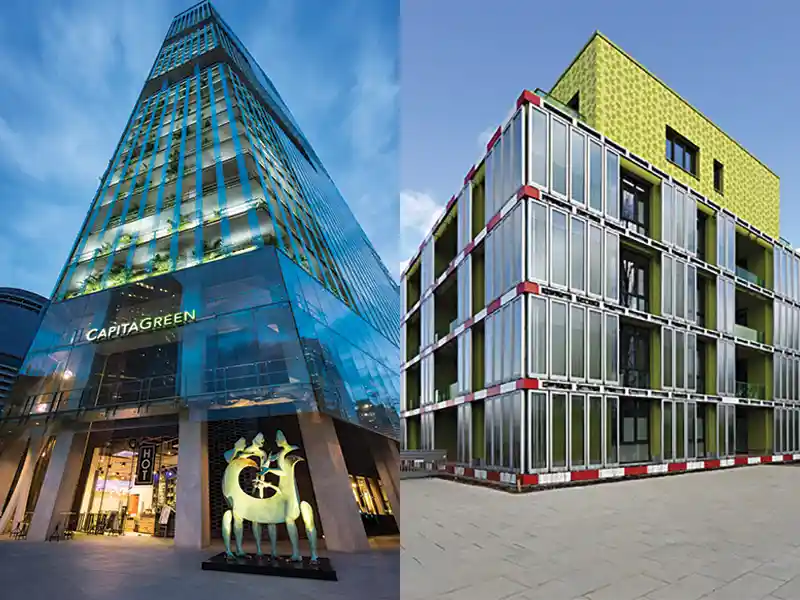
Singapore’s CapitaGreen set an iconic benchmark for what is possible when architecture integrates living systems. Designed by Toyo Ito, CapitaGreen is an aesthetically pleasing double-skin façade that is also a high-performance air filter. By utilizing a wind scoop at the crown and a facade draped in living vegetation, the building mimics the cooling mechanisms of a natural forest, drawing in cleaner, cooler air and reducing the reliance on energy-intensive mechanical cooling.
In the face of escalating climate volatility, architecture must transition toward biological facades which are living, breathing membranes that function like the metabolic organs of a building.
Ar. Bhupendra Kumar and Ar. Pragya Tripathi
Aeiforia Architects

By integrating microalgae, mosses, or vascular plants directly into the building envelope, a structure is transformed from a passive consumer of energy into an active participant in its ecosystem. These systems perform vital metabolic tasks, they scrub carbon dioxide from the atmosphere, release oxygen, and filter urban pollutants, effectively turning high-rise towers into urban lungs that improve the air quality of the entire district.
Beyond carbon sequestration, biological facades offer a revolutionary approach to thermal management known as adaptive shading. In microalgae-integrated systems, the density of the organisms increases in direct response to solar intensity. As the sun gets hotter, the skin of the building naturally darkens, providing automated shading that reduces solar heat gain exactly when it is needed most. This biological response drastically lowers the cooling load on the building, offering a nature-based alternative to energy-hungry HVAC systems, a shift that is particularly vital for the tropical urbanism of Southeast Asia.
We must design cities in harmony with nature, not against it. Scaling these solutions requires updated policies, cross-sector collaboration, and investment in research.
Another wonderful example is, The Algae Façade, BIQ House in Hamburg. By integrating SolarLeaf bioreactors directly into its facade, the building utilizes live microalgae to transform its exterior into a dynamic energy generator. This living skin functions as a closed-loop system: as the algae thrive on sunlight and carbon dioxide, they create a natural density that provides adaptive shading for the residents, while the excess biomass and solar-heated water are harvested to provide on-site heat and electricity.