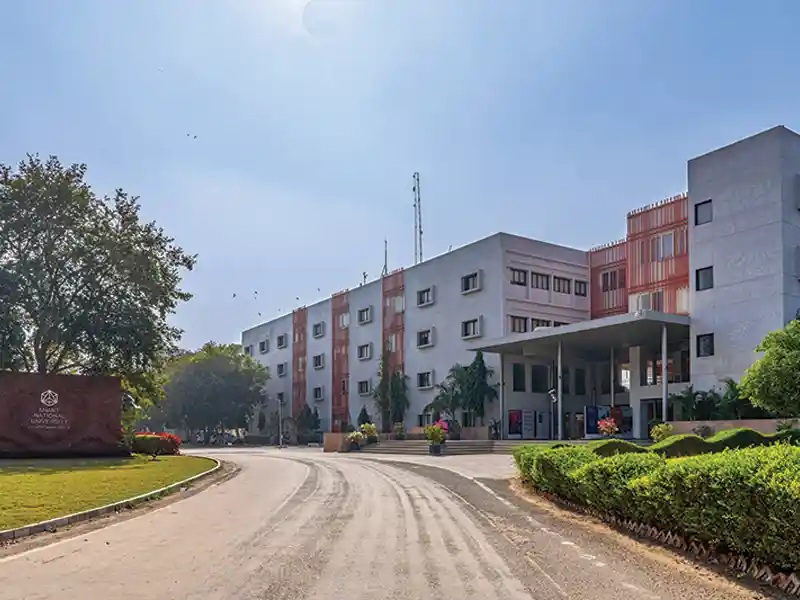
Campus design and infrastructure play a crucial role in shaping pedagogical practices, encouraging participatory, interdisciplinary and experiential learning. The campus itself can serve as a living laboratory, demonstrating environmentally responsible practices. At the same time, innovative pedagogies can inspire institutions to design environments that are flexible, inclusive and conducive to inquiry. Together, learning environments and pedagogy form a dynamic relationship that defines how learning is experienced and sustained.
As we reimagine the future of education, questions arise about what kind of learning will shape responsible and resilient professionals. How do we define sustainability, not just as an environmental concern, but as a way of thinking that connects ecology, economy, culture and equity? And how can this understanding translate into the way we design and structure curricula?
Preparing architects for the future requires a balance of contextual knowledge, technological awareness, and interdisciplinary engagement.
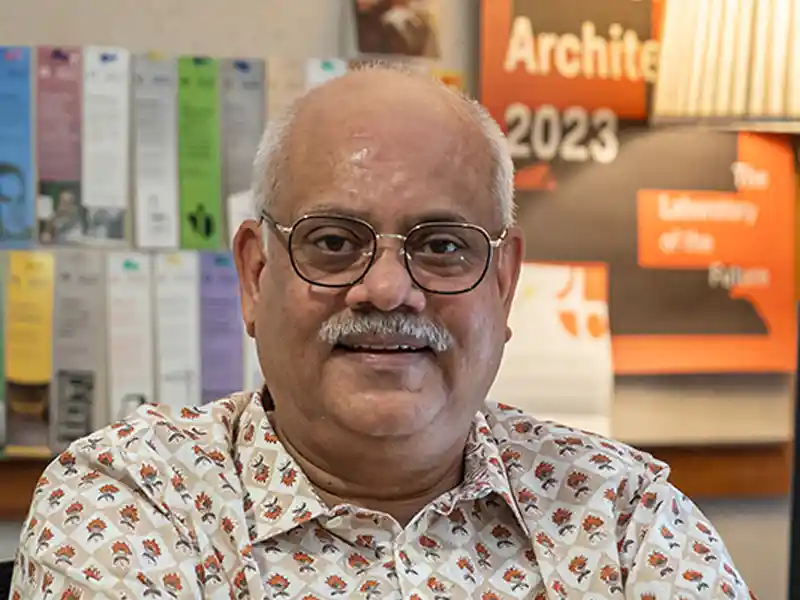
Dr. Sanjeev Vidyarthi Provost
Anant National University
Sustainability in architectural education in India must extend beyond abstract awareness to becoming an integral part of how we conceive, teach and practice architecture. Our educational framework today has notable strengths, such as a robust, time-tested curriculum. However, seeing imaginative studio work being translated into a society-wide embrace of sustainability, shaping the country’s built landscape in meaningful ways, has remained a long-standing aspiration.
As a huge positive, architecture schools in India today are increasingly cognizant that the campus itself can function as a living laboratory, where students engage directly with climate-responsive design, material systems and spatial intelligence. Such environments allow sustainability to be experienced rather than simply studied.
Ultimately, preparing architects for the future requires a balance of contextual knowledge, technological awareness, and interdisciplinary engagement. When educational institutions, industry partners and policy frameworks work in broad conceptual alignment, architectural education plays a far more meaningful role in shaping built environments that are environmentally responsible, socially responsive and resilient for the decades ahead.
Learning does not happen in silos. Unfortunately, architecture departments have been living in silos for too long.
Manisha Agarwal Founding Partner MO-FO Architect

There are interrelationships across disciplines, and it’s important to create intersectional opportunities between departments, both programmatic and non-programmatic. The built environment can also respond to this. We can create spaces for connection that allow students and faculty across different departments to engage with each other. This can be done by looking at how we design both learning and living spaces on our campus.
There are a lot of conditions where students and faculty can interact with each other, and various natures of interaction are possible. So, it’s not just that you are walking in the corridor and you intersect, but there could be discussion spaces, courtyards, etc. There could also be formal and informal spaces or programme and non-programme spaces that are constantly overlaid with each other. The intersections across departments or grades will happen more naturally then, and this will help create a community, which is social sustainability. So, sustainability should be hinged on both aspects - environmental and social.
When rooted in local contexts, campuses can be more than just buildings; they can be living laboratories.
Dr. Vidhu Bansal
Assistant Professor School of Architecture Anant National University

The built environment is not just stones, concrete, brick, mortar or technology. It creates space that brings people together and can help nudge behaviour change. When rooted in local contexts, campuses can be more than just buildings; they can be living laboratories. They can become learning tools that influence the everyday learning of the people inhabiting these environments.
There are two broad layers associated with the campus: the visible, which is built, and the invisible surrounding ecological systems that help sustain the campus. When the campus becomes a living laboratory, the visible and the invisible start to engage more deeply with each other. In such a scenario, the visible part of the campus should include spaces where climate-responsive design is easily evident in the way that mass, voids, materials, orientation and shading are handled.
Similarly, invisible systems like water, energy, soil and waste can also assume a central role. They can be measured and displayed to ensure accountability and demonstrate overall environmental performance. This helps students learn the complexities of sustainability through physical interactions with the space, eventually transitioning into the creation of regenerative and responsible built environments.
When specialists ascend to leadership and decision-making roles, their expertise will transform climate-ready buildings from a niche offering into the baseline industry expectation.
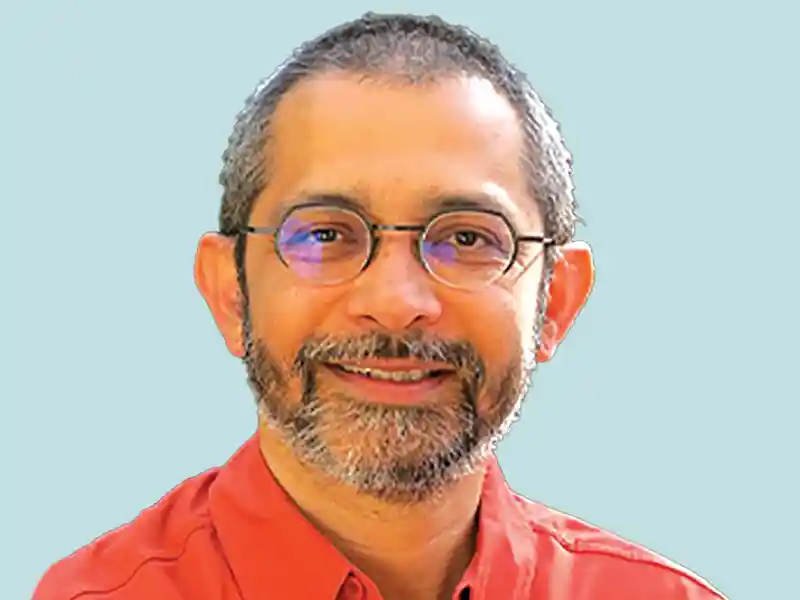
Prasad Vaidya
Director
Solar Decathlon India
The shift toward building decarbonisation is currently driven by global capital. Investors are increasingly prioritising lower Scope 2 emissions, building operating energy to mitigate systemic economic risk. This transformation begins in the service sector, where multinational corporations demand low-footprint assets, a trend that will soon migrate to the residential market as consumer demand for a lower Energy Performance Index (EPI) grows.
To meet this demand, we must fundamentally realign architectural education. Professionals are now required to provide empirical evidence of climate resilience against intensifying heat waves and storms. By integrating programmes like SDI (Solar Decathlon India) into core curricula, we can ensure that within a decade, 10% of architects are experts in net-zero design. As these specialists ascend to leadership and decision-making roles, their expertise will transform climate-ready buildings from a niche offering into the baseline industry expectation. We are preparing students to lead the essential tipping point for a resilient built environment.
NEP 2020 opens the possibility that a student will have the opportunity to pursue his or her own interests through flexible courses.
Habeeb Khan Director
PIADS
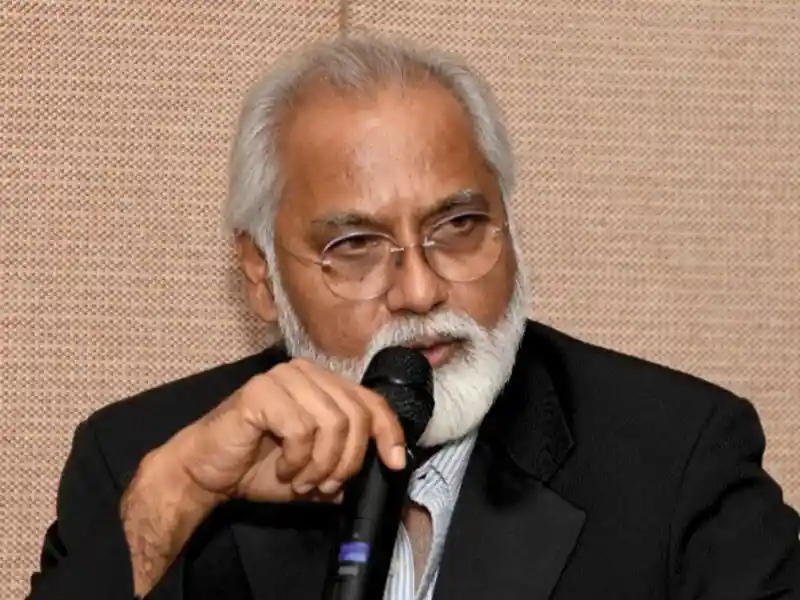
NEP 2020 will liberate architecture education to a great extent. Architecture is a healthy combination of technology, arts, sciences, humanities and commerce. Everything is involved in architectural learning. So, NEP 2020 opens the possibility that students will then have the opportunity to pursue their own interests and strengths through flexible courses.
Apart from the technical challenges, the tangible challenge that we will have to address is how we look at credit systems, credit transfers, credit equality and banking of credits. Additionally, the intangible aspect that we will have to work on is how we work with a heterogeneous classroom.
The biggest challenge will be to ensure that all stakeholders in the education system, whether it’s the head of the organisation, the directors, the faculty, the administrators or the researchers, rise to this challenge. Currently, our classrooms are homogeneous. And if not in the immediate future, then in the long term, we are looking at heterogeneous classrooms, and academia will have to rise to meet this challenge.
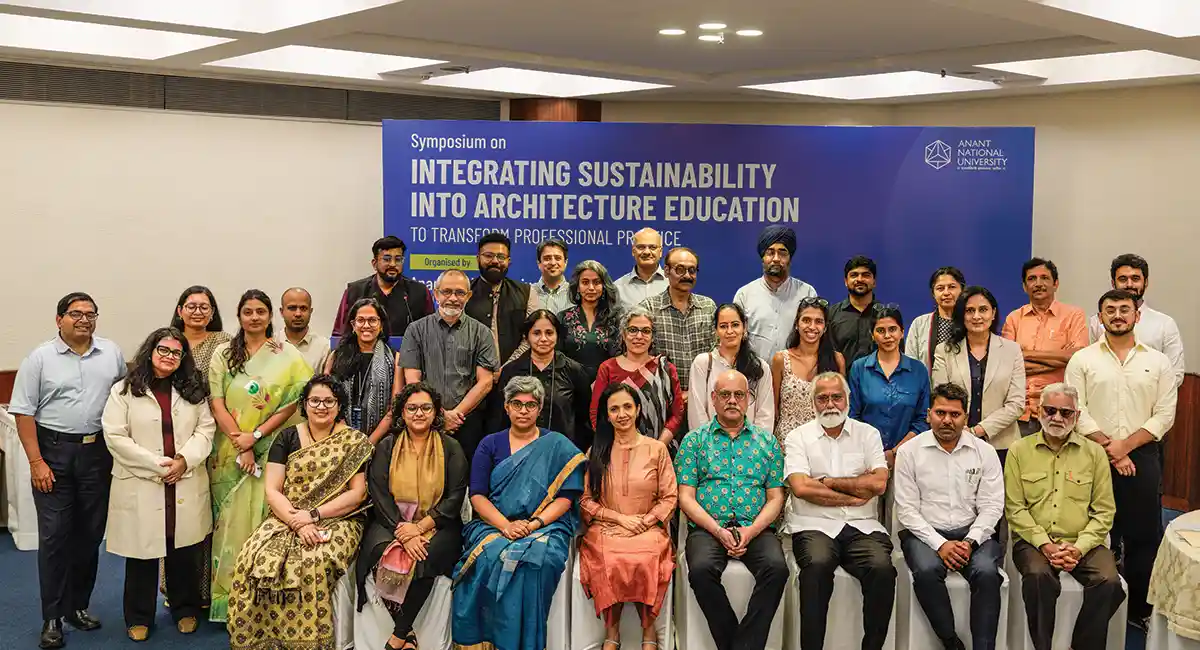
Imagery and visualisation are very different when we work in groups, and they expand when we work in real-world external settings.
Zeenat Niazi
Chief Advisor - Circular Economy and Climate Resilience Programs, Development Alternatives

Architecture is fundamentally a science and art of systems thinking. It inculcates in you the need to look at the very small elements, like the details of the room, and the complex aspects like site planning, simultaneously and iteratively. You are working at the level of how humans interact with a space and the different relations they have with everything around them, both human and non-human, biotic and abiotic, inside and outside that space.
You are both impacting and being impacted by not only the spatial aspects and physicality, but also the natural elements, biodiversity, water systems and the changing climate.
So, it’s fundamentally a systems science. If you are only in the classroom, your vision and imagination remain limited to only the human being, i.e. your client. The moment you start looking beyond the human being and society, and the ecological system, which are critical for designing, you need to engage with other systems as well.
Inside the classroom, we draw upon disengagement, working only from our lived experiences. Often, that lived experience is not a shared one, especially when you work on individual design projects. When you have a variety of students sitting in a class, you might suddenly find that one student has a lived experience from a rural area. Another person has a lived experience from a metropolis like Delhi or Mumbai, and a third person has a lived experience from a small town or a tier-3 city. You also have different lived experiences because you are coming from different socio-economic strata.
In fact, I have found, both as a student myself and now when I’m engaging with students, that the imagery and the visualisation that come to our minds are very different when we work in groups, and these really expand when we work in real-world external settings. We are able to have a space to have conversations about these different images and share them with each other. This is important because when students go out to work, they are often not going back to their own social economic niches to practice. Being in the field opens many other doors, too. It allows you to come together and discuss things, which now everybody has experienced together. It also puts you in a bit of a challenging space, a bit of discomfort. And that helps you grow, learn and ask questions. I think that both physical and mental discomfort are huge learning spaces.
I don’t think classrooms always allow us to do that. Being out in the field enables you to talk freely, question mental models and the experiences you come from. It also enables you to see a reality which you have not seen before. When you see problems on the field in real time, you see connections that are more than spatial and visual connections. These are socio-economic, socio-ecological, technological, justice and equity-related, gender, caste, class-related, and so many other interconnections that enrich your design thinking – both problem identification and solution orientation tremendously.